
The Almanac: Moon Phases, the Date of Easter, and a Calculator Back to the Exodus
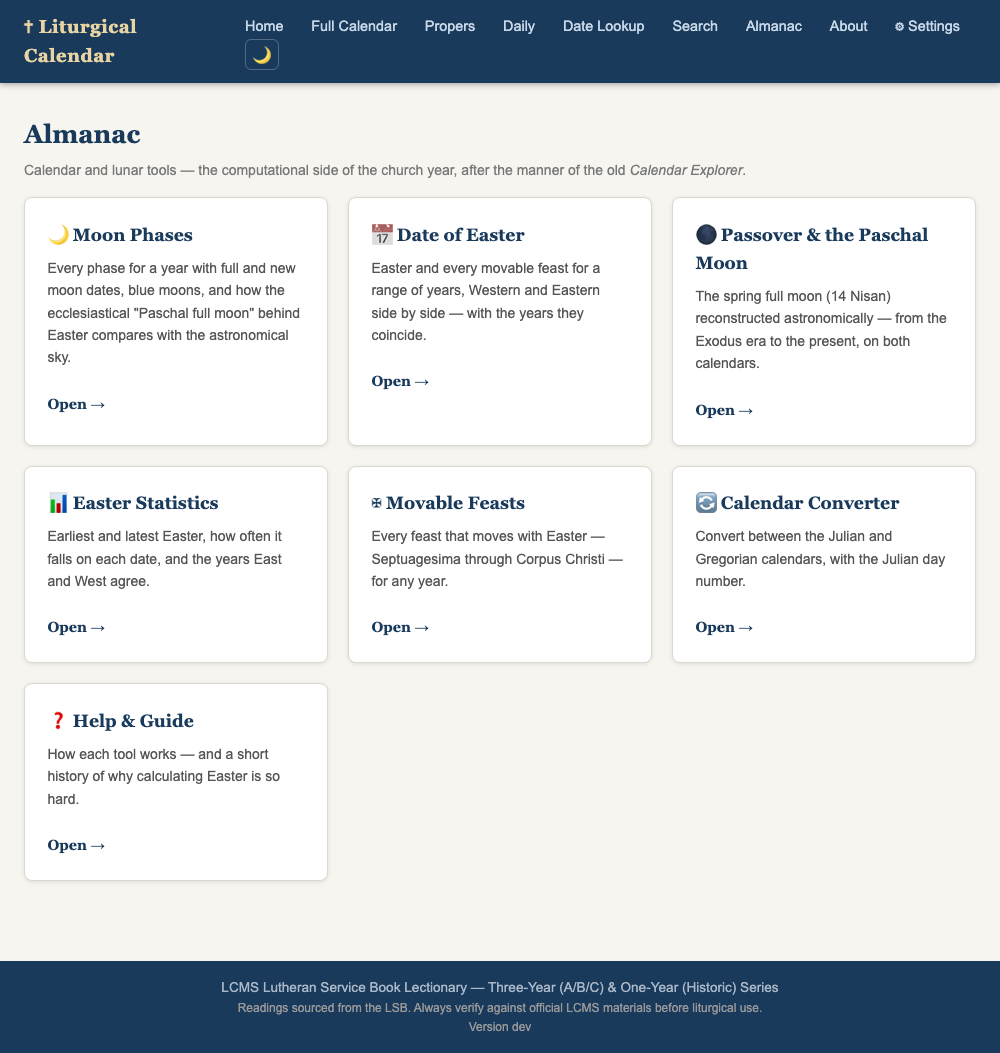
Almost thirty years ago I wrote a little Windows program called Calendar Explorer. It computed the date of Easter, the phases of the Moon, the movable feasts, and the strange arithmetic that ties them together. That program has now been reborn — as the Almanac, a new section of the Lutheran Service Book Lectionary site. It is the computational side of the church year: no readings or propers here, just the calendar and the sky.
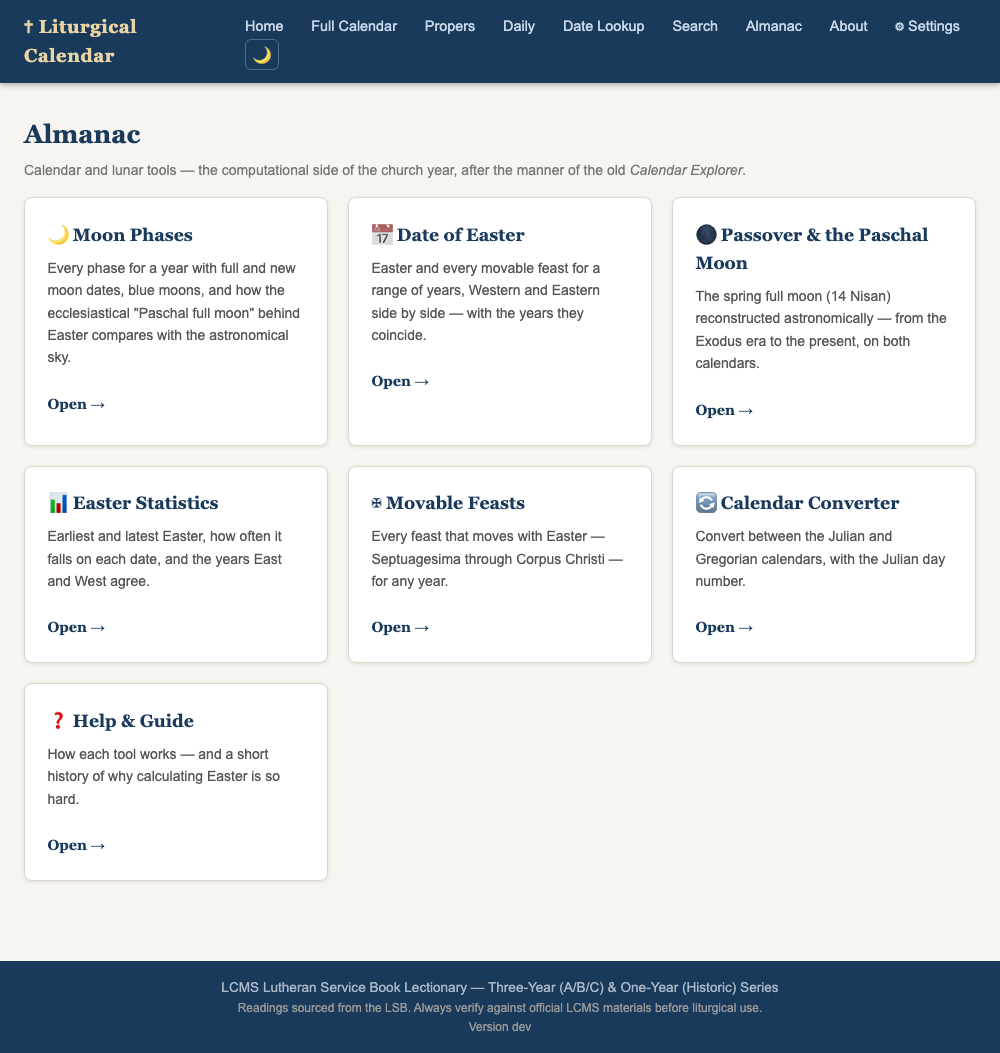
Everything runs locally in the browser-facing app — no third-party services, no calls to the cloud — and every number is checked against published astronomical data. Here is what it does, and a little of the history that makes the date of Easter such a wonderful, frustrating problem.
The tools
Moon phases
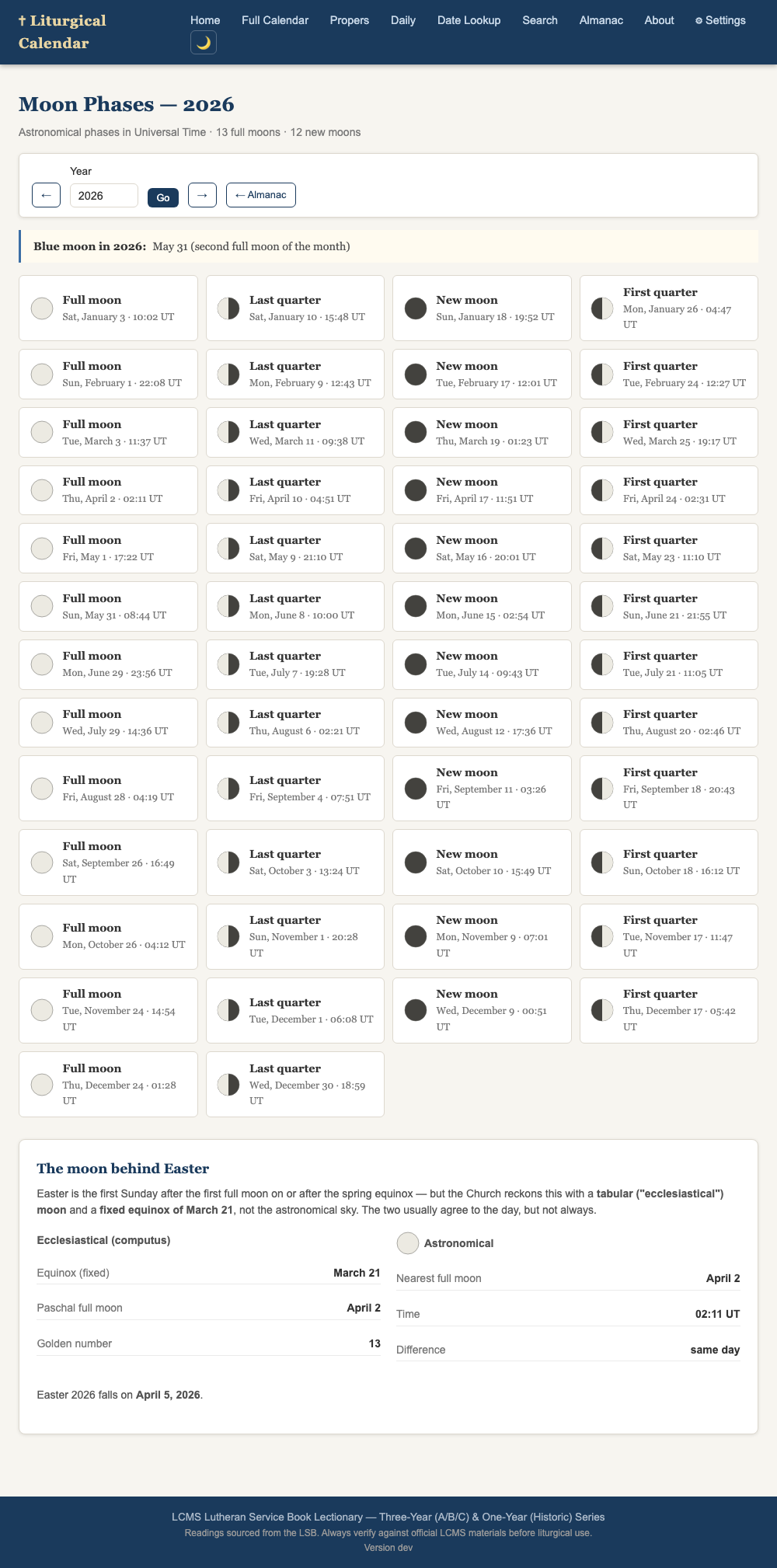
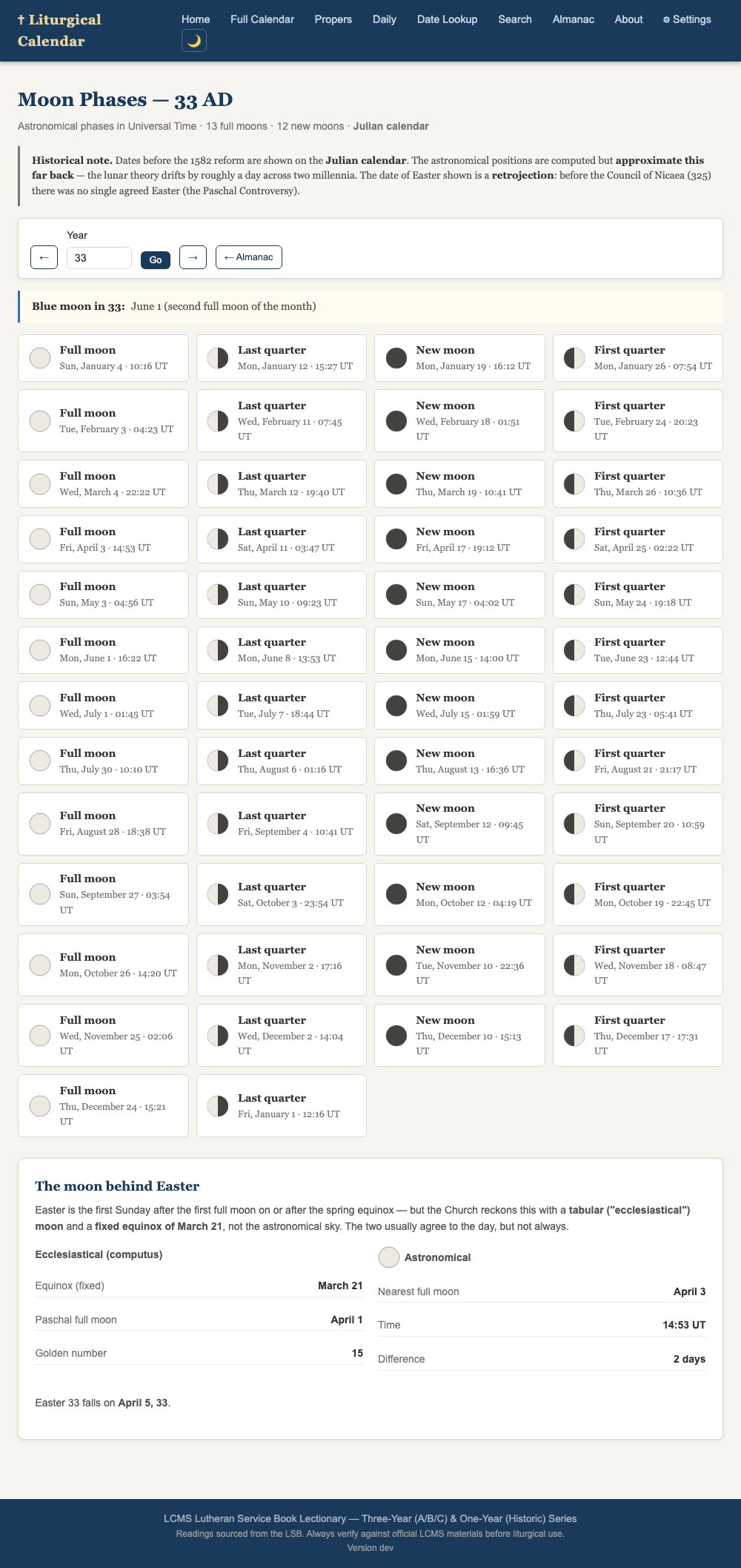
For any year, the Almanac lists every phase of the Moon — new, first quarter, full, last quarter — with the date and the time in Universal Time. It marks the full and new moons, flags blue moons (in both the second-full-moon-of-a-month and the older seasonal sense), and includes a panel that compares the Moon as the Church reckons it with the Moon as it actually appears in the sky.
The date of Easter
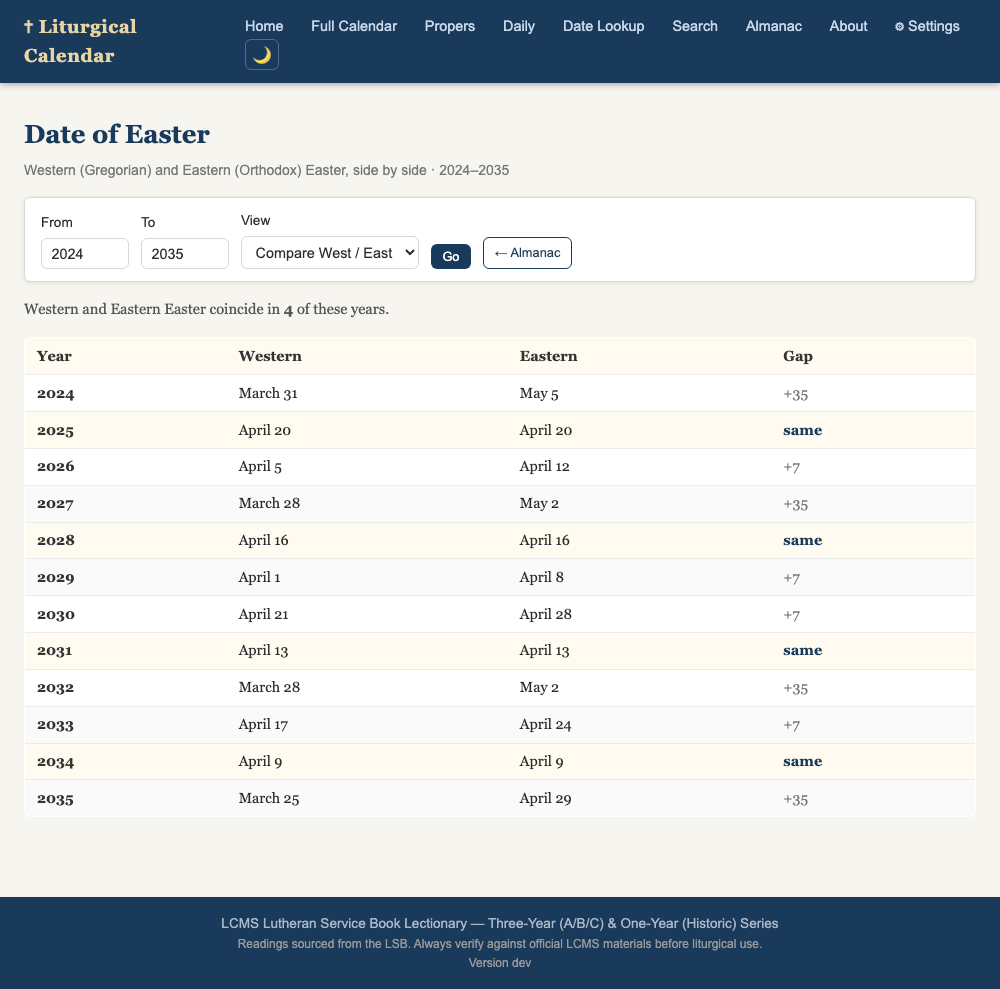
Easter and all the movable feasts, for a range of years. The compare view sets the Western (Gregorian) and Eastern (Orthodox) dates side by side and marks the years they coincide — which, as you will see, is rarer than you might think.
Alongside it are a Movable Feasts table for a single year, an Easter Statistics page (the earliest and latest possible Easter, the full distribution of dates, and how often East and West agree), and a Calendar Converter that moves any date between the Julian and Gregorian calendars and gives its Julian day number.
A civil calendar, alongside the sacred
This release also adds something quieter but, for the parish, just as useful. The lectionary now shows the major U.S. civil holidays beside the liturgical day — clearly marked as civil observances, never as feasts of the Church.
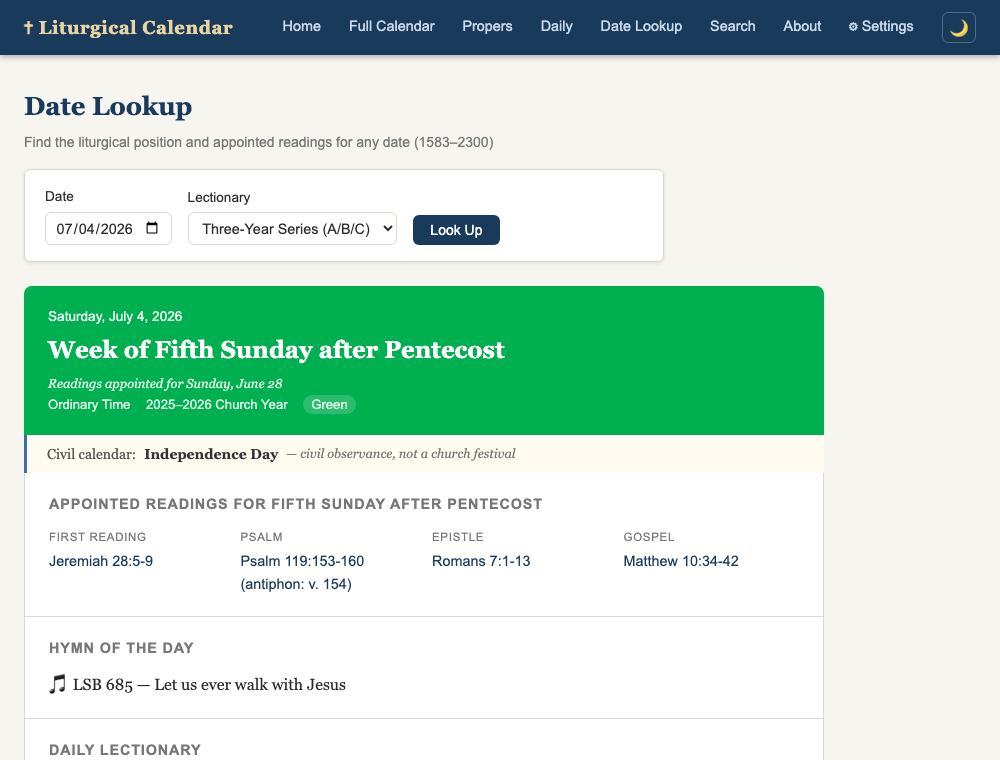
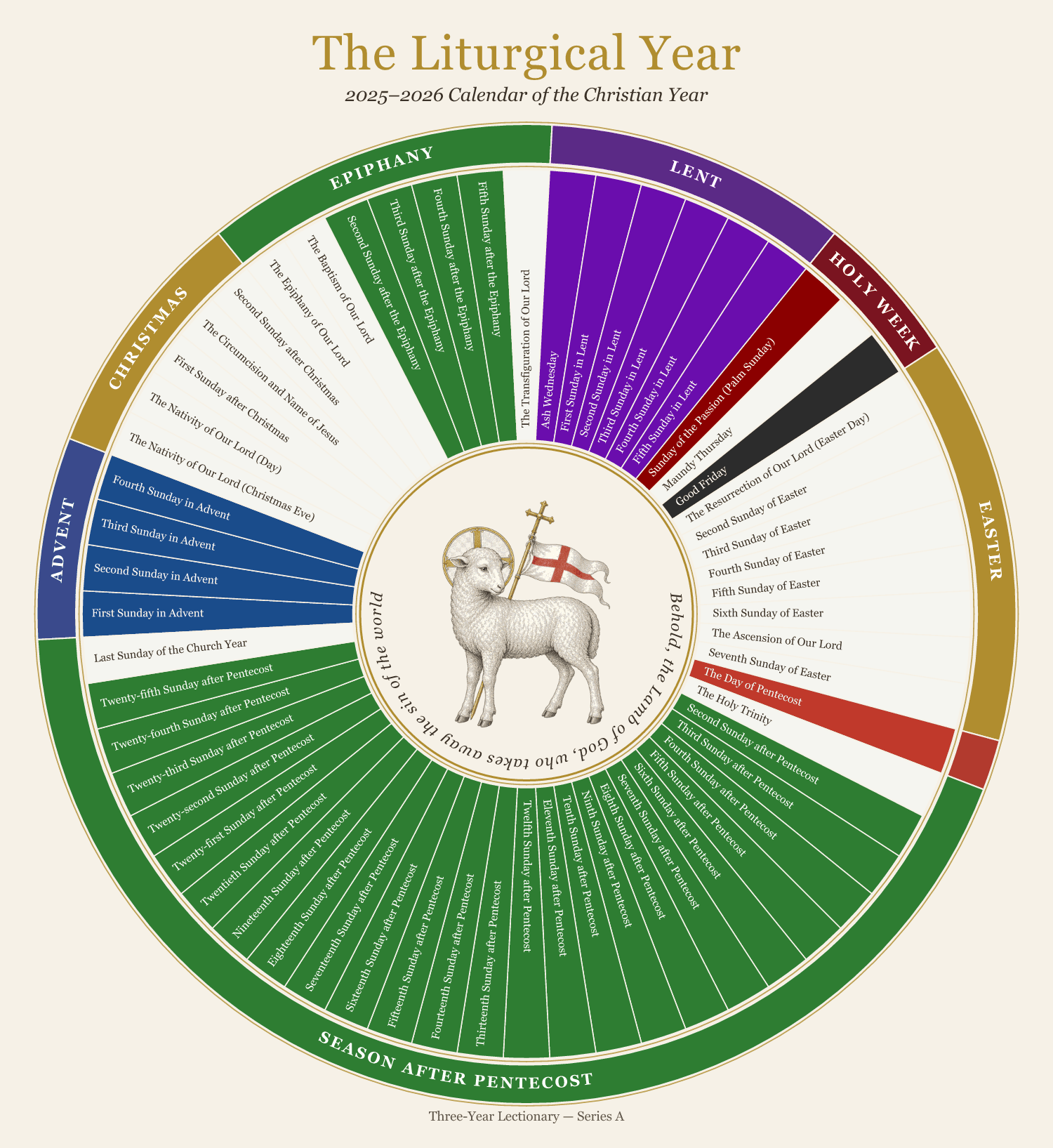
Why? Because when the appointed readings for a given Sunday are read and preached, it helps to keep in mind what most people in the pews already have on their minds that day. The church year and the civil year run on top of each other, and a preacher applying the texts in a modern context is well served by knowing that the Fourth Sunday after Pentecost in 2026 is also Father's Day, or that a summer Sunday falls on Independence Day.
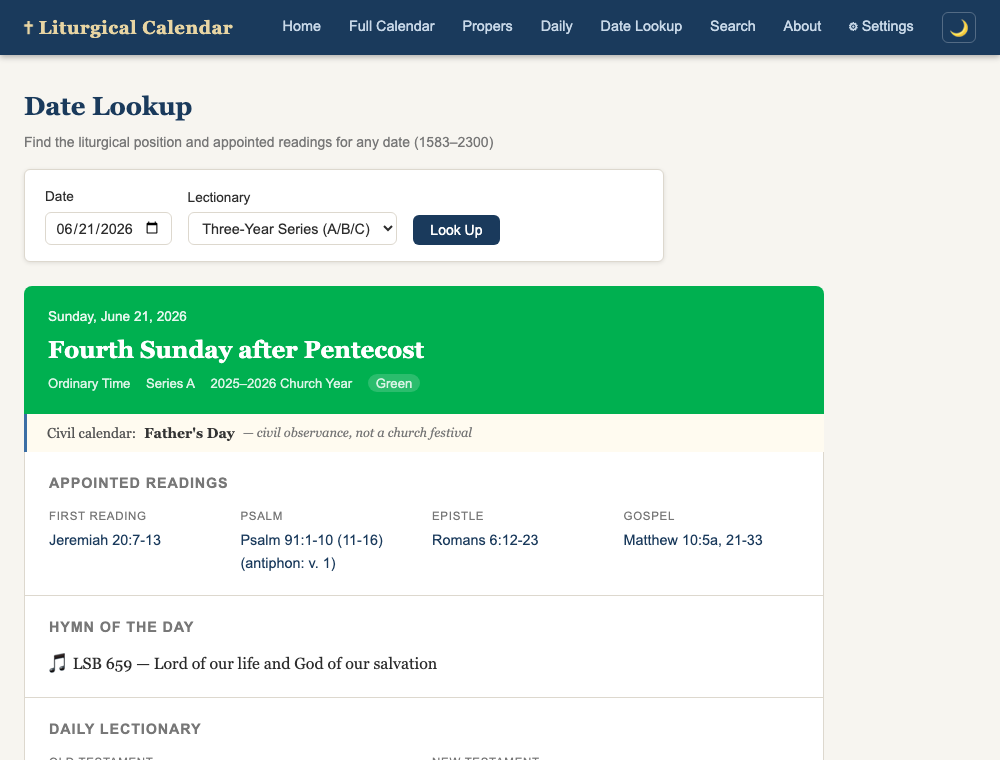
The civil note appears on the home page's "today" card and in any date lookup, sitting just below the day's name and color but visually distinct from it. The moveable holidays — Mother's and Father's Day, Memorial Day, Thanksgiving — are computed, not hand-entered, and the whole feature can be switched off in Settings or added to the calendar feed.
Why is the date of Easter so hard?
The rule sounds simple: Easter is the first Sunday after the first full moon on or after the spring equinox. Every clause of that sentence hides centuries of difficulty.
It begins with the Gospels themselves. They do not agree on whether the Last Supper was the Passover meal — the Synoptics present it as one, with Jesus dying on 15 Nisan, while John places the crucifixion on 14 Nisan, the Day of Preparation. This is the famous problem at the heart of Joachim Jeremias' The Eucharistic Words of Jesus, and it matters enormously, because it decides which year's astronomy can possibly fit.
Then came the disputes. In the second century the churches of Asia Minor kept Pascha on 14 Nisan no matter the weekday, while Rome insisted on the following Sunday — the Quartodeciman controversy, which nearly split the Church. The Council of Nicaea in 325 ruled that Easter should be computed independently of the Jewish calendar, but it gave no formula; and so Alexandria (which fixed the equinox at 21 March) and Rome (which long used 18 March, and a different lunar cycle) could announce different dates for the same Easter, year after year. It took the work of Dionysius Exiguus in 525 and the Venerable Bede to bring the West into line.
It is worth remembering what that calendar was. All of this reckoning rested on the Julian calendar — itself the rescue of a broken system. By the first century BC the old Roman calendar, padded by leap-months inserted at the magistrates' whim, had fallen into chaos. Julius Caesar, advised by the Alexandrian astronomer Sosigenes, swept it away and put a solar calendar of 365¼ days in its place, beginning in 45 BC. It would govern the Western world for more than sixteen centuries.
And even then the calendar kept drifting, until in 1582 Pope Gregory XIII dropped ten days and reformed the leap year. Most of the East never adopted the change — which is why Eastern and Western Easter still part ways, sometimes by more than a month.
The ecclesiastical moon and the real one
To keep Easter calculable, the Church uses a tabular moon and a fixed equinox of 21 March — neither of which is the real astronomical event. The Almanac shows the gap. Usually the ecclesiastical Paschal full moon agrees with the true full moon to the day; but not always, and the difference is part of why "the first full moon after the equinox" is not as simple as it sounds.
The year of the crucifixion
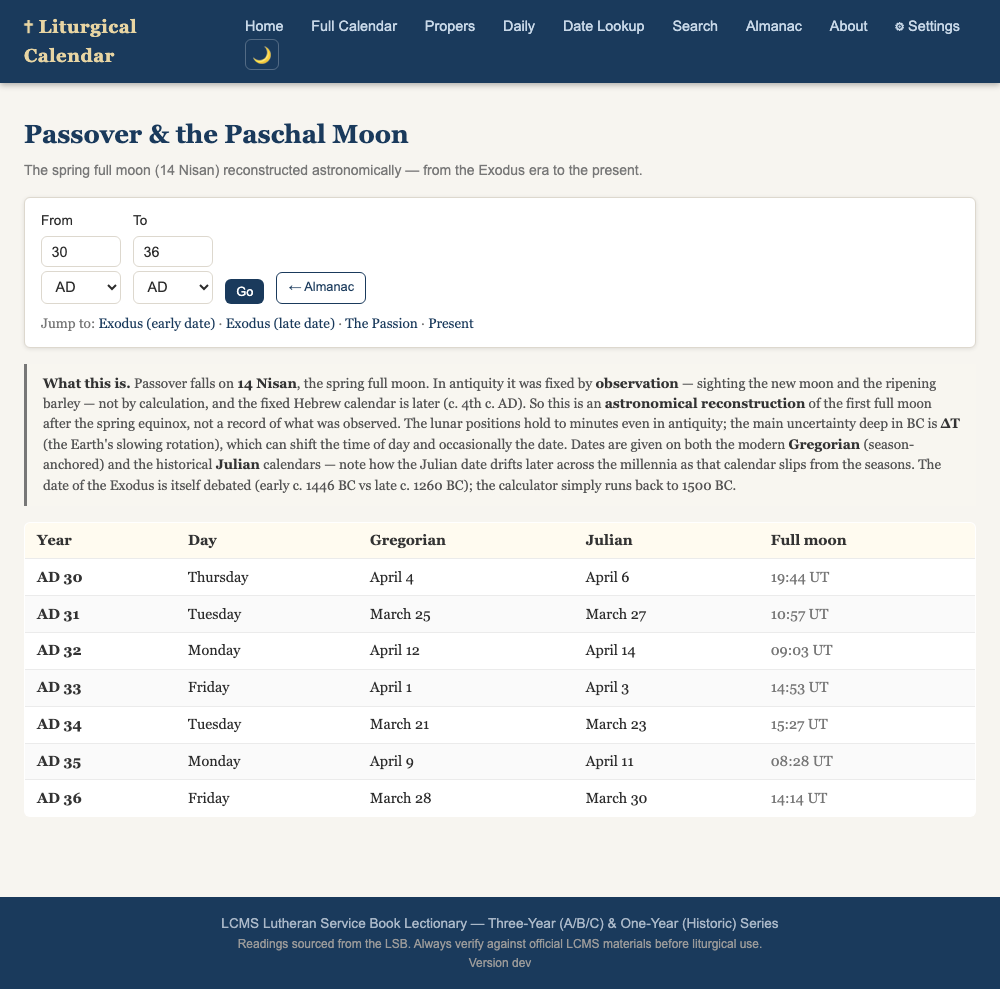
The two serious candidates are AD 30 (Friday 7 April) and AD 33 (Friday 3 April), each a Friday at Passover under Pontius Pilate. Weighing the chronology of Jesus' ministry — John names at least three Passovers, and Luke dates John the Baptist to the fifteenth year of Tiberius — together with a lunar eclipse that rose over Jerusalem on the evening of 3 April AD 33, this site adopts AD 33 as its working date. The Almanac's own reconstruction agrees: ask it for the Passover moon of the Passion years and AD 33 falls exactly on Friday, 3 April (Julian).
Reaching back to the Exodus
The most unusual tool is the last one. Passover & the Paschal Moon reconstructs the spring full moon — 14 Nisan — for any year from 1500 BC to the present, on both the Gregorian and the Julian calendars. Watch the Julian date drift later and later as you go back: the Julian calendar itself slips from the seasons over the millennia, so by the time of the Exodus the spring full moon lands in what the old calendar called May.
A word of honesty is owed here. The ancient Hebrew calendar was observational — fixed by sighting the new moon and the ripening of the barley — so even a perfect astronomical full moon is not a record of the day Passover was actually kept. And the date of the Exodus is itself debated, from roughly 1446 BC to 1260 BC; the calculator simply runs back to 1500 BC and lets you choose. These tools reconstruct the sky; they do not replace the historical record.
How accurate is it?
The Moon is computed with Jean Meeus' methods. For the modern era the phase times match the U.S. Naval Observatory to within about two minutes. The model holds up astonishingly well in antiquity, too: the Almanac's full moon for 4 BC matches NASA's catalog of ancient lunar eclipses to within about eight minutes. The dominant uncertainty deep in BC is not the Moon's orbit at all but ΔT — the gradual slowing of the Earth's rotation — which can shift the time of day and, occasionally, the calendar date. The date of Easter, by contrast, is exact integer arithmetic and correct for every year.
You can explore all of it under Almanac in the navigation, and there is a Help & Guide page that explains each tool and tells this history at greater length. It is, in a small way, a thirty-year-old program come home.



Comments ()