
The Army at the Gates
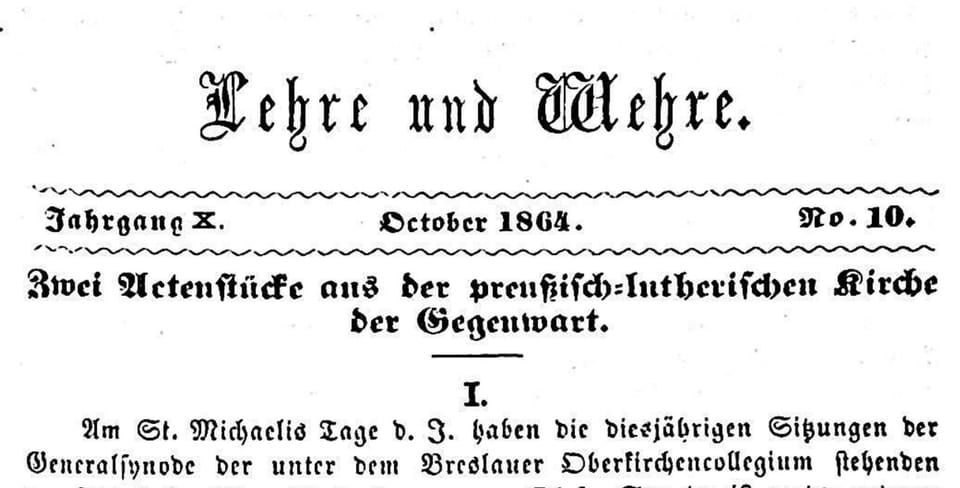
Every number of Lehre und Wehre carries a department headed Kirchlich-Zeitgeschichtliches, usually at the back. The word is one of those German compounds that English has to unpack: Zeitgeschichte is "time-history," the history of one's own time, and the adjective in front of it, kirchlich, means "churchly." Church affairs of the present day, then. It is the column where a monthly journal of theology, printed in St. Louis, stepped out of the sixteenth century for a few pages each month and looked at the world around it. In 1864 the world around it was on fire, and the fire was coming up the road.
What was happening outside
The received account of that autumn is not in dispute. On the second of September 1864 Sherman's army walked into Atlanta. On the nineteenth, Sterling Price crossed from Arkansas into Missouri with twelve thousand Confederate cavalry, the largest force the South ever sent into the state, and turned north toward St. Louis. He broke himself against a small earthwork at Pilot Knob on the twenty-seventh, then came on anyway, and in the first days of October his columns stood at Pacific and Franklin, within forty miles of the city. St. Louis called out its militia and dug in. Price turned west instead, toward Jefferson City and then Kansas City, and was beaten at Westport on the twenty-third of October and driven back south. On the eighth of November Abraham Lincoln was re-elected over George McClellan. On the fifteenth, Sherman left Atlanta for the sea.
Four numbers of Lehre und Wehre went to press while all that happened: September, October, November, and December, one hundred and twenty-eight printed pages, set and printed in St. Louis by men who could hear the city preparing for a siege. I had expected to find the raid in them. It seemed the kind of thing a column called "the church history of our own time" would record, if only in a line: the pastors of the Western District scattered, the seminary students drilling, a Sunday service cancelled because the enrolled militia had been called out. I searched for it. The full run of the journal, 1855 through 1864, is now corrected against the scans and searchable, German and English, at chi-archive.collver.biz, and the search takes a few seconds. The word Price does not occur. Neither does Pilot Knob, nor Westport, nor Atlanta, nor Sherman's march, nor the draft. The election is there once, in March, as the title of an essay a Methodist pastoral conference had assigned itself on whether Abraham Lincoln deserved a second term; after that, nothing. The Confederate army that came within a day's ride of the printing office is not in the book.
What the column recorded instead
It is not that the column ignored the war. Read the four numbers straight through and the war is on nearly every page of the department, but it arrives in a particular shape. It arrives as news about other churches.
The September number, printed as Price was crossing the state line, carries one item that touches the Union war effort at all, and it is a note on the great Sanitary Fairs, the civic bazaars that raised money for the soldiers' aid societies. The Evangelist had reported that the societies' receipts had fallen from two million dollars to one million in a year, "that is, they have diminished by exactly half," and the officers had confessed that "it would have been much better for the soldiers had no fairs been held at all." The St. Louis editors pass this on with evident satisfaction. Charity, they observe, is the kind of thing "in which the left hand does not know what the right hand does," and a fair puts "a sham in its place." That is page 284. It is the whole of the war in the September number.
The October number, printed while the raid was still in the state, gives the war three full pages, and every line of them is about a Catholic bishop in Mississippi. William Henry Elder, Bishop of Natchez, had been summoned in the summer by Brigadier General Tuttle and asked why the prayer for the civil authorities was being omitted from the Mass. The journal reprints the exchange from the Wahrheitsfreund at length, and it is a fine piece of reporting. The general, having procured a Catholic prayer book on his own, lays it before the bishop and says: "I request you to read this prayer. I am now completely satisfied. I shall regard your refusal to read this prayer as a sign of your disloyalty, sir. I hate a traitor. There are many traitors in this city, and I believe you are one." The bishop answers, "I thank you, sir, for your compliment," and asks whether the general has any evidence. "This is fact enough," says the general. Two Catholic paymasters in the Union army then point out that the prayer in question asks God's blessing on the President of the United States and on the governor and legislature of Mississippi, which in 1864 meant praying for a rebel governor from a Union pulpit. The general thinks about it and orders the prayer read "exactly as it stands in the book." Elder appealed, the journal says, "directly to Major General Sherman and to President Lincoln," was banished across the river to Vidalia by a successor's Special Order No. 11, and was released two weeks later by Special Order No. 31. The editors print the release order, with its sour military sarcasm, and then a long letter of the bishop's on the freedom of the church from the state, and they give him the last word: render unto Caesar.
That is the only time Sherman is named in the whole volume, and he is named as the addressee of a Mississippi bishop's protest. Lincoln fares a little better, four times in three hundred and eighty-four pages, and every one of the four is inside somebody else's church business: the Methodist essay in March, an address the Methodist General Conference presented to him in July, the bishop's appeal here, and one more to come in November. The two most consequential men in the country that autumn reach a St. Louis journal only when a Methodist or a Catholic has occasion to write to them.
Directly beneath the Natchez story, on page 312, is a short item headed Methodisten-Schwindelei, Methodist humbuggery. The Christian Apologist of Cincinnati, the German Methodist paper, had written that the war was a struggle over "whether Christian civilization or barbarism, whether a free popular government or aristocratic absolutism, is to triumph." The editors answer in one sentence, and it is the sentence that explains the silence: "Just as we have no one but the abolitionist sects here to thank for the present horrible war, so they also wish to have the honor of being the cause of its continuation." Then the moral: "Oh, how terribly God is now teaching us what fruits of temporal and eternal ruin false doctrine, sectarianism, and religious fanaticism bring upon whole peoples."
The November number, printed after Price had been driven out and the election held, gives its war pages to Bishop Matthew Simpson of the Methodist Episcopal Church, who had addressed a crowd at Mozart Hall in Cincinnati on "the national crisis." Simpson's speech is famous; it is the one in which the gold and silver of the western mines are offered as proof the Union cannot lose. The journal quotes him at length and without mercy: "Our ships could be armored with silver and our soldiers equipped with silver rifles." The editors set the item under the heading "Comfort of a Servant of Christ in this Sad Time of War," and observe that repentance, the one thing a preacher might have offered a nation at war, "naturally, this false prophet said not a word" about, "for that would of course have dampened the elevated mood." On the same page they note that McKendree Chapel in Nashville had been handed back to its Southern Methodist minister "by an order of President Lincoln," and that the Northern Methodist paper reported the fact "with a troubled heart." That is the last appearance of Lincoln's name in the volume, and once again he is a figure in a quarrel between Methodists.
December has nothing of the war at all. The volume closes on a Mecklenburg nobleman's obituary and a four-line errata table.
Why the silence is not an accident
Here I should be careful, because the absence of a word is not the absence of a thing. Silence in a source is evidence only when you know what the source was for. So the first question is whether this column ever recorded anything of the kind, and the answer is yes. A year earlier, in the October 1863 number, an editorial on the word "Loyalty" spoke of "the former governor of Missouri, later deposed," meaning Claiborne Jackson, whom the state convention had removed in 1861, and of the "marvels" the loyal Methodists of St. Louis had performed while he still held a lawful office. The editors knew where they lived and were willing to say so in print. The Dakota uprising of 1862, which fell on Lutheran congregations in Minnesota, they never mentioned in three years; but Missouri's own politics they could touch when it served an argument.
The second question is what the argument was, and the editors state it in that one sentence about the abolitionist sects. Their theory of the war was not military. It was a judgment of God on false doctrine, on the sects who had made a Gospel out of politics and a politics out of the Gospel, and on the German Methodist paper in particular, which they quoted more than any other. Under that theory a Confederate army in Missouri is not news. It is weather. What is news is another Methodist bishop promising silver rifles, another army officer dictating a bishop's prayers, another Northern paper reporting a court decision with a troubled heart. Every one of those items is a data point for the thesis that the church which meddles in the state ends by being meddled with. The raid proved nothing of the kind, so the raid went unrecorded.
There is a third thing, and it is the one I find most telling. The department that carried these items was not written from Missouri. It was clipped. Nearly every paragraph opens by naming its source: the Evangelist of July 30, the Wahrheitsfreund of September 21, the Apologete of October 17, the Observer of October 14. The editors read the religious press of the whole country and reprinted what suited them, with a sentence or two of comment. The one paper they did not clip was the one outside the window. A St. Louis daily in October 1864 would have been full of Price; the church papers of Cincinnati and New York were not, or not in a way that could be turned to doctrine. The silence of Lehre und Wehre is in part the silence of its scissors.
What it means now
I do not think the editors were cowards, and I do not think they were fools. Walther and the men around him lived through the raid like everyone else in the city, and the January 1865 number, when it comes, will tell us whether they ever looked back at it. What the four numbers of 1864 show is something more ordinary and more useful to a historian: a periodical records the world through the questions it has already decided to ask. Ask about the war between the churches and you will see the war between the churches, in fine detail, every month, with the names and dates. Ask about the army at the gates and you will get nothing, because nobody in that office thought the army at the gates was a church question.
That is worth remembering when we read our own periodicals, which are also written from a theory, and which also clip. And it is the reason an archive that can be searched for a word is a different instrument from a shelf of bound volumes. The old way to discover what a journal never said was to read every page and keep a list. The new way is to type the word and watch the empty result come back. The empty result is a document too. Ten years of Lehre und Wehre, 1855 through 1864, three thousand eight hundred and forty pages, are now on the site in German and English, and the search box is open. Try Price. Then try Sherman, and read what comes back, and notice whose story he is in.
The pages discussed here are in the archive at page 284 (the Fairs), pages 309 through 312 (Bishop Elder, and the Methodist item), and pages 350 and 351 (Bishop Simpson and McKendree Chapel) of the 1864 volume, and the 1863 "Loyalty" editorial is on pages 311 and 312 of the 1863 volume.
Note: the journal's news items are signed, when they are signed at all, with a single initial, and I have left them that way rather than guess at the hand. The scans were made from a library copy; the transcriptions and translations are machine work corrected against the page, not yet human-reviewed.

Comments ()