
The Luther Missouri Read: The St. Louis Edition of Luther's Works, 1880–1910
How a district pastoral conference decided to reprint all of Luther, why it took thirty years, and what the Missouri Synod's own Luther tells us about the Missouri Synod
On a Sunday afternoon in May 1911 some twenty thousand Lutherans tried to get into the St. Louis Coliseum, and several thousand of them failed. They had come from Chicago, Milwaukee, Indianapolis, Fort Wayne and Cleveland for the hundredth birthday of Dr. C. F. W. Walther, who had been dead for twenty-four years and could still fill a hall. There was a German address and an English one. The English speaker, Professor W. Dau, worked his way through Walther's labors and then said something that must have pleased the home crowd:
"And he lived to see a work begun in our beloved city and state, — which was completed last year, — which has grouped the name of St. Louis among the few cities of the world from which a complete edition of Luther's works has been published."
It is a short list. Wittenberg, where the first collected edition began appearing in 1539 while Luther was alive to complain about it. Jena, Altenburg, Leipzig. Halle, where the Jena professor Johann Georg Walch saw twenty-four volumes through the press between 1740 and 1753. Erlangen. Weimar, whose great critical edition had begun in 1883 and would not finish until 2009. And, as of 1910, a river town in Missouri whose Lutherans had been in the country for seventy-one years.
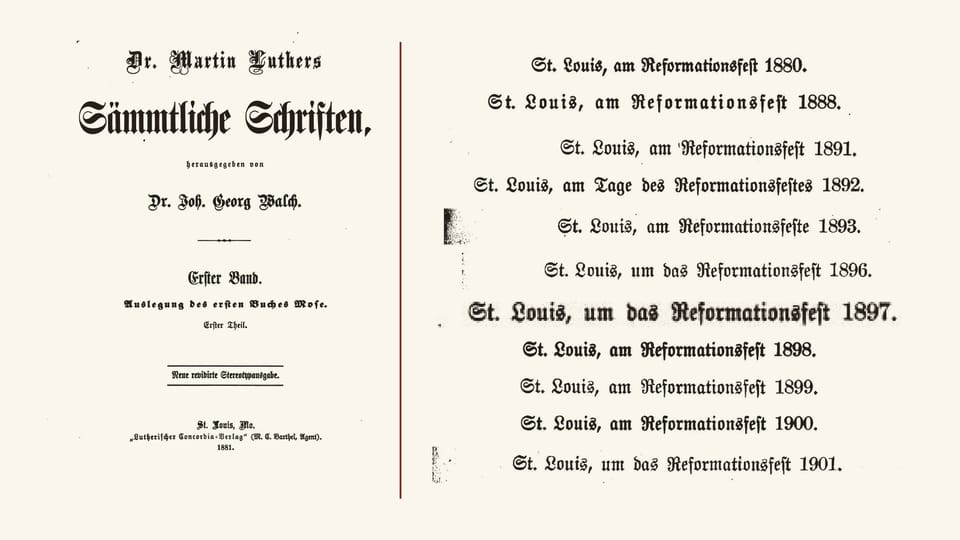
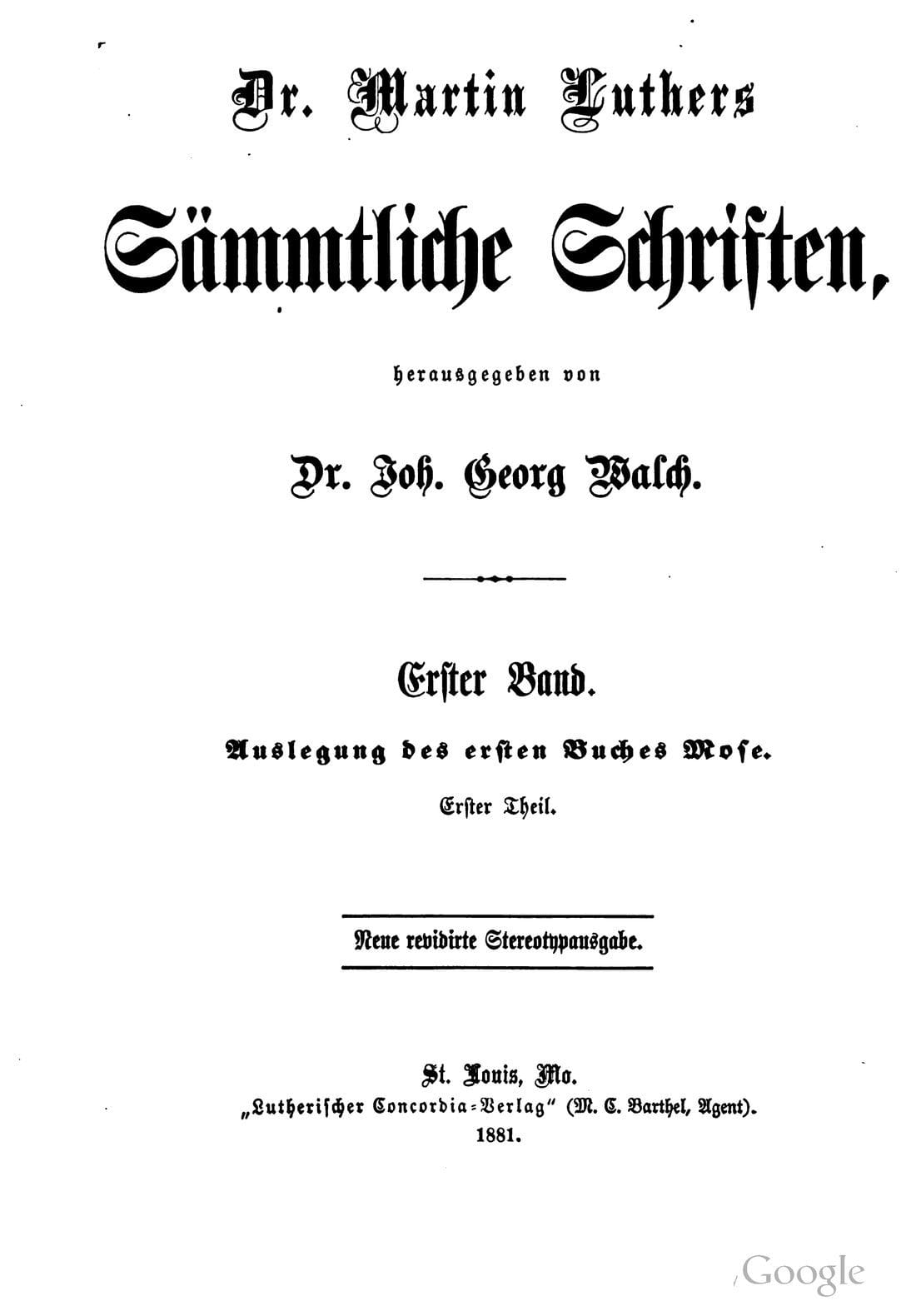
Scholars call the set the St. Louis Edition, or "Walch 2," or simply St. L. with a volume and a column number. Its full name is Dr. Martin Luthers Sämmtliche Schriften — Dr. Martin Luther's Complete Writings — herausgegeben von Dr. Joh. Georg Walch. Neue revidirte Stereotypausgabe, "new revised stereotype edition." Twenty-three volumes bound as twenty-five books, a little under twenty-seven thousand leaves, set in two columns of Fraktur (the German blackletter type), and printed by the Synod's own press between 1880 and 1910.
This month we gathered all twenty-five books from public scans, and we have begun the work of putting them into the Concordia Historical Institute's digital archive in German and in English. This post is the exhibit that goes with that beginning. The edition has had one careful historian, Robert Kolb, whose 1983 article in the Concordia Historical Institute Quarterly remains the standard account and is drawn on gratefully below. What follows adds what the volumes and the Synod's minutes say for themselves: who decided to make it, what they said they were doing, what the Synod's convention minutes record about it, and what the order of the volumes gives away.
A small correction, at my own expense
I should begin by correcting myself. For years I carried around a tidy explanation of this edition: old Walch was in German and Latin, and Missouri reprinted it in German only, because most of its pastors could not manage the Latin.
The second half of that is near enough to the truth. The first half is wrong, and the edition's own foreword says so.
Walch's Halle edition of 1740–53 was already entirely German. That was its point. Luther lectured and disputed in Latin and preached and pamphleteered in German, and the older collected editions kept the two apart, Latin volumes and German volumes. Walch gave German readers the whole man by printing the Latin works in German translation — some translations old, some made for him — and, as Kolb points out, by putting Luther's own sixteenth-century German into a more modern dress for the pastors of the 1740s. The smoothing of Luther for his readers did not begin in St. Louis. It was the edition's founding idea. The edition that kept Luther's Latin in Latin was the newer, scholarly one: Erlangen, begun in 1826.
So the question before Missouri in 1879 was not whether to strip the Latin out of Walch. It was which Luther to put on a pastor's shelf: the scholars' edition, or the readable one. They chose the readable one, deliberately, and said why.
September 1879
The foreword to the first volume is two pages long and signed only Die Redaction — "The Editors." It is dated St. Louis, am Reformationsfest 1880: St. Louis, on the Festival of the Reformation, 1880. It opens with a sentence that still has the exclamation point of a launching:
In GOttes Namen sei hiermit der erste Band der alten, in der lutherischen Kirche wohlbekannten und hochgeschätzten Walch'schen Ausgabe von Dr. Luthers Werken in erneuter Form und Gestalt der Oeffentlichkeit übergeben!
In God's name the first volume of the old Walch edition of Dr. Luther's works — an edition well known and highly valued in the Lutheran church — is herewith handed over to the public in renewed form and shape!
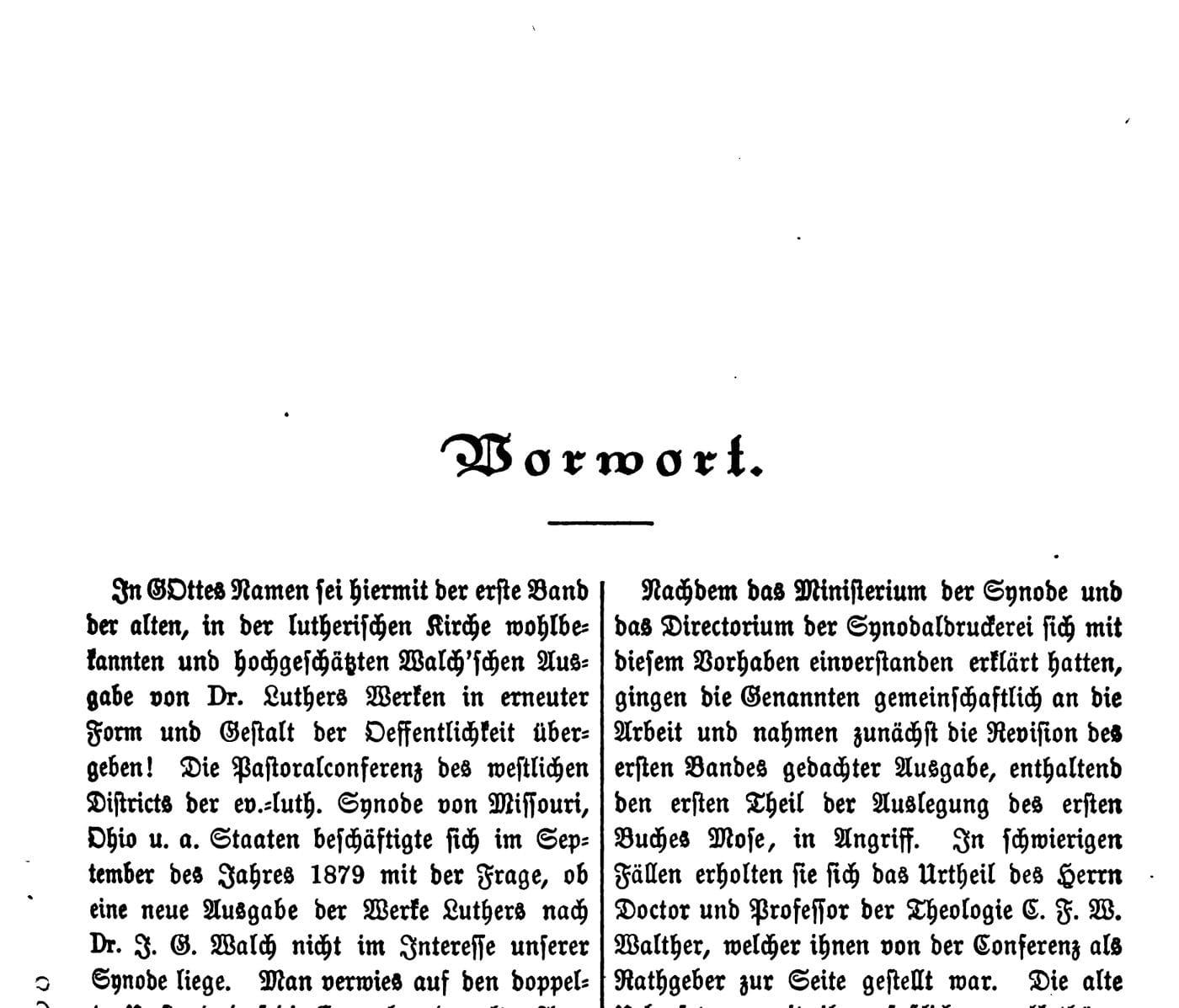
Then it tells the story. In September 1879 the Pastoral Conference of the Western District of the Evangelical Lutheran Synod of Missouri, Ohio and Other States — not the Synod in convention, not the seminary faculty, but a district's pastors meeting as pastors — took up the question of whether a new edition of Luther's works following Walch might not be in the Synod's interest. Two facts were put forward:
…daß die Exemplare der alten Ausgabe immer seltener werden, und daß die Erlanger Ausgabe, welcher die schätzenswerthen, längeren Vorreden und die Uebersetzungen der lateinischen Schriften abgehen, die Walch'sche Ausgabe nicht ersetze.
…that copies of the old edition are becoming steadily rarer, and that the Erlangen edition, which lacks the valuable longer prefaces and the translations of the Latin writings, is no substitute for the Walch edition.
There is the correction in the editors' own words. Erlangen lacked the translations of the Latin writings. A pastor in Perry County or on the Nebraska prairie who owned Erlangen owned a good deal of Luther he could not comfortably read, and his people could not read at all. Old Walch he could read, if he could find one. By 1879 he mostly could not. The sets had come over in emigrants' trunks forty years before, and there were not many of them.
The conference resolved — "in the name of the ministerium" of the Synod, and assuming its consent — to produce a new and revised edition. It named the editors: P. G. Stöckhardt, that is, Pastor Georg Stöckhardt, with the help of E. W. Kähler. Kolb fills in the men. Stöckhardt had been in the country little more than a year. He had studied at Erlangen and Leipzig, had left the Saxon state church for the Lutheran Free Church, and had been jailed in Saxony for the manner of his leaving. Kähler was a Fort Wayne graduate with two decades in the parish behind him, who had come to St. Louis in 1876 as Walther's private secretary and served the whole faculty as its literary editor. The Synod's clergy and the board of the Synodical Printing House agreed. And the conference gave its editors an adviser for the hard places:
In difficult cases they obtained the judgment of Dr. C. F. W. Walther, Professor of Theology, whom the Conference had placed at their side as an adviser.
So Dau was being exact in 1911. Walther did not merely live to see the work begun. He was its court of appeal, and by Kolb's account a good deal more than that. As a student at Leipzig in the winter of 1831–32, Walther had spent six months flat on his back with a serious illness, reading Luther in the Walch edition, and he came out of that sickroom the theologian he remained. He spent the rest of his life telling pastors to read Luther daily. By the late 1870s his German-born students could no longer find a Walch to buy. The details of the 1879 conference are lost, Kolb says, but the wish behind it was Walther's, and his St. Louis colleague Pastor J. F. Bünger pressed it on the brethren.
When the first volume came out, Walther announced it in Der Lutheraner with a psalm verse — the Lord has done great things for us — and with the price: three dollars and fifty cents, kept that low, he explained, because the object was not money but the spread of saving doctrine. The whole set would come to about a hundred dollars. Kolb observes that for some pastors that was several months' salary. They bought it anyway, and left it to their sons.
What "revised" meant
The editors were candid about what they did to Walch. The old translation, "with its plain, popular language" — mit ihrer faßlichen, volksthümlichen Sprache — was to be kept essentially as it stood. But since the point of an edition of Luther is "to capture Luther's own sense and meaning as exactly as possible," they compared Walch's German once more against the Latin originals. Wrong and inexact renderings were corrected. Unintelligible expressions were replaced by clearer ones. Long-winded paraphrases were shortened. Walch's chapter-by-chapter tables of contents, "which merely classify the familiar biblical text," were dropped, along with notes in his preface "now barely of antiquarian value." Remarks from the newer Luther scholarship were taken in.
And this, which matters more than it looks: "The German of the old translation has been made clearer according to the rules of the newer orthography."
It is worth saying plainly what that adds up to. Where Luther wrote Latin, the St. Louis text is a German translation, revised in St. Louis. Where Luther wrote German, it is Luther's German respelled and gently regularized for a reader of the 1880s. In neither case is it the sixteenth century on the page. It is a nineteenth-century American Lutheran's Luther: accurate in sense, checked against the sources, and smooth enough to be read aloud to a congregation in Frohna or Fort Wayne without a stumble.
German scholars said at the time that a revised Walch was the wrong thing to build on, and Stöckhardt answered them in the foreword to volume 18, in 1888. He granted that one might wish many things different. What had decided the men who resolved on the edition "nearly a decade ago," he wrote, was that old Walch had acquired eine Art Hausrecht in der lutherischen Kirche — a kind of right of residence in the Lutheran church — since "in most of the theological and Christian writings that are read in our circles, the passages quoted from Luther are cited according to Walch." Upset Walch's arrangement, and the reader with a reference in his hand could no longer find his place. It is a librarian's argument, and a pastor's.
For a critical edition that would be a fault. For a history of the Missouri Synod it is the whole interest. When a pastor of 1895 quoted Luther in a sermon, a conference paper, or the pages of Der Lutheraner, these are the words he quoted. This is the Luther Missouri read.
The machinery on the page
Open any volume and the care shows before a sentence is read.
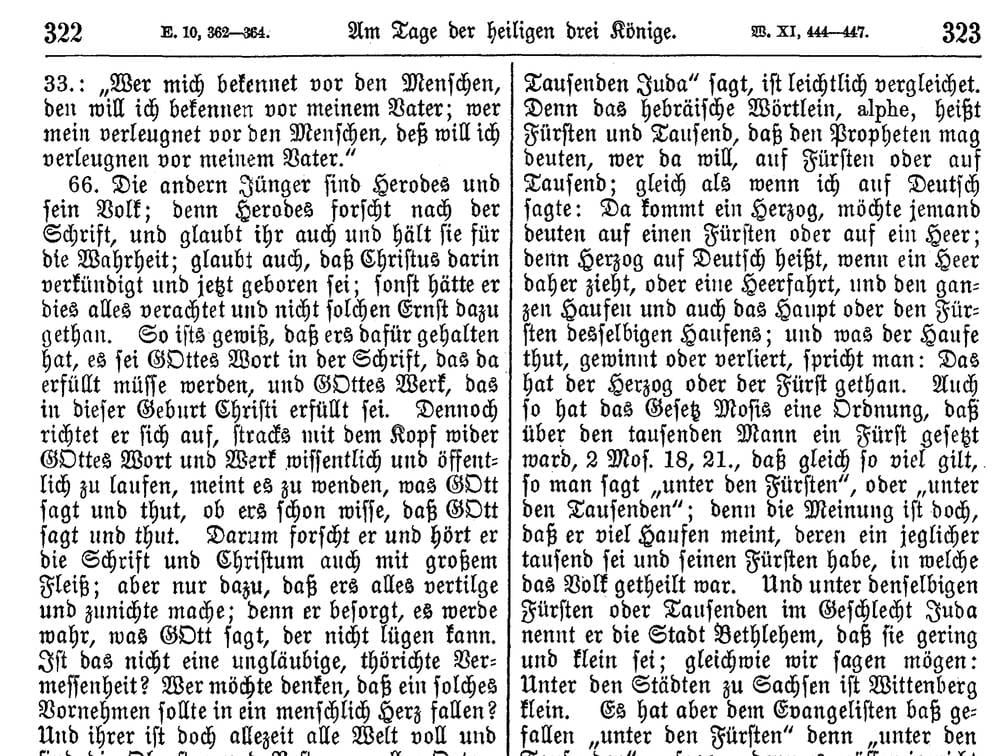
The edition numbers its columns, not its pages: the left column's number stands at the far left of the running head, the right column's at the far right, and the scholarly citation ever since has been volume and column — St. L. 18, 1668. Between the numbers runs the title of the work in hand. And on either side of the title, in small type, stand two references the foreword explains: under W. the corresponding pages of old Walch, under E. the pages of the Erlangen edition. Every page of the set is its own concordance. A reader with a reference to either of the older editions could find his place in the new one. The editors had built, in lead type, what we would now call a cross-reference table, tens of thousands of entries long.
Walch's numbered paragraphs were kept, so that a citation could be exact to the paragraph. The foreword thanks Mr. Christian Körner — an employee of the publishing house, Kolb tells us — for "the rather laborious proofreading of the printed sheets," and having now read a fair number of those sheets at high magnification I am prepared to say he earned it. A computer reading this Fraktur with no human help makes about four errors in a thousand characters, which says as much for the evenness of the 1880s typesetting as for the software.
He did not catch everything. In the exposition of Genesis 22, where the angel calls to Abraham, the first volume prints:

nnd sprach — "aud said," an n standing where a u belongs. It is a small thing, and it is there in the 1881 printing and would be there in any later one, because of the other word in the title: Stereotypausgabe. A stereotype edition is printed from metal plates cast from the standing type. Once a page is cast it can be stored, brought out years later, and printed again without resetting a letter, errors and all. Our copy of volume 10 has a title page dated 1892 over a foreword dated 1885; our volume 13 part two says 1892 over 1884. Same plates, later printings. The plates were the capital of the enterprise, and the Synod's minutes say what they cost.
What the Synod's minutes say
The convention proceedings of the period — the Synodal-Berichte, which the archive now carries in corrected German and English — mention the edition rarely and briefly, which is itself informative. It was a publishing-house project, carried on the publishing house's books.
In 1884 the general convention took it up in one line among the resolutions on the printing house:
Beschlossen, daß die Synode die Fortsetzung der Herausgabe von Luthers Werken nach Walch gutheiße.
Resolved, that the Synod approve the continuation of the publication of Luther's Works according to Walch.
The publishing-house report to that same convention counted 5,300 individual volumes of Luther's Works sold in the three years 1881–1884, and added a footnote: of the house's inventory value, "the cost of the plates for the volumes of Luther's Works published so far is $8000.00." The convention met from the seventh to the seventeenth of May. Five volumes were out by then, and a sixth was at the press. Eight thousand dollars was serious money. Measured by prices, it comes to something like $270,000 today. Measured the way the men who paid for it would have felt it — against what a working man earned in a year — it is closer to two and a half million. Three years later the general treasurer's report shows whole districts sending in four, eight and ten thousand dollars over a three-year period toward the synodical treasury.

Three years later the report has a heading of its own, and not a cheerful one: Shortfall in the sale of Luther's Works. In 1881–1884, 5,300 volumes sold. In 1884–1887, 1,282. "Thus fewer sold: 4,018 volumes." The first rush of subscribers had bought their Genesis and their postils, and the curve had fallen off a ledge.
Here is what I find most telling in the whole record. Nobody proposed to stop. With sales down by three quarters and eight thousand dollars sunk in plates, the Synod's press went on casting Luther for another twenty-three years — through the polemical writings, the Gospels, the Psalms and the Prophets, three fat volumes of Reformation documents, two of letters, and at last, in 1910, an index volume of 1,100 pages that can have sold to almost no one and is the most useful book in the set. A church body that prints the index is a church body that means it.
One more entry, from 1905. The convention resolved that from the first of January 1906 all the Synod's books and publications — "including the school Bible" — should appear in the newest German spelling. With an exception: "Luther's Works and all devotional books published up to now." The plates again. You do not recast twenty volumes for the sake of a th.
What they printed first
The volume numbers follow Walch's plan: Bible exposition first, then sermons, then catechism, then the Reformation writings, letters, Table Talk, index. The volumes did not appear in that order. Each foreword is dated, and lining up the dates gives the real sequence:
| Foreword dated | Volume | Contents |
|---|---|---|
| Reformation Day 1880; Pentecost 1881 | 1, 2 | Lectures on Genesis |
| Easter 1882; Epiphany 1883 | 11, 12 | The Church Postil — sermons on the Gospels and Epistles of the church year |
| Pentecost 1883; Pentecost 1884 | 13a, 13b | The House Postil, in both recensions |
| Pentecost 1885 | 10 | Catechetical writings |
| St. John's Day 1887 | 22 | Table Talk |
| Reformation Day 1888; Michaelmas 1889; Luther's birthday 1890 | 18, 19, 20 | Writings against the papacy; against the sacramentarians and enthusiasts |
| Reformation Day 1891, 1892, 1893 | 7, 8, 9 | The Gospels, John, Galatians and the Epistles |
| 1894; Michaelmas 1895; Reformation Day 1896, 1897 | 3, 4, 5, 6 | The rest of the Old Testament: Moses, the Psalms, the Prophets |
| Reformation Day 1898, 1899, 1900, 1901 | 14, 15, 16, 17 | Prefaces; the documents of the Reformation, 1517–1546 |
| Pentecost 1903; Michaelmas 1904 | 21a, 21b | The letters |
| Easter week 1910 | 23 | Index |
After Genesis — which the foreword commends as "a short, clear summary of Luther's teaching, drawn directly from God's word" — the editors jumped nine volumes ahead to the postils. The first four years of the edition, six books out of the first six, gave a pastor two things: Luther's fullest commentary, and Luther's sermons for every Sunday and festival of the year, twice over. Then the catechism volume. Then, and only then, the controversies.
Some of this was surely convenience. The postils and the catechetical writings are Luther's own German and needed no comparison against a Latin original; they could be revised faster than a volume of lectures. But convenience and conviction pointed the same way, and the sales figures bear it out: those early volumes are the 5,300. What Missouri wanted from Luther first was help in the pulpit on Sunday morning. The documents of the Diet of Worms could wait until 1899, and did.
There is one thing more to set beside that table. In 1887, the year he died, Walther read a paper to a pastoral conference on the fruitful reading of Luther, and Lehre und Wehre printed it. His advice to the beginner runs nearly opposite to the order of his own edition. Do not start, he said, with works taken down from student notes, nor with works translated out of Latin, since no translation quite catches the original — which describes the Genesis lectures exactly. Do not start with the exegetical or the sermon volumes either. Start with the polemics: the great confession on the Lord's Supper, the book against the papacy at Rome, Against Hans Worst. Not every illness, he remarked, is cured with buttermilk and honey. The postils, he added, a pastor should simply read every week as he prepares to preach. Kolb notices the irony. I notice that the next three volumes off the press, in 1888, 1889 and 1890, were the polemics.
The schoolmaster from New Orleans
The first forewords are signed "The Editors." In 1885 Stöckhardt signs volume 10 by name. Then the foreword to the Table Talk, at midsummer 1887, introduces a new hand: the volume "has been prepared by Professor Hoppe, who since the autumn of last year has been called to the editorship of this our Luther edition," and who "has for a number of years made special studies" of the Table Talk. The foreword to volume 18 says the work "cost the man who did it, Professor Hoppe, much time and trouble." From 1890 he signs for himself, A. F. Hoppe, and he goes on signing for twenty years.
Kolb's article is where one learns who he was, and the story deserves to be better known. Albert Friedrich Hoppe was born in 1828 at Rostock on the Baltic, a surgeon's son and the grandson of a professor of English. He studied there under the Old Testament scholar Franz Delitzsch, was drawn further into confessional Lutheranism by Philippi and Kliefoth, and came to St. Louis in 1855 on Kliefoth's recommendation to Walther. After teaching briefly in the seminary's preparatory school he took a call to Zion congregation in New Orleans, and New Orleans kept him for thirty years: through yellow fever, through the siege and the Federal occupation, through a change of vocation from pulpit to schoolroom. He founded a classical school, tutored all over the city, and served for years as corresponding secretary of the New Orleans Academy of Science.
He told the story of his own beginning with Luther. In 1857 President Wyneken, on an official visit, looked over the young pastor's bookshelves and asked where his sermon books were. Hoppe stammered that he had only the sermons in his Erlangen Luther. Wyneken told him that would do. Five years later Hoppe sent Walther a long critique of the Erlangen edition — passages it had printed twice in different volumes, pieces it had taken for independent works that were really excerpts, people its notes had failed to identify — and Walther printed it in Lehre und Wehre. That article, "A Contribution to the Improvement of the Editions of Luther's Works, Particularly the Erlangen," is in this archive, in German and English: the future editor of the St. Louis edition, twenty-four years early, correcting the scholars' Luther from a parsonage in wartime New Orleans. Kolb's judgment of it is exact. It shows no special gift for theological analysis, he says, and an encyclopedic knowledge of the text. Hoppe seems to have had something close to a photographic memory, and he had spent it on Luther.
In 1885 Stöckhardt asked him to prepare the Table Talk. The manuscript reached St. Louis in October 1886, Walther wrote of it with open pride, and the publishing house called Hoppe to take over the edition and pressed him to come at once. On the third of November he put his family and some of the boys from his school on a steamboat and went up the Mississippi. His old friend Louis Lange, the publisher, had found him a house. He worked in it for the remaining quarter century of his life, with seminary students to help him check his text against old Walch. In 1896, Kolb found, the editor of Luther's works was paid $840 a year. The foreman of the publishing house's composing room was paid $1,400.
His Table Talk was no reprint. He threw out the arrangement everyone had followed since Aurifaber's edition of 1566, translated the two chief Latin sources afresh, removed the duplicates and the strays, and sorted the whole under eighty topics. For the polemical volumes he wrote introductions of sixty and seventy pages. For the letters he abandoned Walch's three categories for strict chronological order and added notes; the editors of the Weimar edition, not given to flattering American work, later allowed that his German renderings of the Latin letters were trustworthy and often a real help to understanding them. He spent his last six years remaking the index, finished it "in Easter week 1910," and died in 1911, a little more than a year after he laid down his pen.
Germany mostly did not notice. Kolb quotes the Berlin church historian Gustav Kawerau, surveying twenty-five years of Luther research in 1908, to the effect that the St. Louis edition was all but unknown there, though he granted its editors' energy in taking up the newest German findings. It could not match Weimar and was never meant to. Yet Kolb cites a 1982 guide to Reformation research that was still sending students to St. Louis: for the documents, for German renderings that help with Luther's harder Latin — the Weimar editors used them for just that — and for the index volume, until Weimar's own subject indexes should be finished.
And there is the pattern in the dates, which is my favorite thing in the edition. The first foreword is dated on the Festival of the Reformation, 1880. So is the foreword to volume 18, in 1888. And 7, in 1891; and 8, 1892; and 9, 1893; and 5, 6, 14, 15, 16 and 17, every autumn from 1896 to 1901. There are variations: volume 20 is dated "on the birthday of Martin Luther, 1890," a few are dated at Michaelmas or Pentecost, and the index "in Easter week." But the habit is plain. Year after year Hoppe finished his volume, wrote his foreword, and dated it by the Festival of the Reformation.
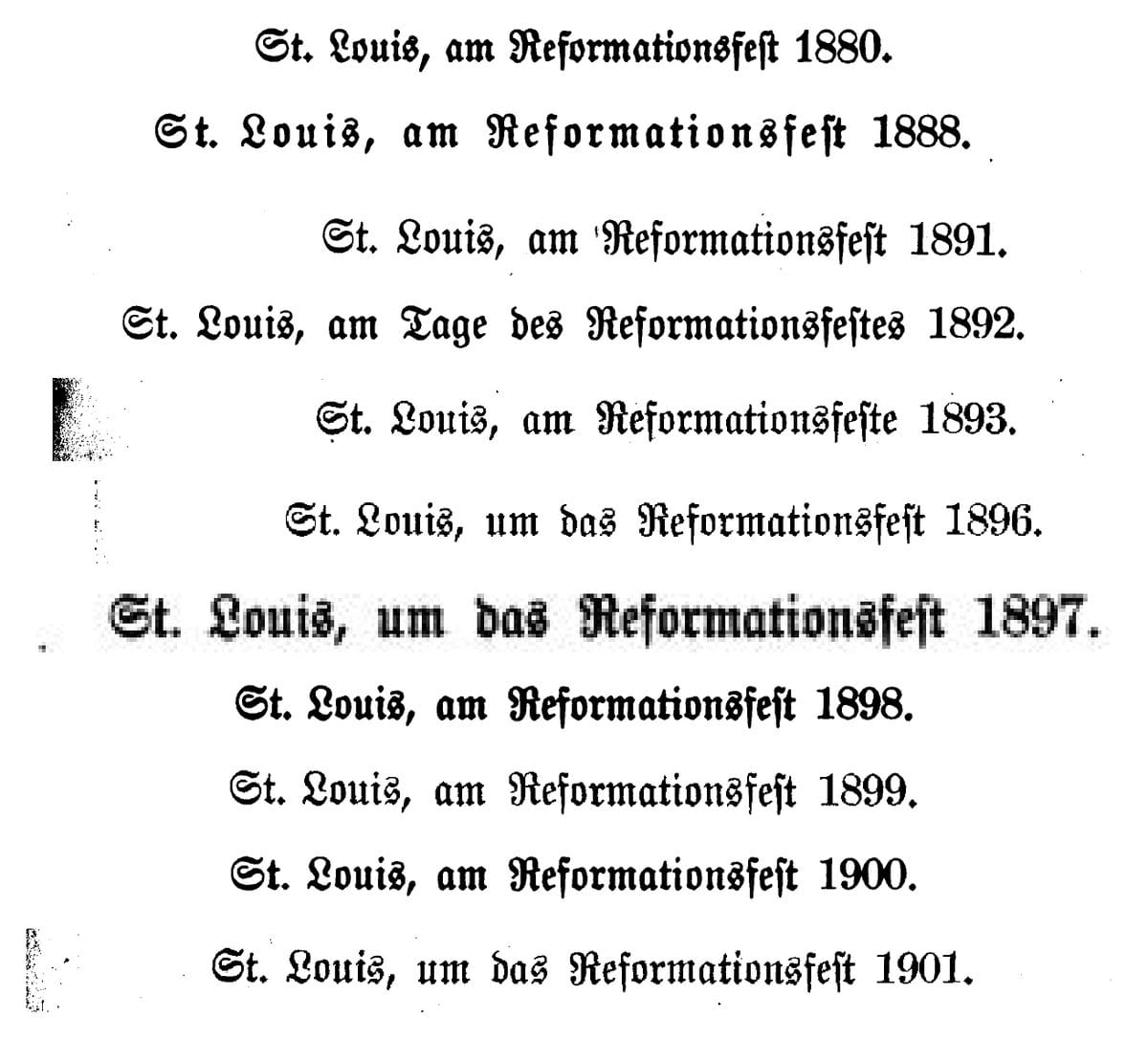
Nobody made him do that. It is a man on $840 a year telling you, once every autumn and without comment, what he thought he was doing.
The year it began
The first foreword also explains its own date. 1880 was a double jubilee: three hundred and fifty years since the Augsburg Confession was presented to the emperor, and three hundred since the Book of Concord was published. The editors drew the moral themselves:
The double jubilee of this year … has earnestly reminded Lutheran Christendom to be a faithful steward of the treasures handed down to it by the fathers. Luther's writings in particular belong among these treasures. By God's great grace the long forgotten and buried, unadulterated teaching of Luther has been opened up anew to the Lutheran church of North America. Let us show our thanks for this blessing of God also by searching out and studying Luther's teaching from Luther himself.
From Luther himself — aus Luther selbst. That is the Missouri Synod of the 1880s in three words. This was the decade of the controversy over election, when the Synod was being told from several directions that it had misread its own fathers. Its answer was characteristic: reprint the fathers, all of them, in a form every pastor could afford and any literate member could read, and let people look for themselves. The foreword's wish is not for scholars. It is that the edition may spur "Lutheran Christians" — die lutherischen Christen — "to listen diligently and eagerly to the voice of their teacher."
What we are doing with it
The twenty-five books are all in the public domain and all online, scattered among the Internet Archive, Google Books and HathiTrust in scans of uneven quality, some of them mislabeled. We identified each by its own title page rather than its catalog record and measured what we had: 26,837 leaves, roughly 119 million characters of German.
The plan for the archive is the same as for Der Lutheraner, Lehre und Wehre and the convention proceedings already there: the page image, a corrected German text beside it, an English translation beside that, all of it searchable, every page citable by volume and column as the editors intended. The running-head references to old Walch and to Erlangen will be captured too, so that the edition's built-in concordance works again.
We are beginning with volume 15, and the reason is a practical one. Most of what is best known in Luther has been in English for decades in the American Edition of Luther's Works — fifty-five volumes from Concordia and Fortress between 1955 and 1986, and a continuing new series from Concordia since 2009. We mapped that edition against this one, column by column. Genesis is there almost entire; the postils are there; the great treatises are there. Volume 15 is not. It is the first of three volumes of documents for the history of the Reformation from 1517 to 1524, several hundred numbered pieces, most of them not by Luther at all: the papal bulls on indulgences back to the jubilee of 1300, the indulgence letters granted to individual Saxon churches, the instructions given to Tetzel's preachers, the proceedings at Augsburg before Cajetan, the Miltitz correspondence, the Leipzig Disputation. About a seventh of it exists in the American Edition. Much of the rest, so far as we can find, has never been put into English.
Many of those documents were Latin to begin with, so an English version made from the St. Louis German is a translation of a translation, and the archive will say so on every such piece. I have made my peace with that, for the reason given above. This is an archive of the Missouri Synod's history. The question it answers is not "what did Leo X write?" but "what did a Missouri pastor in 1899 read when he wanted to know how the Reformation began?" He read this, in this German, in this book. The English is there so that his great-grandchildren can read over his shoulder.
The English will be plain and modern — the editors of 1880 modernized their Luther for their readers, and it would be an odd tribute to translate their modernized German into imitation King James. The work goes in small portions, each checked before the next begins, and it is frankly machine-assisted: optical character recognition for the first reading, language models for drafts, and then a good deal of looking at the page image, which is where the nnd turned up. The page image is always beside the text, so that no reader has to take our word for Luther's.
The voice of their teacher
There is a symmetry here that the editors of 1880 could not have seen and would, I think, have recognized.
In 1879 a conference of pastors looked at the best scholarly Luther of their day and saw that their people could not read it, because a great part of it was in Latin. So they took the old translation with its plain and popular language, corrected it, respelled it, and gave their church a Luther it could read. It cost eight thousand dollars in plates before the sixth volume was out, it stopped selling almost at once, and they finished it anyway, thirty years later, down to the index.
Kolb ended his article in 1983 with an observation that has only gained weight. For half a century and more, he wrote, this edition shaped what Missouri's pastors preached, because they read it week after week; and when the Synod moved into English it left that Luther behind, and had to turn to English-speaking theologians of other traditions and another spirit. That could not fail to tell on the preaching and the teaching.
A hundred and forty-five years on, their set stands complete on the shelves of a good many Missouri Synod studies and is opened in very few of them, because it is in German, and in Fraktur at that. The treasure handed down by the fathers has become unreadable to the children for exactly the reason Erlangen was unreadable to the fathers. The remedy is the one they chose. Take the text they made; check it against the page; put it into the plain, popular language of the people who are actually going to read it; and keep the original beside it so that anyone may look for himself.
They hoped the edition would move Lutheran Christians "to listen diligently and eagerly to the voice of their teacher." The voice has not changed. It only needs, once again, to be put where people can hear it.
Sources. The standard history of the edition is Robert Kolb, "Luther for German Americans: The Saint Louis Edition of Luther's Works, 1880–1910," Concordia Historical Institute Quarterly 56, no. 3 (Fall 1983): 98–110, to which this essay owes the life of A. F. Hoppe, the backgrounds of Stöckhardt and Kähler, Walther's part in the founding, the prices, the salary figures, and the German reception; Kolb's own sources include Ludwig Fuerbringer, Persons and Events (St. Louis, 1947), and the obituary material in Der Lutheraner 67 (1911). The forewords are quoted from volumes 1, 18 and 22 of the edition itself, the convention resolutions and publishing-house reports from the Synodal-Berichte of 1884, 1887, 1905 and 1911, and Hoppe's 1862 article from Lehre und Wehre 8, all of them in the archive. Walther's 1887 paper on reading Luther is in Lehre und Wehre 33, pages 305–314. The translations from the forewords are ours.
Note on the money. By the Consumer Price Index, $8,000 in 1884 is about $273,000 in 2026 dollars; MeasuringWorth.com gives a "real price" of $264,000 (2024) and a "labor value," reckoned against production workers' compensation, of about $2.5 million. Prices tell you what the plates would cost; wages tell you what they cost the people who bought them.
A print edition of this essay, with the figures, is available as a PDF: The Luther Missouri Read (Three Doves Press, 2026).

Comments ()