
The Historic Propers, Restored: Introits, Collects, and Graduals from 1917
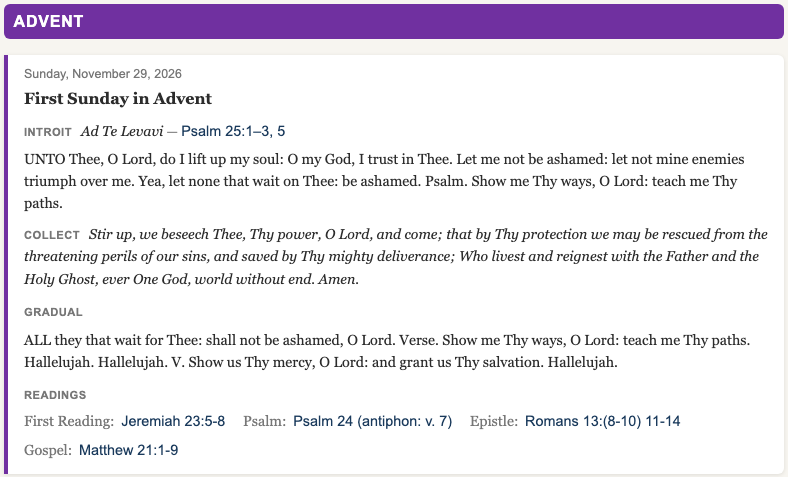
The historic, one-year lectionary has always been the heart of the Lutheran Lectionary app's Historic series. Until now it gave you the readings, the Latin introit names, and the Collect of the Day. This week it gained the rest of the historic propers — the full introit antiphons, the graduals, and proper collects for the saints' days — all drawn from a single public-domain source: the Common Service Book of the Lutheran Church (1917).
Why the 1917 book?
The Common Service Book carries the historic Western propers in dignified, KJV-era English. Just as importantly, it was published before 1928, which places it squarely in the public domain. That matters here. This project has always followed one rule about texts: publish only two kinds of content — facts, and public-domain texts, and nothing under active copyright.
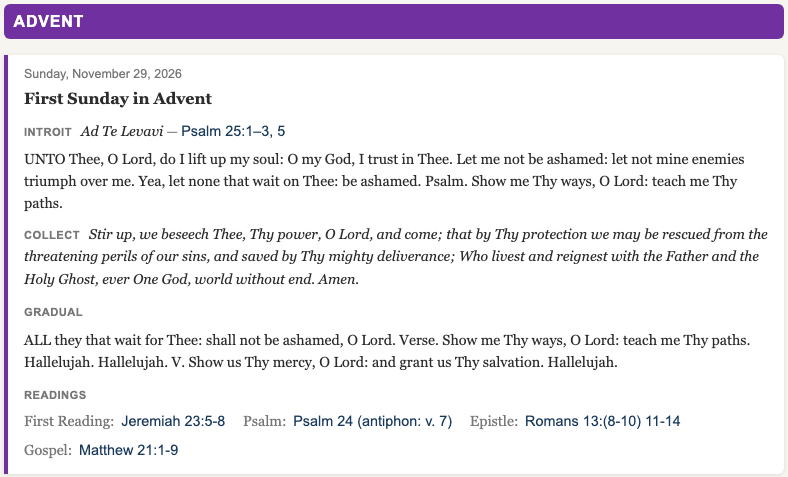
The same historic wording was later carried into The Lutheran Hymnal (1941), which many of us know by heart — but TLH is still under copyright. So the app reproduces the 1917 source it actually can, and cites it. Where you would say "Stir up, we beseech Thee, Thy power, O Lord, and come," the Common Service Book says it word for word:
Stir up, we beseech Thee, Thy power, O Lord, and come; that by Thy protection we may be rescued from the threatening perils of our sins, and saved by Thy mighty deliverance; Who livest and reignest with the Father and the Holy Ghost, ever One God, world without end. Amen.
On every date card
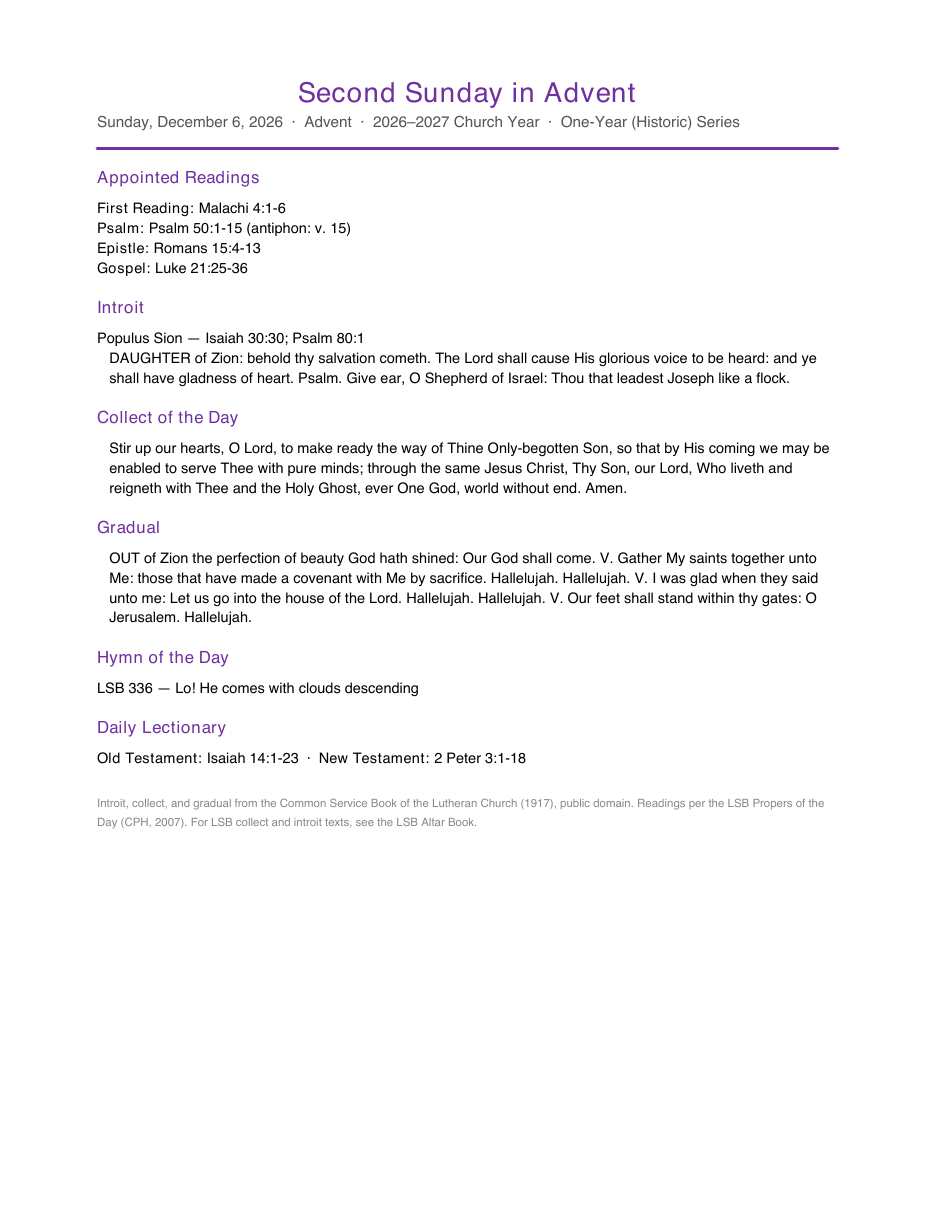
The same propers appear whenever you look up a date — the introit with its antiphon, the Collect of the Day, the gradual, the appointed readings, the Hymn of the Day, and the day's entry in the LSB Daily Lectionary for personal or family devotion.
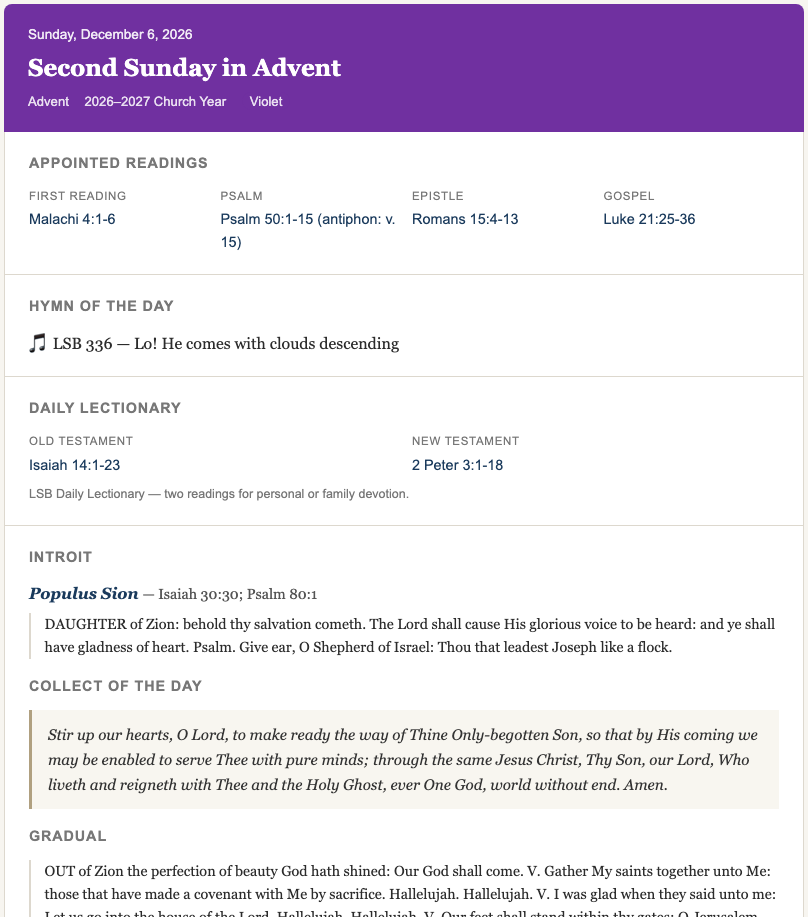
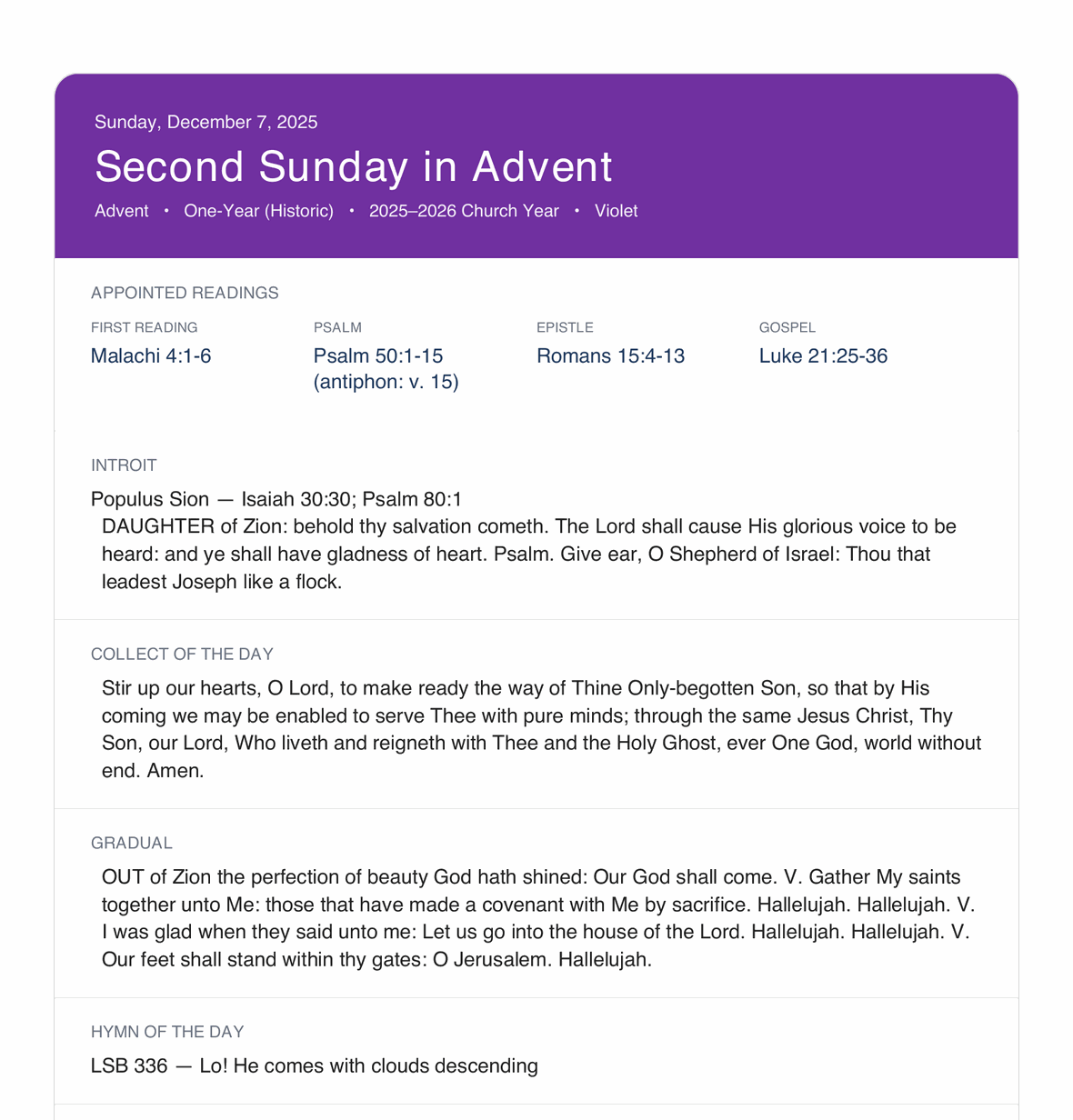
You'll notice the violet header. The One-Year (Historic) series now defaults to violet Advent — the older practice — rather than contemporary blue. If you prefer blue, it's one click away in Settings, and the app remembers your choice (right down to the PDFs).
The saints, too
The apostles' and evangelists' days now carry their collects — proper where the book appoints one, and the shared "Apostles' Days" or "Evangelists' Days" common where it doesn't. A handful of more recent commemorations that the 1917 book simply doesn't contain keep their readings without a collect. I would rather show you nothing than invent something.
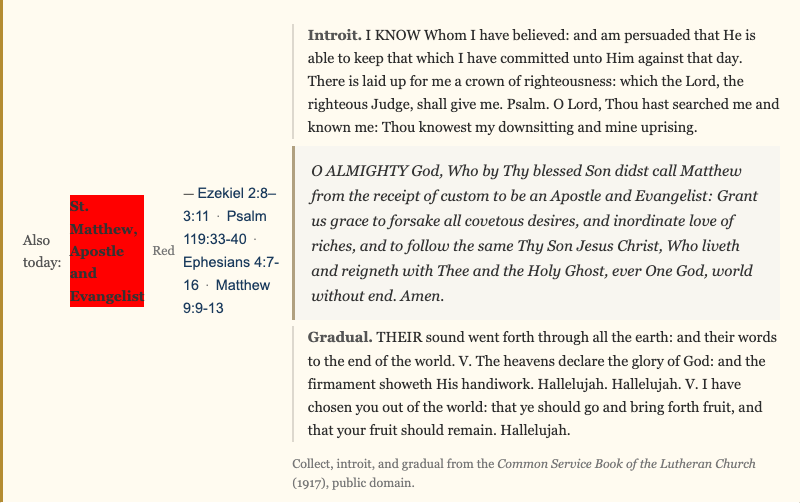
The great festivals that punctuate the year now gather, too — Reformation Day, All Saints' Day, St. Michael and All Angels, and the Day of Thanksgiving — in their own section at the foot of the propers page, each with its introit, collect, gradual, and readings.
Print it for the bulletin
There's also a new one-page Propers for the Day sheet. From any lookup, click ⬇ PDF and you get a clean, bulletin-friendly page: day, season, readings, introit, collect, gradual, Hymn of the Day, and the daily lectionary — sized for a service folder or a study handout.
A word on method
None of this was typed by hand. The texts were parsed programmatically from the 1917 source, then cross-checked three ways — every collect compared against the printed book (67 of 76 were already identical to the letter), every introit antiphon traced back to its place in the source, and the appointed psalms checked for consistency — and pinned with an automated test suite. That discipline earned its keep: the review turned up a real mix-up between the Christmas Eve, Midnight, and Dawn introits, which is now fixed. Liturgical data deserves that kind of care; a service book is no place for an educated guess.
From screen to sheet
The propers aren’t only for reading on a screen. Every Sunday and feast now prints to a clean, one-page Propers for the Day sheet — readings, introit, collect, gradual, Hymn of the Day, and the daily lectionary — in a card that mirrors the site and is color-coded to the season. Hand it to the organist, tuck it in the bulletin folder, or keep it for the files; a plainer, toner-light version is a click away for the office copier.
An old project, still going
If you've read how this began in 1997, you know the historic, one-year calendar was there from the start. Thirty years on, it finally has the full propers to go with it — free, open-source, and owing no one a license fee.
To mark the occasion, I've cut the project's first numbered release — version 1.0. If you run your own copy at home or in your parish, it now reports its version and will quietly let you know when a newer release is available.
You can use it at lectionary.collver.biz, switch to the One-Year (Historic) series, and look up any Sunday or feast.


Comments ()