
I First Wrote This Program in 1997
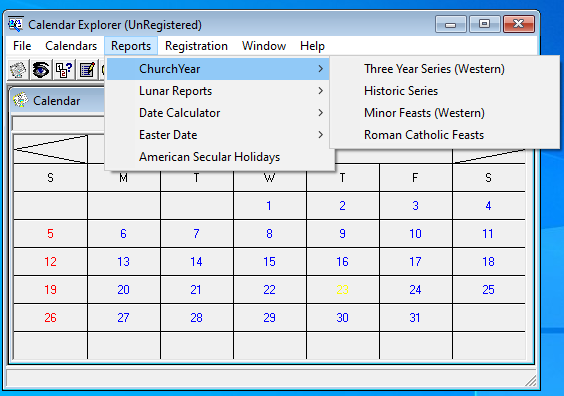
In December 1996, someone on the microsoft.public.vb.syntax newsgroup asked how to convert Julian dates in Visual Basic. I answered with the conversion algorithms, and my signature pointed to a page on my CompuServe homepage — for a shareware program I'd written called Calendar Explorer.
Thirty years later, I'm writing this because I recently realized something: the Lutheran Lectionary web app I've been building isn't a new idea. It's the same program. I just took three decades off between releases.
Calendar Explorer 1.86
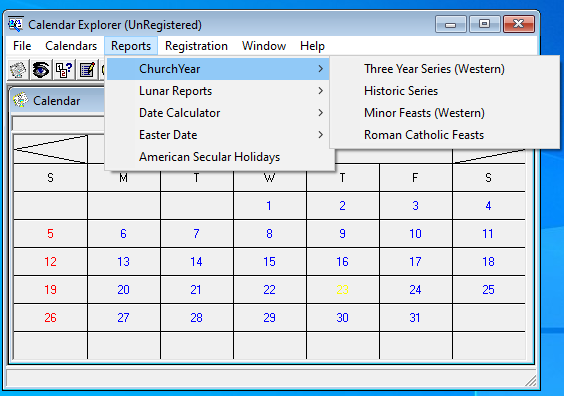
Calendar Explorer was a 32-bit Windows 95/NT program, written in Visual Basic 5, released March 24, 1997. The Internet Archive preserves the original installer — and look at that Reports menu: Three Year Series. Historic Series. Minor Feasts. Roman Catholic Feasts. Lunar reports. The date of Easter — Eastern and Western — through the centuries.
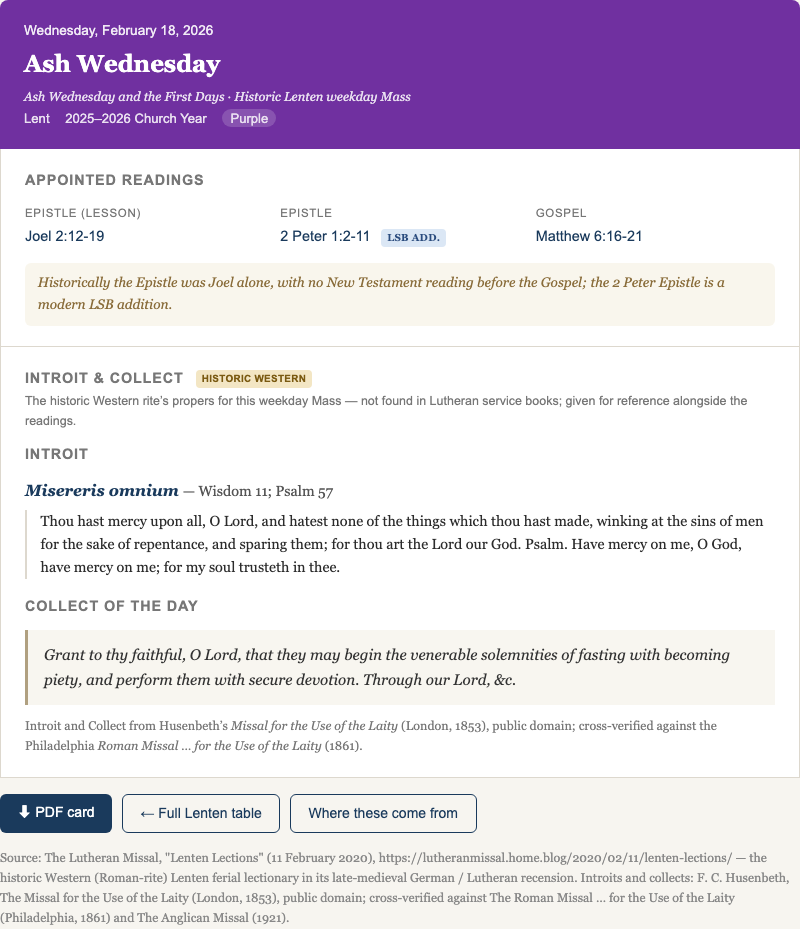
If you've used lectionary.collver.biz, that menu should look familiar. The church year data followed Lutheran Worship, the LSB's predecessor. There was a weekday finder ("when your birthday will happen on a Monday"), a Year-in-Brief view, Julian/Gregorian conversion — even conversion to the Islamic and Indian civil calendars, which the new app doesn't do. Yet.
The website, vintage 1999
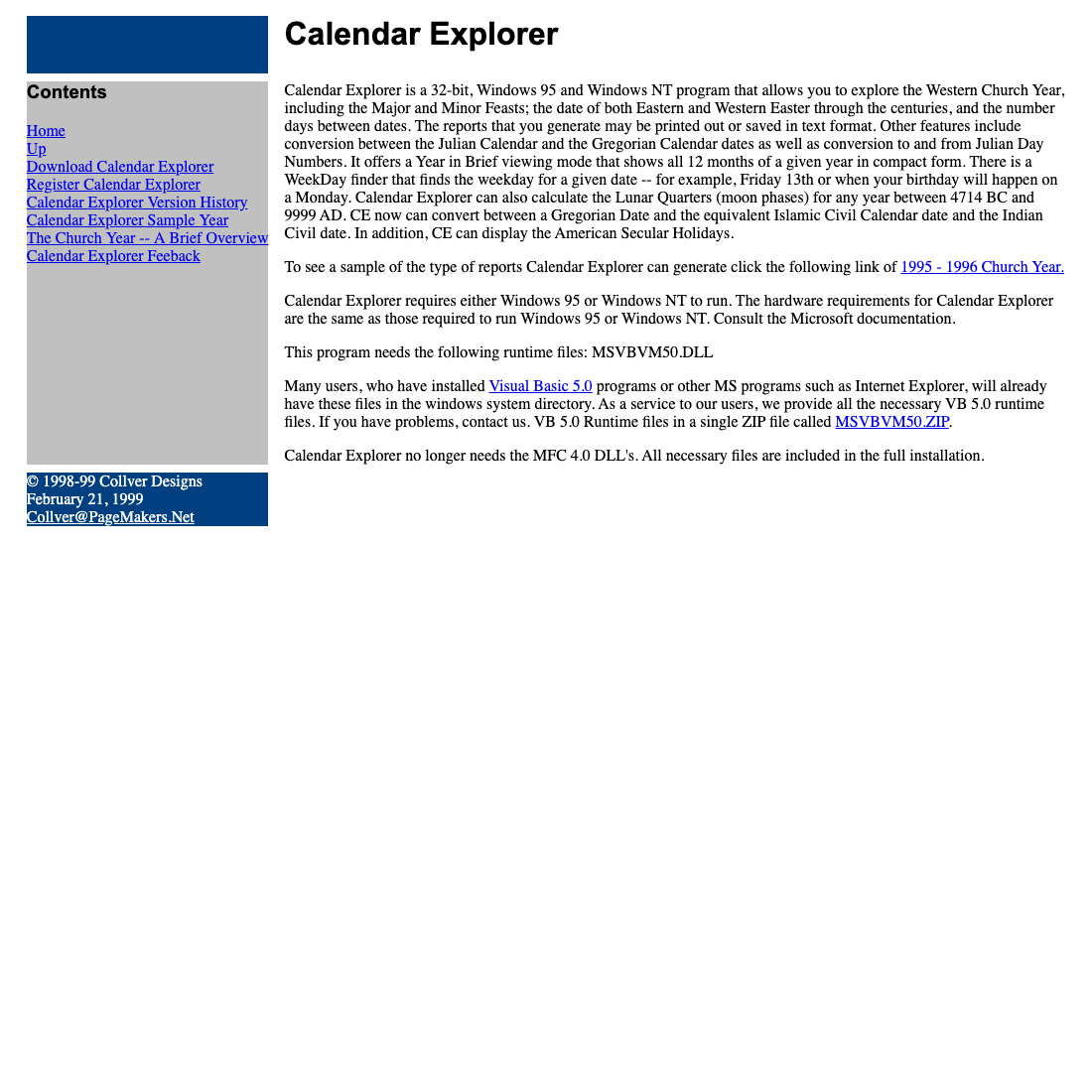
The Wayback Machine kept my old product page. Registration was $17 through CompuServe — you'd log on, type SWREG, and your CIS account was charged. By February 1999 I'd marked it down to $12. (Today's price is somewhat lower.)
And here's my favorite find — the sample output page, a church year table from 1995–96, complete with liturgical color coding:
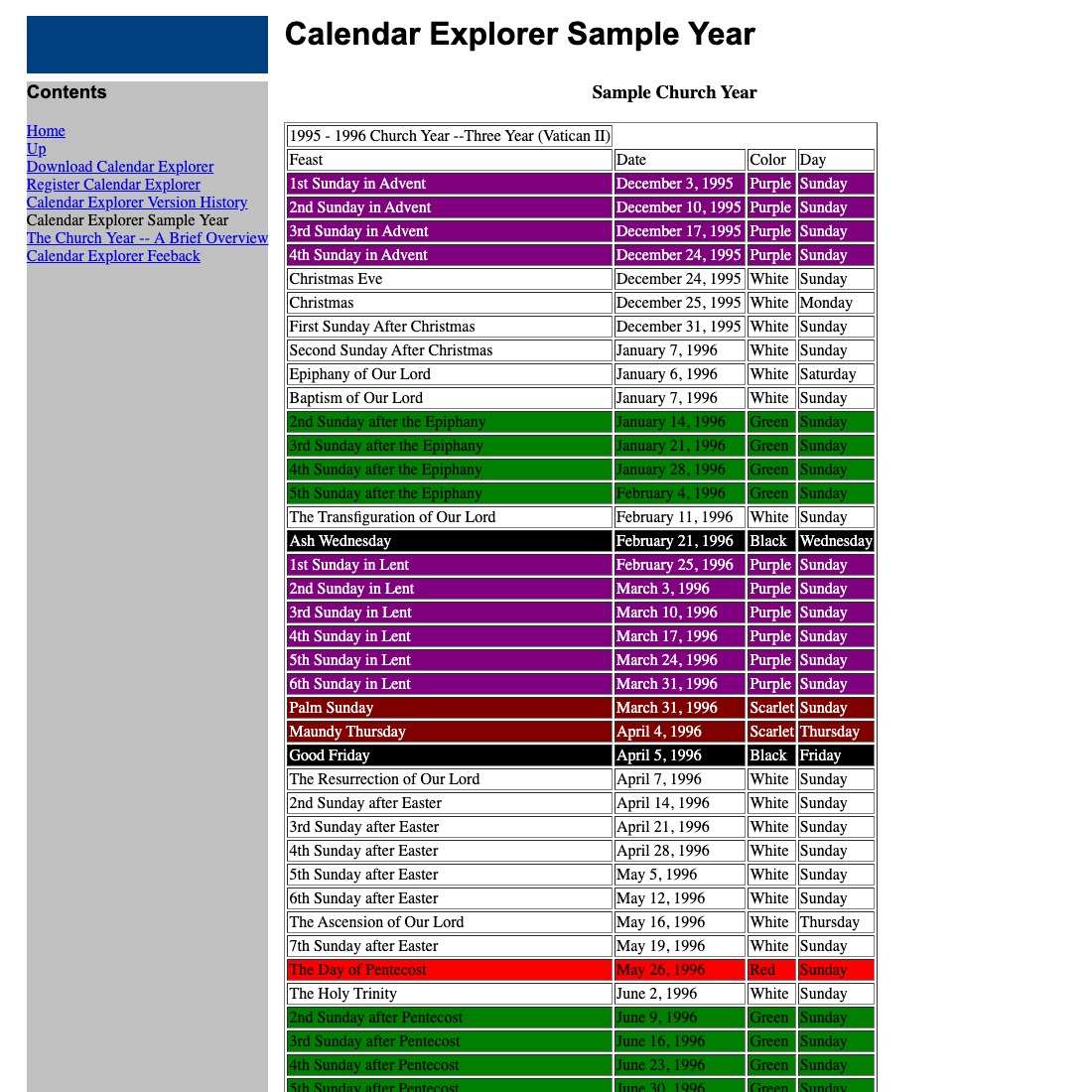
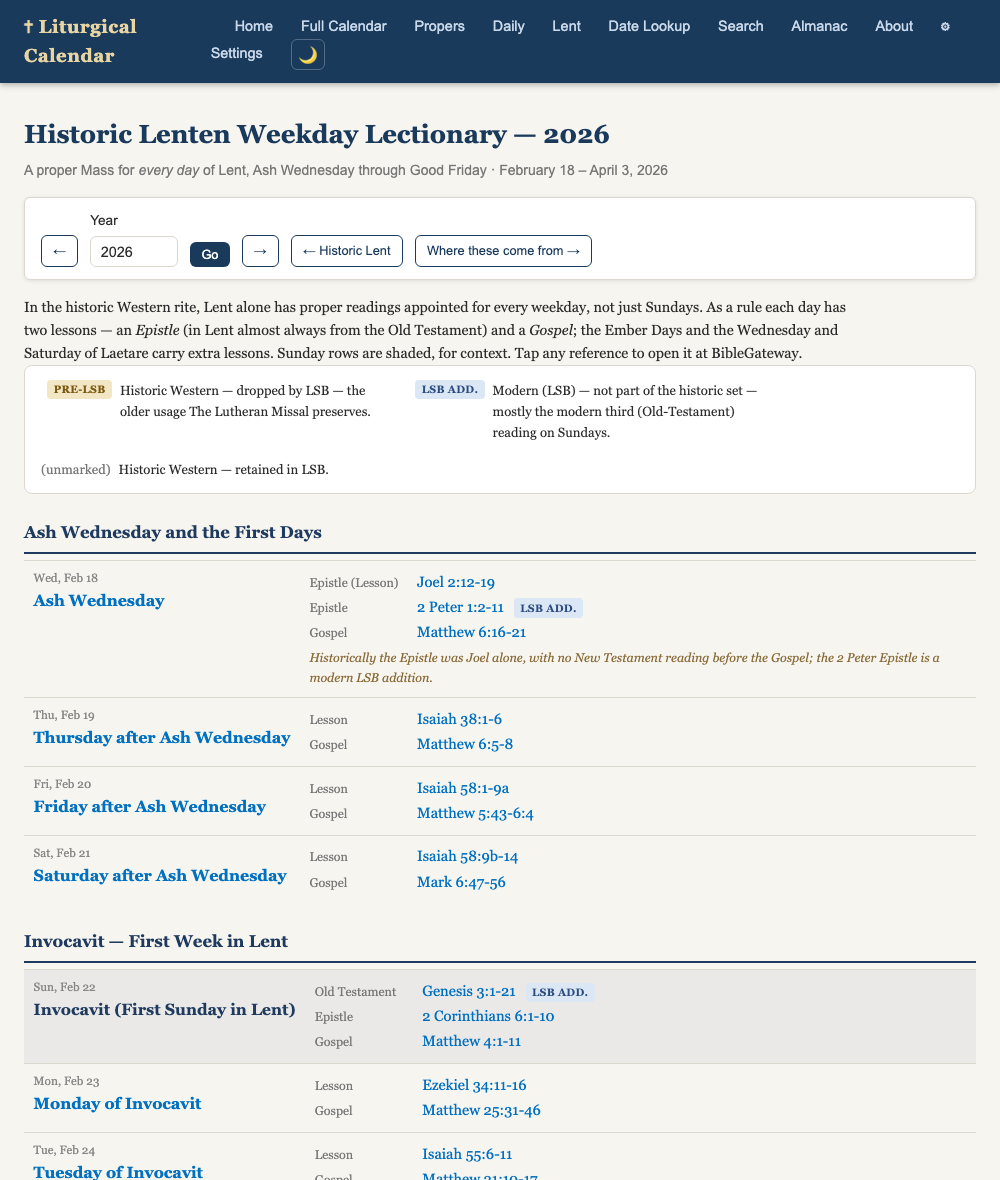
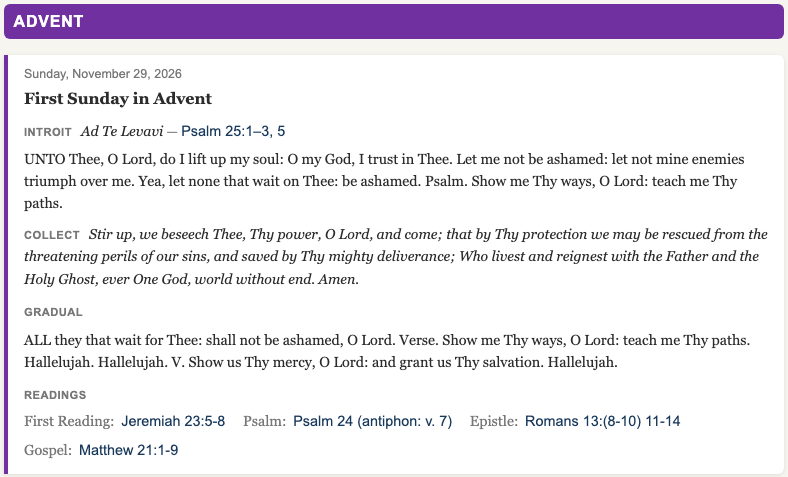
If you put that next to today's calendar page, the resemblance isn't a coincidence — it's a bloodline.
Distribution before GitHub
How did shareware travel in 1997? It rode CD-ROMs. Thanks to the wonderful Discmaster index, I can now see exactly where Calendar Explorer ended up: the PsL Monthly discs, the CICA Windows Collection, Win Heaven '95, a Spanish compilation that filed it under Negocios, a 1998 religious-shareware CD called Essential Bibles — and Monster Media #17, which moved it from the utilities folder into /religion/. Somewhere between October 1996 and January 1997, a CD curator decided a church-year calculator was religion, not utility. They weren't wrong.
Some things never change
From the version 1.62 changelog, 1996:
Fixed problem that caused the Church Year to be one week too short.
Two weeks ago, a commenter on Facebook caught the new app calling June 7 the Second Sunday after Trinity when it should have been the First — an off-by-one error in the church-year calculation, found by a user and fixed the same day. Thirty years apart, the same author wrote the same class of bug into the same calculation, and both times the church caught it. There's probably a sermon illustration in that.
What else hasn't changed: the Western computus is still the computus. The historic lectionary is still the historic lectionary. In 1996 I wrote an essay for the program's help file, The Church Year — A Brief Overview, which opened by noting that in Sense and Sensibility a character says "I will have you married by Michaelmas" — and that for a thousand years, ordinary people marked time by the feasts. That's still why this project exists.
What changed
| 1997 | 2026 | |
|---|---|---|
| Language | Visual Basic 5 | Python / Flask |
| Platform | Windows 95/NT | Any browser; Docker on anything |
| Distribution | CompuServe SWREG, shareware CDs | GitHub, docker pull |
| Price | $17 (later $12) | Free, open source (MIT) |
| Bug reports | Facebook comments and pull requests | |
| Church year data | Lutheran Worship | Lutheran Service Book |
| Roman Catholic support | In the menu | On the roadmap |
The 1997 feature list is, almost embarrassingly, the 2026 roadmap. Roman Catholic feasts were in the VB5 menus. Eastern Easter was in the VB5 menus. I'm not adding features to the Lutheran Lectionary — I'm catching up with myself.
Explore the originals: Calendar Explorer 1.86 on the Internet Archive · the 1999 site on the Wayback Machine · the modern incarnation · GitHub

Comments ()