
Unto Each One According to His Faith
Not long ago my field worker from the seminary and I conducted the service together, dividing its parts between us as pastors and seminarians have always done. We used Divine Service, Setting Four, and the opening portion fell to me, so it was I who spoke the words printed on page 203 of Lutheran Service Book: “Almighty God in His mercy has given His Son to die for you and for His sake forgives you all your sins.”1 Afterward he asked me about them. Why do we say it that way? He did not have a name for the thing he was asking about, which is itself part of the story. The older books called it the Declaration of Grace. And behind his question stood a larger conversation now running through our circles: whether the general confession and absolution belongs in the service at all, and—among those who tolerate the absolution—a certain disdain for the Declaration of Grace as something less than the real thing.
The word absolution comes from the Latin absolvere, to loose from—the same loosing Christ speaks of in John 20 and Matthew 16. A declaration comes from declarare, to make fully clear. Both words describe something done to a sinner with the forgiveness of sins: one unbinds him, the other holds the thing up to the light so he cannot miss it. The question my field worker was really asking, and the question our current arguments keep circling, is whether one of these is more the gospel than the other—whether “I forgive you all your sins” carries something that “God for Christ's sake forgives you all your sins” does not.
I want to suggest that this question has been asked before, in almost exactly our terms, and answered—in October of 1533, over the signatures of Luther, Bugenhagen, Jonas, Melanchthon, and Cruciger. And I want to tell the whole story of where these pieces of our liturgy came from, because I do not recall seeing it told entire, and because the history has a way of reversing the assumptions on both sides of the present argument. The form treated today as the weak modern substitute turns out to be the older. The form defended as the ancient heritage turns out to be a court composition of about 1580 that never stood at the beginning of any service until 1941. And the argument against letting the whole congregation hear either one turns out to be the single position in this story that the Lutheran church heard, considered, and declined—twice; and when the question stirred once more, the answer that ended the controversy was a general absolution composed in Luther's own hand.
Three Moods of One Promise
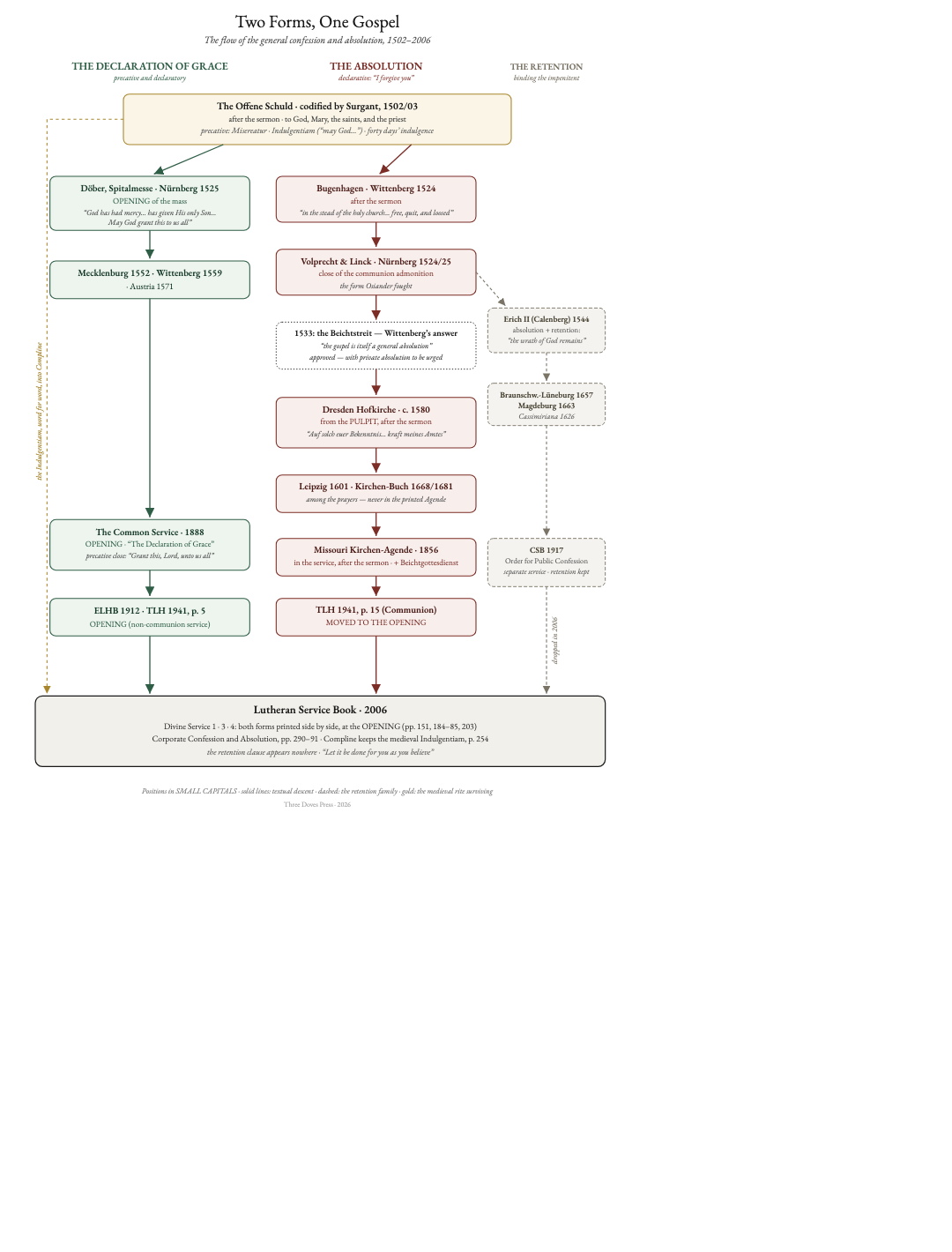
The old Explanation of the Common Service sorted the church's absolution formulas into three kinds, and the sorting is worth recovering.2 An absolution may be precative—a prayer that God would forgive, the most ancient form. It may be declarative—an announcement that God does forgive, spoken either of God (“He forgives you”) or in the first person as Christ's command runs (“I forgive you”). Or it may be indicative in the old Roman manner—“I absolve thee.” These are not three gospels. They are three grammatical moods of one promise, and the question of which mood to speak in has been answered differently, side by side, within Lutheranism from the first decade of the Reformation.
Open Lutheran Service Book and you find the moods still standing in parallel columns. In Setting Three the left column has the pastor say, “Upon this your confession, I, by virtue of my office, as a called and ordained servant of the Word, announce the grace of God unto all of you, and in the stead and by the command of my Lord Jesus Christ I forgive you all your sins.” The right column has him say, “Almighty God, our heavenly Father, has had mercy upon us and has given His only Son to die for us and for His sake forgives us all our sins. To those who believe on His name He gives power to become the children of God and has promised them His Holy Spirit. He that believes and is baptized shall be saved. Grant this, Lord, unto us all.”3 Settings One and Four print the same alternatives in their own words. The book takes no side. The people arguing that it should are asking the church to decide something she has deliberately, for five centuries, left both-and.
The Medieval Inheritance
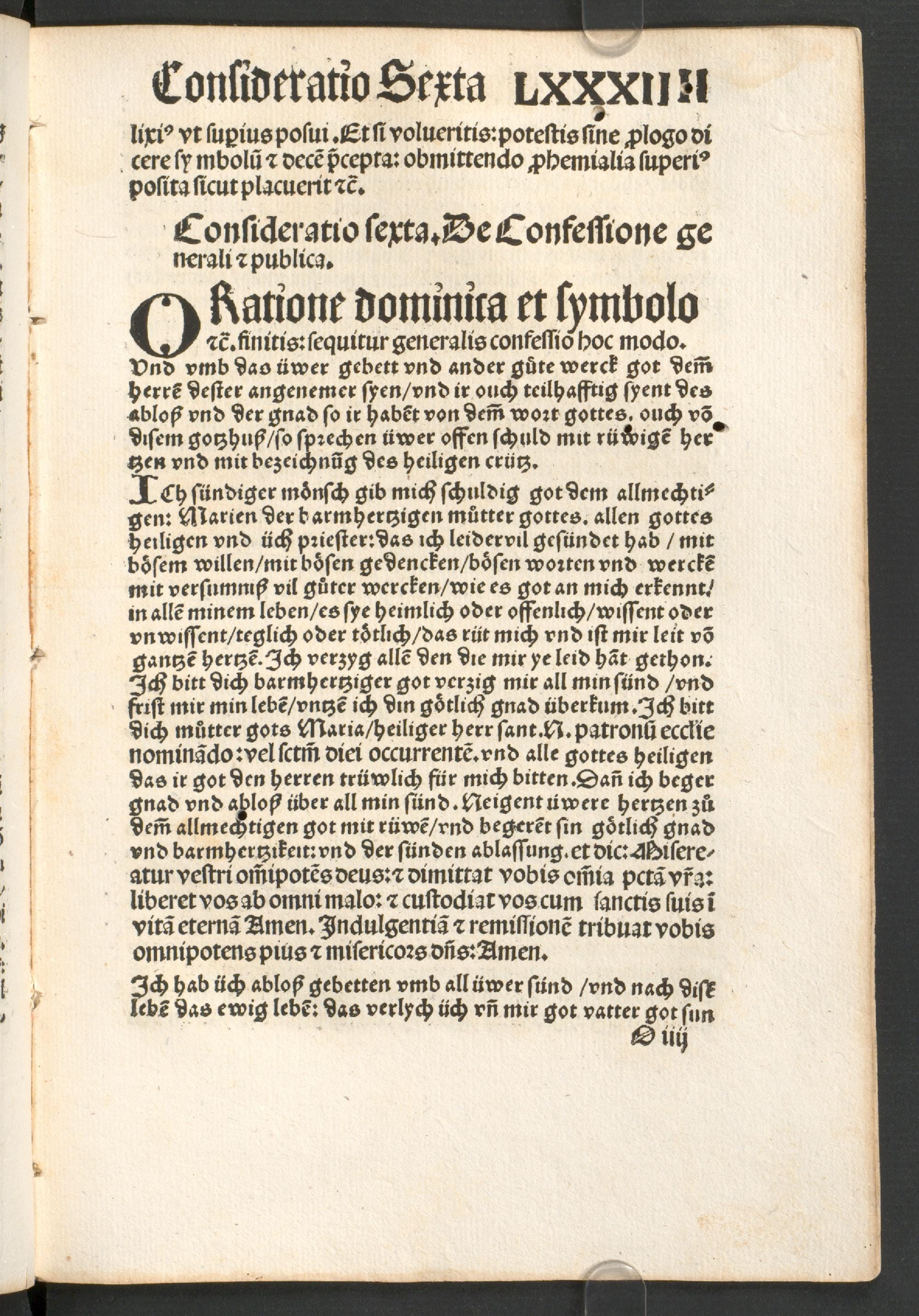
To see what kind of thing the general confession is, one must first see what the Reformation received. The medieval church of the German lands had, besides the priest's private Confiteor at the altar steps, a vernacular rite the people knew by heart: the Offene Schuld, the “open confession,” spoken after the sermon in the vernacular preaching office set within the Mass. The Basel preacher Johann Ulrich Surgant codified the usage in his handbook for parish priests of 1502, and his chapter “On the general and public confession” lets us hear the rite exactly as the generation before the Reformation heard it.4
The people, repeating after the priest, confessed “to God the Almighty, to Mary the merciful mother of God, to all God's saints, and to you, priest”—in the fuller form, “to you, priest, in the stead of God”—itemizing their sins by the five senses and the Ten Commandments, and asking Mary, the patron saint of the parish, and all the saints to intercede for them.5
What followed was not an absolution in our sense at all. The priest bade the people bow their hearts to God and then spoke the old Latin prayers of the Mass—Misereatur and Indulgentiam: may almighty God have mercy on you and remit your sins; may the almighty and merciful Lord grant you pardon and remission. And then, in German, he told them plainly what he had just done: “I have prayed pardon for you for all your sins”—or, in the shorter form, “I have wished you grace and pardon.” Then, where the day allowed it, he proclaimed forty days' indulgence to all who had heard the sermon.6 Over the gathered congregation the medieval church dared to speak only a wish. The precative mood is therefore not the late, weak form of the general absolution. It is the oldest form there is.
And it is still in our book. Open Compline in Lutheran Service Book and the congregation confesses “to God Almighty, before the whole company of heaven and to you, my brothers and sisters,” and hears in reply: “The almighty and merciful Lord grant you pardon, forgiveness, and remission of all your sins.”7 That is the Indulgentiam, translated whole—and in that rite the congregation speaks it over the pastor as well. Whoever disdains the precative form as a lesser gospel has, without quite noticing, disdained the oldest general absolution formula the Western church possesses, which our own hymnal gives God's people to pray over one another every night.
The Older of the Two Forms
Here is the first reversal. The Declaration of Grace—the form my field worker puzzled over, the form now sometimes waved away as a soft substitute for real absolution—is the older of the two by more than half a century.
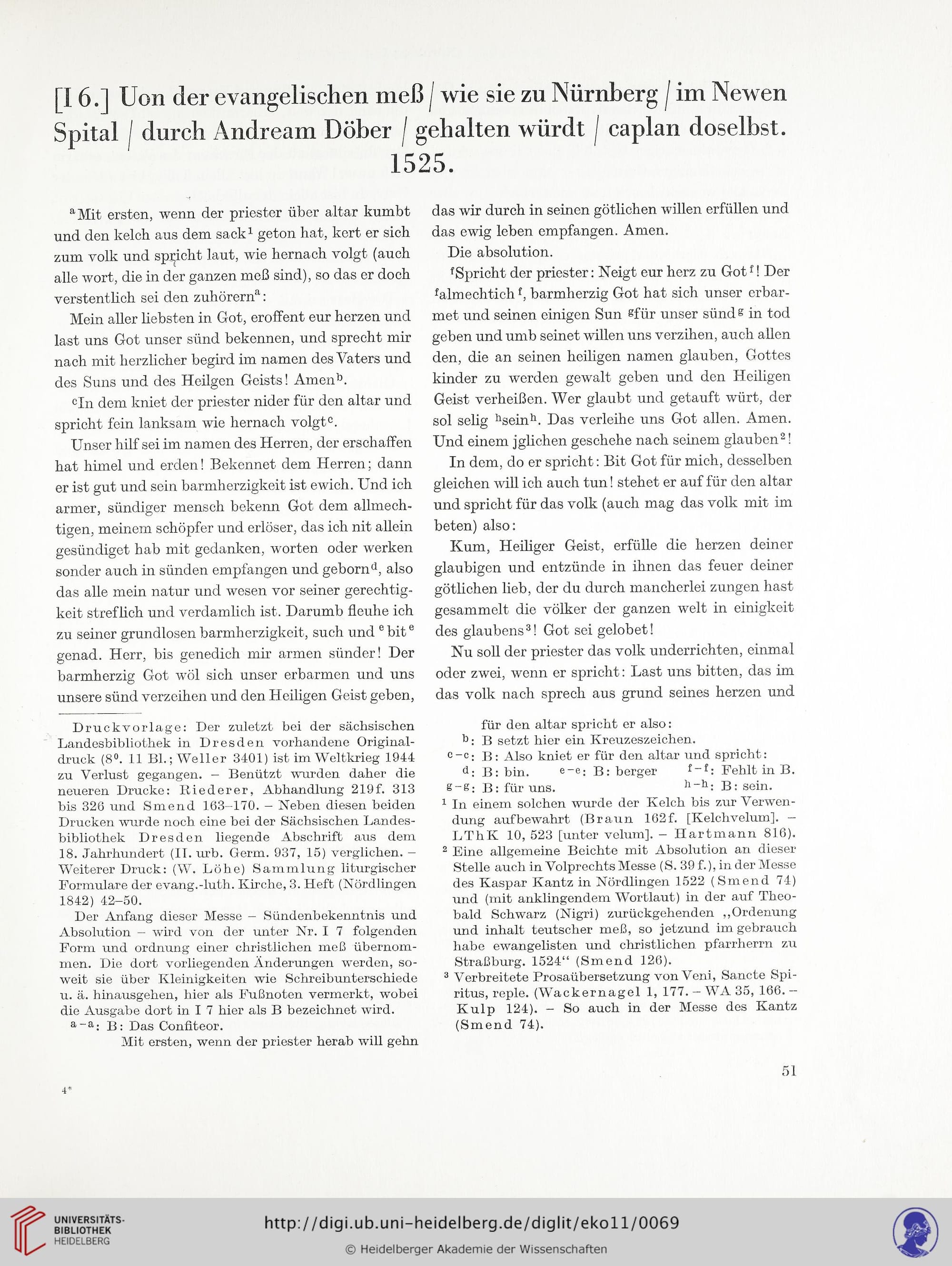
In 1525, a chaplain named Andreas Döber prepared a German evangelical mass for the church of the New Hospital in Nürnberg.8 It opens, before anything else, with the priest facing the people: “My dearly beloved in God, open your hearts and let us confess our sins to God.” Then, kneeling before the altar: “Our help is in the name of the Lord, who made heaven and earth.” Then a confession—“I, poor sinful man, confess to God the Almighty, my Maker and Redeemer, that I have not only sinned in thoughts, words, or deeds, but am conceived and born in sin, so that all my nature and being is culpable and damnable before His righteousness. Therefore I flee to His bottomless mercy, seeking and praying for grace. Lord, be merciful to me, a poor sinner.”9 And then this:
The absolution. The priest says: Bow your hearts to God. The almighty, merciful God has had mercy upon us and given His only Son into death for our sins, and for His sake has pardoned us, and to all who believe on His holy name has given power to become the children of God, and has promised them the Holy Spirit. He that believes and is baptized shall be saved. May God grant this to us all. Amen. And unto each one be it according to his faith.10
If that sounds familiar, it should. It is the Declaration of Grace, nearly word for word, four hundred and eighty years before Lutheran Service Book—and it is the skeleton of Setting Four itself, from “Our help is in the name of the Lord” to “God, be merciful to me, a sinner” to “Almighty God in His mercy has given His Son to die for you.”11 The rite my field worker met on page 203 is, piece for piece, the Nürnberg hospital mass of 1525. When we speak the Declaration of Grace we are not speaking a twentieth-century dilution. We are speaking the oldest surviving form of the Lutheran general absolution, composed while Luther was still two years away from writing the Small Catechism.
Was it the gospel? Its own last line answers the question the way Scripture does: “unto each one be it according to his faith”—the words of Christ to the centurion. The promise is proclaimed to all; faith receives it; unbelief receives nothing though the words wash over it. Keep that line in mind. It is the whole theology of the matter in eleven words, and it was there from the beginning.
Set Döber's rite beside Surgant's and you can watch the Reformation happen in a single page. Mary, the saints, and the priest vanish from the address: the confession is to “God the Almighty, my Maker and Redeemer,” alone. The itemized sins of sense and commandment give way to the one condition beneath them all—“conceived and born in sin.” The indulgence is amputated without replacement. And the wish becomes a proclamation: not may God have mercy, but God has had mercy, has given His Son, has pardoned—anchored no longer in the church's treasury but in John 1:12 and Mark 16:16. Yet the old body is everywhere: even the gesture survived the surgery, for Surgant's “Bow your hearts to almighty God” is Döber's “Bow your hearts to God,” word for word.12 The Declaration of Grace, in short, is not a modern softening of the absolution. It is the medieval Offene Schuld converted to the gospel—the oldest prayer of the German congregation, given a new heart.
The Argument Is Older Than We Are
Nürnberg had a second form as well. Attached to the end of the communion exhortation—an exhortation composed, as it happens, by Andreas Osiander—stood an Offene Schuld, an “open confession,” whose absolution was written by Wenzel Linck: “… I loose you, in the stead of the holy Christian church and by the command and promise of our Lord Jesus Christ, when He said, `Whosesoever sins ye remit, they are remitted unto them,' from all your sins, in the name of the Father and of the Son and of the Holy Spirit.”13 There is our other track: the declarative absolution, spoken over the whole congregation, in the stead and by the command. Both tracks, please note, in the same city, in the same years—1524 and 1525. In Wittenberg itself, Bugenhagen's order of 1524 already had the pastor say after the sermon: “The almighty merciful God forgive you your sins, and I, by the command of our Lord Jesus Christ, in the stead of the holy church, pronounce you free, quit, and loosed of all your sins.”14
And then someone decided the people should not have it. In 1533 Osiander, with Brenz, prepared the great Brandenburg-Nürnberg church order and quietly omitted the general absolution. His reasons, preserved in his sermons and in a long apologia of that September, will sound contemporary. A mixed crowd—and every congregation is a mixed crowd—contains hypocrites, impenitents, the self-secure. To absolve such a body wholesale is to speak forgiveness over people who have no claim on it. It devalues private confession, which withers in its shadow. It puts consciences to sleep. The old church, he insisted, knew nothing of the sort.15 And beneath all of these lay his sharpest argument, and it was quarried from Luther himself. Nürnberg's formula was conditional. It asked the worshippers to humble themselves, repent, and forgive their neighbors, and then it said, in effect: if you do that, then I loose you. But Luther, in The Keys of 1530, had condemned the pope's absolution on exactly that ground—it had become a conditionalis clavis, a conditional, vacillating key, the erring key, which does not say candidly “I most certainly loose you,” but only “if you are repentant and pious, I loose you; if not, then I fail.” Osiander laid Luther's page beside Nürnberg's formula and asked how the one could tolerate the other.16 If you have followed the current discussion in our synod, you have heard every one of these arguments within the last year, usually offered as fresh discoveries.
The laity of Nürnberg complained, and the council put the question to Wittenberg directly: does the general absolution do more harm than good? Luther and Melanchthon answered that April that it should stand, and the council ordered the rite restored. Osiander fought on—four defiant sermons by August, the long apologia in September—so the matter went back to Wittenberg, and the fuller answer came on October 8, 1533, in a letter signed by Luther, Bugenhagen, Jonas, Melanchthon, and Cruciger. It deserves to be far better known than it is.17
The faculty conceded Osiander's best point before answering it. “It is true, what Osiander says: the conscience does not struggle in general over whether God is merciful, but concerning the person—whether God will be gracious to me.”18 Precisely because that is true, they said, the general promise must not be silenced but applied: the preaching and promises of the gospel “are general speech, yet each one should mark that they are universal, and should not exclude himself from them, but take them to himself as his own and particular word, since God alone has commanded that His promise be believed.”19 And then the sentence on which everything turns: “Thus the gospel is itself a general absolution; for it is a promise which all, and each one in particular, are to take to themselves by God's command.” The general absolution is legitimate because it does what the gospel itself does—and your form, they told Nürnberg, “is framed for exactly such a reminder.”20
To the objection about the unworthy crowd they gave two answers that our present discussion has largely forgotten. First: preaching and jurisdiction are two different things. The binding key belongs to public sins and public discipline; secret sins can only be bound and loosed “in general, through the preaching office”—which the sermon does every Sunday whether or not a formula follows it.21 Second: every absolution, private as well as general, “has the condition of faith; for without faith it does not loose—and it is not on that account a faulty key. For faith does not build on our worthiness, but amounts only to this: that one accepts the absolution and says Yes to it.”22 The absolution needs no gatekeeper at the door. The condition of faith does the discriminating, infallibly, in every pew—exactly as Döber's closing line had said eight years earlier.
One more feature of the 1533 settlement matters, and I will return to it: it had two clauses. The general absolution was approved—and both parties were directed to keep urging the people toward private absolution.23 The concession and the condition were a package.
The settlement held for eighteen months, and then it did not. In August 1536 Osiander preached against the rite again, and pressed the argument about the formula to its point: the absolver who utters a condition “still does not know if he binds or looses, indeed he does not know if he does anything or only pretends”—and how are distressed souls to be comforted by such sleight of hand?24 This time the doubt was not confined to one pulpit. The magistrates sent the sermon for evaluation to Veit Dietrich, the Nürnberg-born preacher of St. Sebald who had been Luther's own secretary and had lived in his house for years; and Dietrich, though he rejected much else in it, conceded the sermon's central point—“it is surely plausible that the minister does not know what he does, who says that he absolves and yet adds a condition”—and advised the city's preachers to fall back on the church order of 1533, which had no general absolution at all.25 Wittenberg still did not yield the rite. Writing to the council again that November, the theologians planted the flag where it had stood since April 1533—forgiveness of sins comes “not only through private absolution, but also when the heart receives right faith and comfort from the common preaching,” and “on this article stands the sum and ground of this quarrel”—and promised a fuller judgment by their own messenger.26
The promised judgment never arrived as a judgment. What arrived instead, in February 1540, ended the controversy in a better way. The Nürnbergers had proposed a revised formula; Melanchthon told Dietrich it pleased neither him nor Luther. Melanchthon then drafted one himself and judged it a failure—he showed it to Luther, who “reprehended its prolixity”—and asked Luther to compose the form; Luther promised. On February 15 Melanchthon sent the result south: “I send you Luther's autograph, in which is a form of absolution, which you may use if you will.” The autograph survives in the Nürnberg city library, and the whole of it is four sentences:27
Dear friends: since we are all mortal, and sure of no hour of death, humble yourselves before God and confess in your hearts that we are all poor sinners, in need of his grace and forgiveness every moment. And should God today or tomorrow summon anyone among you out of this vale of tears, then I, as a pastor and preacher, by his command declare all who are now here and hear God's word, and who with true repentance for their sins believe on our Lord Jesus Christ, loosed from all sins, in the name of the Father, the Son, and the Holy Spirit. Amen. Go forth in peace, whether it be to live or to die.28
Mark what is not there. There is no if. Osiander's best textual point—that “if you do that, then I loose you” is the erring key in evangelical dress—is quietly granted: the if-then is expunged, and the condition is spoken into the address instead. Luther absolves “all who are now here and hear God's word, and who with true repentance for their sins believe on our Lord Jesus Christ”—which is the 1533 opinion turned into liturgy. Every absolution “has the condition of faith”; so the formula names the faithful rather than bargaining with them.29 The warrant is Bugenhagen's of 1524: “as a pastor and preacher, by his command.” And the rite is not surrendered by an inch. It is a corporate absolution, first person, declarative, spoken over the whole assembly, composed by the man whose theology Osiander had claimed for its abolition. Whether Osiander ever saw it we do not know; neither 1540 formula appears ever to have been used in Nürnberg's services, and the old exhortation with Linck's conclusion went on being spoken.30 But no one in Wittenberg wrote about the matter again. The answer to the third stirring of the question was not a treatise. It was an absolution.
The general absolution outlived Osiander in Nürnberg's books into the 1590s, and a Nürnberg boy named Friedrich Lochner—later the Missouri Synod's teacher of liturgics—could still write in 1895 of hearing that very exhortation with that very conclusion “in the churches of Nürnberg” in his youth.31
Where “Upon This Your Confession” Actually Comes From
Now the second reversal. The declarative formula we prize as the old Lutheran inheritance—“Upon this your confession, I, by virtue of my office…”—is real, and Saxon, and venerable. But it is not, as folklore has it, simply “the historic liturgy.” Its birthplace was the electoral court chapel at Dresden, around 1580, and we know how it got there: the court preachers agreed on a formula and submitted it to Elector August, who introduced the general confession by his own personal intervention.32 It was an offene Beichte und Absolution auf der Kanzel—spoken from the pulpit, after the sermon, in the old medieval position—and from the Dresden court it spread; Leipzig adopted it in 1601. Sehling prints the text, and every Missourian will recognize it at sight:
Upon this your confession I announce to you, by virtue of my office, as a called and ordained servant of the Word, the grace of God, and forgive you, in the stead and by the command of my Lord Jesus Christ, all your sins, in the name of God the Father, the Son, and the Holy Spirit. Amen.33
Here is a detail I have not seen in print anywhere: this formula never entered the printed Saxon agenda. I have now read the Agenda of Duke Henry in its reprints of 1647, 1658, and 1672, page by page, and in all of them the order after the sermon runs directly from the paraphrase of the Our Father to the Words of Institution—no corporate confession at all, exactly as in 1539.34 The formula traveled instead in the Leipzig Vollständiges Kirchen-Buch, whose title page lists “the ordinary church prayers, that is, the general confession” as its own section, separate from the agenda.35 Sunday by Sunday all Saxony prayed it; the official agenda never printed it. It was our own Missouri Synod, compiling its Kirchen-Agende of 1856 “from the old orthodox Saxon church agendas,” that first fused the Dresden pulpit confession into the order of service itself—after the sermon, where Saxony had always spoken it.36
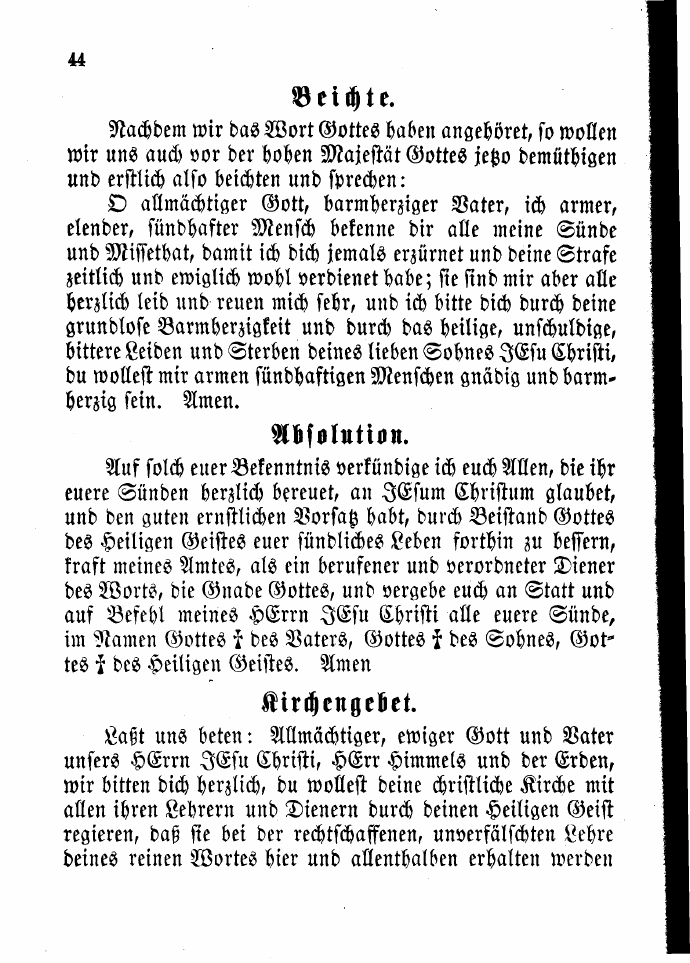
Why did the Saxon fathers care so much about this particular formula? Because they had bled for it. In 1812 the rationalist court in Dresden issued a new agenda that changed “I forgive you all your sins” to “I declare unto you the forgiveness of your sins”—softened it, made the pastor a commentator rather than Christ's mouth. Pastor Ernst Moritz Bürger kept using the old words, was denounced to the consistory, summoned, and finally—“O shame,” he wrote in his memoirs—signed a pledge to conform.37 He carried that shame to Missouri in 1839. When the Saxon immigrants restored “Auf solch euer Bekenntnis” in 1856, they were not making a liturgical preference. They were confessing. That is worth honoring—and worth stating precisely: what the 1812 rationalists attacked was not the Declaration of Grace, which proclaims that God forgives for Christ's sake. They attacked the office—the I that speaks in Christ's stead. Döber's form and Bürger's form fall on the same side of that line, against the same enemy.
And the arrangement we now know as simply “the liturgy”—confession and declarative absolution at the head of the Sunday service? That is 1941. The Common Service of 1888 had put a confession at the beginning, but with the Declaration of Grace, deliberately precative at its close, on the pattern of Döber's line through Mecklenburg. Missouri's first English hymnal of 1912 carried it unchanged.38 It was The Lutheran Hymnal that split the difference: the non-communion service kept the Common Service's forms, while the Communion service received the Saxon confessional service—“O almighty God, merciful Father, I, a poor, miserable sinner” with “Upon this your confession”—transplanted from the dying Saturday Beichtgottesdienst into the opening of the Sunday service.39 A pastoral decision, and I think a defensible one: as the old confessional service and the practice of announcing for Communion collapsed, the church moved the pre-communion confession inside the service rather than lose it. But let us be clear about what that means. The combination we are tempted to defend as ancient—Saxon formula, opening position—existed in no sixteenth-century rite anywhere. It is not yet a century old.
What the Tradition Did about the Unworthy
If the worry is that the impenitent will hear themselves absolved, it should be said plainly: the Lutheran tradition took that worry seriously, and it had an answer—an answer that was not silence.
Some church orders bound as well as loosed. The Calenberg order of 1544 followed its general absolution with a warning that over those who do not confess from the heart “the wrath of God remains.”40 The Coburg order edited by Johann Gerhard spoke it fully: “But on the contrary I say, on the basis of God's Word and in the name of Jesus Christ, to all unrepentant and unbelieving persons… that God has retained your sins and certainly will punish you.”41 Braunschweig-Lüneburg, Magdeburg, Pomerania carried similar clauses. And this retention crossed the Atlantic: the Common Service Book of 1917, in its Order for Public Confession, still had the pastor declare “unto the impenitent and unbelieving, that so long as they continue in their impenitence, God hath not forgiven their sins.”42 The Saxon line, notably, never included the clause—consistent with Wittenberg's rule that binding belongs to public sins—and Lutheran Service Book has dropped it everywhere. It is worth noticing how over-determined that outcome was. Whichever inheritance Missouri drew on—the Saxon agenda of 1856 or the Common Service that our first English hymnal took over whole in 1912—the Sunday absolution came retention-free; the binding key lived only in the separate confessional orders, and it died with them.43 Whether that quiet abandonment of the binding key was wise is a fair question for another essay. But notice what the retention tradition proves: when Lutherans feared for the impenitent in the pews, their remedy was to add a word of law beside the word of gospel—never to suppress the gospel. The option of silencing the absolution so that the unworthy might not hear it was proposed in our history by Osiander—seconded for a season, as we saw, by no less a man than Veit Dietrich—and it lost.
Lutheran Service Book's own Corporate Confession and Absolution keeps the better safeguard. Before the absolution the pastor asks—as Saxon pastors have asked since the sixteenth century—“Do you believe that the forgiveness I speak is not my forgiveness but God's?” The penitents answer yes, and the pastor replies in the very words of Matthew 8: “Let it be done for you as you believe.”44 There is Döber's closing line again, alive in our own book. The rite has always carried its own answer to the question of the unworthy.
The Diagnosis, and the Better Remedy
So what is actually driving the present unease? Let me venture the diagnosis charitably. I do not believe most of those who argue against the general confession and absolution, or who disdain the Declaration of Grace, want to starve anyone of the gospel. I believe they have looked out at a congregation and worried, as Osiander worried, that grace announced to everyone lands seriously on no one—that a three-minute rite at the warm-up of the service has been made to carry the entire weight of sin and forgiveness. And on that narrower point they are not wrong, and they are in surprising company. Eugene Brand, the architect of the Lutheran Book of Worship—no ally of our confessional wing—said it at the Common Service's centenary in 1988: in most congregations, to omit the general confession “would mean no confession at all,” and even the absolving power of preaching and sacrament “can remain personally unappropriated by the distressed believer.”45 Personally unappropriated. That is Osiander's concern, conceded across every party line in American Lutheranism, and it was Wittenberg's concern too—it is why their 1533 answer had two clauses.
It is worth remembering who Osiander became. Twenty years after Nürnberg he tore Lutheranism apart again, teaching that the sinner's righteousness is not Christ's obedience credited to him but Christ's divine nature dwelling within him—a righteousness in us rather than a verdict over us—and he insisted, under his own name, that he had taught the same doctrine for thirty years, which reaches back past 1533.46 The two quarrels are one theology seen from two sides: if forgiveness is a substance conferred on the fit, then the absolution must be guarded, examined, restricted; if it is a promise proclaimed, it can be published to every sinner and received by faith. The Formula of Concord answered the second quarrel the way the Wittenberg faculty had answered the first.47 Those today who would exalt private absolution by silencing the general one are not reviving a stricter Lutheranism. They are, perhaps unknowingly, reviving the spirit of Osiander—and the church has already answered him, twice, with one and the same gospel.
It is worth watching how Wittenberg handled the man while refusing the doctrine. On the same October day in 1533 that the faculty answered the council, Luther wrote two private letters. To Osiander: hold your opinion at home if you must, keep the dispute out of the pulpit, and do not begrudge others the public absolution; no one will force you to use it. To Linck, the author of the contested formula: bear Osiander as a man “captive to his own opinions, like a sick man”; aim not at “how he may be publicly confounded and condemned” but “that the soul of this brother be won through you”—and show this letter to no one, “except Spengler.”48 The verdict was unbending, and the brother was spared. Whoever undertakes to answer the spirit of Osiander today is bound, I think, to both halves of that example.
There is, however, a harder word that must be said, and I say it as much to myself as to anyone. A desire to protect the gospel, followed to its end, becomes a desire to withhold the gospel from people deemed unworthy of it—deemed unworthy, that is, by someone other than Jesus. And a desire to protect the gospel is finally a desire to protect Jesus. We have seen that trap before, and we have seen where it stands: in the sixteenth chapter of Matthew, three verses after Christ gives Peter the keys—the very keys whose use we have been discussing—the Lord announces that He must go to Jerusalem and suffer many things and be killed and on the third day be raised, and Peter takes Him aside: far be it from You, Lord; this shall never happen to You.49 Peter meant it protectively, and he heard the answer every would-be protector of Christ must hear: get behind Me, Satan; you are not setting your mind on the things of God. Jesus does not need our protection, and neither does His gospel. It was not protected on Good Friday; it was poured out—over a crowd that included the man who had denied Him and the men who had nailed Him there: “Father, forgive them.”50 The keys were given to be used, not guarded. The absolution is not endangered by the unworthy who hear it. It is endangered by stewards who will not speak it.
But the remedy follows from the diagnosis, and it is not amputation. If the general word has been made to do the particular word's work, the Lutheran correction is to restore the particular word—private confession and absolution, the practice our Confessions say it would be wicked to let fall—not to silence the general one.51 That was Löhe's path at Neuendettelsau, where he reintroduced private confession and found the church full of penitents the first Saturday.52 It was our synod's founding commitment: the 1847 constitution binds pastors, where private confession is not in use, “to strive towards introducing it.”53 Wittenberg's settlement only works whole. For two centuries Lutheranism kept the concession and dropped the condition; the answer is not now to drop the concession as well, leaving nothing.
As for the claim that one form of the gospel is superior to another—that the Declaration of Grace is somehow less than “I forgive you”—the history gives the answer and the theology confirms it. The Declaration is the older form, composed in 1525, blessed by transmission through Mecklenburg and Wittenberg and Austria into the Common Service. The declarative formula is the court form of 1580, carried to us in the blood of the Saxon confessors of 1812. Both proclaim the identical thing: that for the sake of the death of Jesus Christ, God forgives sinners—this sinner. One holds the promise up to the light; the other presses it into the hand. The church has never had to choose between them, and the pastor who speaks either is not offering a better or worse gospel but the one gospel in one of its lawful moods. What makes any of them “effective” is not the mood of the verb. It is the promise of Christ and the faith that says Amen to it—“for faith does not build on our worthiness, but amounts only to this: that one accepts the absolution and says Yes to it.”
That afternoon I gave my field worker the short answer, from memory: that the public confession and absolution appeared in Nürnberg around 1525; that it is no modern innovation; and that it is the gospel, spoken and received by faith. Then I went to the sources to see whether my memory had told him the truth. This essay is what I found, and the memory held—and more than held. If the essay carries a warning, it is this: we must not let the desire to protect the gospel revive the spirit of Osiander among us, for the gospel is not ours to guard from sinners. It is ours to speak to them. The words I spoke over him and the congregation that morning have been doing their work since a hospital chaplain first spoke them over the sick of Nürnberg in 1525, and the argument against them has been losing since 1533—not because the worriers were wicked, but because the church kept concluding that the gospel is not meant to be protected. The gospel is intended to be received by faith—to be believed and trusted in as God's word for me. The last time Luther set his hand to the question, he did not write another opinion; he wrote an absolution for a congregation of mortals, and closed it with a blessing wide enough for every pew and every deathbed: “Go forth in peace, whether it be to live or to die.” And unto each one be it according to his faith.
Documents. This essay is available as a typeset PDF from Three Doves Press: Unto Each One According to His Faith (23 pp., with full apparatus and works cited). The four Wittenberg letters and Luther’s 1540 absolution formula are published complete, German text facing English translation, as The Wittenberg Opinions on the Nürnberg Absolution Controversy, 1533–1540 (12 pp.).
The Rev. Albert B. Collver III, Ph.D., is pastor of St. Paul's Lutheran Church, Troy, Illinois. He has served The Lutheran Church—Missouri Synod as director of Church Relations and assistant to the President, and served as executive secretary of the International Lutheran Council. A graduate of Concordia Seminary, Saint Louis (Ph.D.), he is the author of the forthcoming Missouri at the Crossroads, hosts the podcast Thursdays at Bad Boll, and writes at news.collver.biz.
Notes
- Lutheran Service Book (St. Louis: Concordia Publishing House, 2006), 203. Quotations from Lutheran Service Book are brief and made for purposes of comment and criticism; the rites are © 2006 Concordia Publishing House. ↩
- An Explanation of the Common Service, 2nd ed. (Philadelphia: General Council Publication House, 1908), 24–25: the close of the Declaration of Grace “resolve[s] what precedes into a prayer for the forgiveness of the confessing penitent, which was the earliest form of the Absolution (precative). The form in the Order of Public Confession is declarative (`I declare unto you,' etc.). The form used in the Roman Church is indicative (`I absolve thee').” ↩
- Lutheran Service Book, 184–85; the same two tracks, in different words, at 151 (Setting One) and 203 (Setting Four). ↩
- Johann Ulrich Surgant, Manuale curatorum predicandi (Basel: Michael Furter, 1503), lib. II, cons. 6 (“De confessione generali & publica”), fol. LXXXIIII recto–verso; exemplar Zentralbibliothek Zürich, digitized at e-rara (DOI 10.3931/e-rara-41453). On the Offene Schuld in the medieval preaching office generally, see Sehling 11:39 n. 6, with the literature there cited. ↩
- Surgant, fol. LXXXIIII: “Ich sündiger mönsch gib mich schuldig got dem allmechtigen: Marien der barmhertzigen mütter gottes, allen gottes heiligen und üch priester: das ich leider vil gesündet hab…”; the longer form, fol. LXXXIIII verso: “… und üch priester an der statt gottes.” ↩
- Surgant, fol. LXXXIIII: “Misereatur vestri omnipotens deus… Indulgentiam & remissionem tribuat vobis omnipotens pius & misericors dominus. Amen. — Ich hab üch abloß gebetten umb all üwer sünd…”; shorter form: “Ich hab üch gewünscht gnad und abloß…”; the indulgence: “Allen denen so das götlich wort gehört haben: verkünd ich viertzig tag abloß tötlicher sünd.” Note that abloß—the pardon prayed for and the indulgence proclaimed—is one and the same word, Ablass. ↩
- Lutheran Service Book, 253–54. The reply is the medieval Indulgentiam, translated whole; and the rite is reciprocal—the congregation speaks the same words over the leader. ↩
- “Von der evangelischen Meß, wie sie zu Nürnberg im Neuen Spital … gehalten würdt, 1525,” in Emil Sehling, ed., Die evangelischen Kirchenordnungen des XVI. Jahrhunderts, vol. 11, Bayern: Franken (Tübingen: J. C. B. Mohr, 1961), 51–56. The last original print perished in Dresden in 1944; the text rests on the reprints of Riederer and Smend. Wilhelm Löhe reprinted this mass in his Sammlung liturgischer Formulare der evang.-luth. Kirche, Heft 3 (Nördlingen, 1842), 42–50, and drew on it for his Agende of 1844. ↩
- Sehling 11:51: “Und ich armer, sündiger mensch bekenn Got dem allmechtigen, meinem schöpfer und erlöser, das ich nit allein gesündiget hab mit gedanken, worten oder werken, sonder auch in sünden empfangen und geborn, also das alle mein natur und wesen vor seiner gerechtigkeit streflich und verdamlich ist. Darumb fleuhe ich zu seiner grundlosen barmherzigkeit, such und bit genad. Herr, bis genedich mir armen sünder!” Translations from the sixteenth-century sources are my own unless noted. ↩
- Sehling 11:51: “Die absolution. Spricht der priester: Neigt eur herz zu Got! Der almechtich, barmherzig Got hat sich unser erbarmet und seinen einigen Sun für unser sünd in tod geben und umb seinet willen uns verziehen, auch allen den, die an seinen heiligen namen glauben, Gottes kinder zu werden gewalt geben und den Heiligen Geist verheißen. Wer glaubt und getauft würt, der sol selig sein. Das verleihe uns Got allen. Amen. Und einem jglichen geschehe nach seinem glauben!” The closing sentence is Christ's word to the centurion, Matthew 8:13. ↩
- Compare Lutheran Service Book, 203, whose versicle (Ps. 124:8), publican's prayer (Luke 18:13), and declaration follow Döber's sequence; and 151, whose second option (“In the mercy of almighty God, Jesus Christ was given to die for us… to those who believe in Jesus Christ He gives the power to become the children of God and bestows on them the Holy Spirit”) renders Döber's absolution clause for clause. The transmission of Döber's text into the Common Service of 1888 ran through Mecklenburg 1552, Wittenberg 1559, and Austria 1571; see Edward T. Horn, “The Lutheran Sources of the Common Service,” Lutheran Quarterly 21, no. 2 (1891): 248–49, and Eugene L. Brand, “The Lutheran `Common Service': Heritage and Challenge,” Studia Liturgica 19, no. 1 (1989): 82–83, who notes that the Common Service attached “an (obligatory) confession of sin prior to the Introit (in CS from the Dober Nürnberg Church Order of 1525), though such a confession is not part of the consensus list.” ↩
- Surgant, fol. LXXXIIII: “Neigent üwere hertzen zû dem allmechtigen got…”; Döber (Sehling 11:51): “Neigt eur herz zu Got!” The Declaration of Grace is thus the medieval people's rite evangelized: same position at the head of the people's devotion, same gestures, same precative reverence—with Christ's promise put where the saints' intercession and the indulgence had been. ↩
- Sehling 11:498 n. k: “So ir solches tut, entbind ich euch an stat der heiligen christlichen kirchen und aus befelch und zusagen unsers Herren Jesu Christi, da er sprach: `Weme ir die sünde vergebt, dem sein sie vergeben' (Joh. 20,23), von allen euren sünden im namen des Vaters und des Sons und des Heiligen Geistes. Amen.” For its attachment to Osiander's own communion admonition in the winter of 1524/25, its authorship by Linck (Sehling 11:498 n. 5, citing Weimarer Ausgabe, Briefwechsel [hereafter WA Br] 6:446), its excision in 1533, and its restoration at the congregation's wish, see Sehling 11:48 and 498 nn. k and 5. ↩
- Quoted in Friedrich Lochner, Der Hauptgottesdienst der evangelisch-lutherischen Kirche (St. Louis: Concordia Publishing House, 1895), 187: “Der allmächtig barmherzig Gott vergebe euch eure Sünd, und ich aus Befehl unsers HErrn JEsu Christi, anstatt der heiligen Kirche, sage euch frei, ledig und los aller eurer Sünden im Namen des Vaters und des Sohnes und des Heiligen Geistes. Amen.” Lochner grounds the whole post-sermon usage in Luther's own remark in the Deutsche Messe that the old pulpit admonition “zu einer öffentlichen Beicht worden ist”—“has become a public confession” (Lochner, 186). ↩
- Brenz's defense of the omission, summarized from his letter to the council, in P. H. D. Lang, “Private Confession and Absolution in the Lutheran Church: A Doctrinal, Historical, and Critical Study,” Concordia Theological Quarterly 56, no. 4 (1992): 252–53. On the whole controversy see Ronald K. Rittgers, The Reformation of the Keys: Confession, Conscience, and Authority in Sixteenth-Century Germany (Cambridge: Harvard University Press, 2004), 138–169, and now, as the fullest study, Terence McIntosh, “The Words of Forgiveness: Luther, The Keys, and the Nuremberg Absolution Controversy,” Archiv für Reformationsgeschichte 113 (2022): 36–69. Osiander's apologia, Von schlüsseln bekanntnus Osiandri, is edited in Andreas Osiander d. Ä.: Gesamtausgabe, vol. 5. ↩
- Luther, The Keys (1530), WA 30/II:499.16–25; the English is that of LW 40:367. Osiander isolated the offending clause of the Nürnberg formula—“If you do that, then I loose you”—and pressed its identity with the erring key throughout the apologia and again in 1536 (Gesamtausgabe 5:465–482, 6:182–83). The argument is traced in McIntosh, “Words of Forgiveness,” 53–58. ↩
- Luther, Bugenhagen, Jonas, Melanchthon, and Cruciger to the council of Nürnberg, October 8, 1533, WA Br 6:527–30 (= De Wette–Burkhardt IV, no. 1540). Two further letters went out the same day, to Osiander and to Linck personally; an earlier joint letter of Luther and Melanchthon on the same question is dated April 18, 1533 (De Wette IV, no. 1512), and a further faculty opinion followed on November 28, 1536 (Corpus Reformatorum 3:190). Translations mine. The letters, together with the general absolution formula Luther himself composed for Nürnberg on February 15, 1540 (WA Br 12:298–300, no. 4275), are published in facing-page German and English as The Wittenberg Opinions on the Nürnberg Absolution Controversy, 1533–1540 (Three Doves Press, 2026), available at https://misc.collver.biz/wittenberg-opinions-parallel.pdf. ↩
- WA Br 6:527–30: “Wahr ist's, das Osiander sagt: das Gewissen streitet nicht ingemein drob, ob Gott barmherzig sei, sondern von der Person, ob mir Gott gnädig sein wolle.” ↩
- “Aber wiewohl die Predigt und promissiones gemeine Reden sind, so soll doch ein jeder merken, daß sie universales sind, und soll sich selbs davon nicht ausschließen, sondern sich der annehmen als eines eigen und besondern Worts, dieweil Gott allein geboten hat, seine Verheißung zu gläuben.” ↩
- “Also ist das Evangelium selbs eine gemeine Absolution; denn es ist eine Verheißung, deren sich alle und ein jeder insonderheit annehmen sollen, aus Gottes Befehl und Gebot… wie denn euer Form zu solcher Erinnerung gestalt ist.” ↩
- “Darauf ist zu wissen, daß zweierlei ist: Predigen und Jurisdiktion. Die Jurisdiktion gehöret zu öffentlichen Sünden; darneben sind vielmehr heimlicher Sünde, welche man nicht anders binden und strafen kann, denn ingemein durchs Predigt-Amt.” ↩
- “… und eine jede absolutio, beide gemein und privat, hat die conditio des Glaubens; denn ohn Glauben entbindet sie nicht, und ist darum nicht ein Fehl-Schlüssel. Denn der Glaube bauet nicht auf unsere Würdigkeit, sondern ist nur so viel, daß einer die Absolution annimmt und Ja dazu spricht.” ↩
- “Und ist dies unser Bedenken: dieweil man des einig auf beiden Seiten, daß die Privat-Absolution christlich und zu erhalten sei, daß beide Teile die Leut zu gedachter Privat-Absolution einhelliglich ermahnen…” Osiander was not to be forced to use the general absolution, nor his colleagues molested for keeping it. ↩
- Osiander's fourth sermon of August 1536, Gesamtausgabe 6:182–83; the translation is McIntosh's (“Words of Forgiveness,” 57–58). ↩
- Dietrich's Latin evaluation of September 1536: “Illud sane plausibile est, ministrum nescire quid agat, dicere, quod absolvat, et tamen addere conditionem” (printed in Bernhard Klaus, Veit Dietrich: Leben und Werk [Nürnberg, 1958], 156–58; see McIntosh, “Words of Forgiveness,” 58–59). The translation above is mine. ↩
- Luther, Jonas, Cruciger, and Melanchthon to the council of Nürnberg, November 28, 1536, WA Br 7:594–95, no. 3108 (= De Wette–Seidemann VI, no. 2457): “… Vergebung der Sünden nicht allein durch die privat absolutio… sondern auch, so das Herz aus gemeiner Predig rechten Glauben und Trost empfähet… Auf diesem Artikel stehet die Summa und der Grund dieses Streits.” English in The Wittenberg Opinions, Letter III. ↩
- Melanchthon to Dietrich, February 12 and 15, 1540, CR 3:945 and 3:955–58 (“Rogavi Lutherum ut ipse formam componeret, et promisit”; “Ostendi meam Luthero, qui prolixitatem reprehendebat”; “Mitto tibi Lutheri αὐτόγραφον, in quo est forma ἀπολύσεως, qua, si voles, uti poteris”). Luther's formula: WA Br 12:298–300, no. 4275 (Nürnberg, Stadtbibliothek, Cod. Solger 70, f. 445). Melanchthon's own longer draft, printed at CR 3:956, still admonished the hearers to amend themselves before it loosed them; Luther's has no such clause. On the two 1540 formulas as a quiet concession to Osiander's criticism of the wording—though never of the rite—see McIntosh, “Words of Forgiveness,” 63–64. Strobel, in his life of Veit Dietrich (Nachricht von dem Leben und den Schriften Veit Dietrichs [Altdorf, 1772], 45–46), reports that Osiander had stirred the quarrel “for the third time” at the end of 1539; the report deserves noting, but the surviving correspondence names no such occasion, and I cannot defend Strobel's account from the evidence (so also McIntosh, 63 n. 76). ↩
- WA Br 12:299: “Lieben Freunde, weil wir alle sterblich, keine Stunde des Todes sicher sind, so demütiget euch vor Gott, bekennet in euren Herzen, daß wir alle arme Sünder, seiner Gnaden und Vergebung alle Augenblick bedürfen. Und ob Gott heut oder morgen jemand unter euch von diesem Jammerthal fordern würde, so spreche ich als ein Pfarrherr, Prediger, aus seinem Befehl alle, die jetzt hier sind und Gottes Wort hören, und mit rechter Reue ihrer Sünden an unsern Herrn Jesum Christum glauben, los von allen Sünden, im Namen des Vaters, Sohns und heiligen Geistes, Amen. Gehet hin im Fried, es sei Leben oder Sterben.” Text and translation as in The Wittenberg Opinions, Letter IV; an independent English rendering is given by McIntosh, “Words of Forgiveness,” 63–64. ↩
- The same structure—repentance and faith spoken into the address rather than attached as an if—recurs in the Saxon formula as Missouri received and printed it in 1856 (“euch Allen, die ihr euere Sünden herzlich bereuet, an JEsum Christum glaubet…”), though not yet in the Dresden text as Sehling prints it (1:557). No documented line runs from Luther's autograph to the Saxon tradition; the kinship is convergence, composers building on the same rule, not descent. ↩
- McIntosh, “Words of Forgiveness,” 64. ↩
- Lochner, 187–88: “Wie oft hörte der Verfasser in seiner Jugendzeit die Vermahnung mit diesem Schluß in den Kirchen Nürnbergs!” Lochner was born in Nürnberg in 1822. In the same passage he conjectures—correctly, as Sehling 11:498 confirms—that this was “that general confession before the Supper which Osiander would not tolerate beside private confession, and over which the Nürnberg Beichtstreit arose.” ↩
- Sehling, Kirchenordnungen, vol. 1, Sachsen und Thüringen (Leipzig: O. R. Reisland, 1902), 553: “Über die Einführung der allgemeinen Beichte, welche durch persönliches Eingreifen des Kurfürsten erfolgte… Die Hofprediger einigten sich über eine Formel, welche sie dem Kurfürsten einreichten. Diese Formel… wurde nicht nur in der Hofkirche zu Dresden regelmäßig gebraucht, sondern… fand auch anderwärts Aufnahme. (So 1601 in Leipzig…)” The formula was first printed by Georg Müller in Beiträge zur sächsischen Kirchengeschichte 10 (1895): 66–70. ↩
- Sehling 1:557 (“Form der allgemeinen Beichte und Absolution. Eine offene beicht und absolution auf der kanzel nach gethaner predigt”): “Auf solch euer bekenntnus verkündige ich euch, kraft meines ampts, als ein berufener und verordneter diener des worts, die gnade gottes, und vergebe euch anstadt und aus befehl meines herrn Jesu Christi alle eure sünde im namen gottes des vaters, sohnes und heiligen geists. Amen.” The preceding confession—“O allmächtiger, gnädiger gott, barmherziger vater, ich armer, elender sünder…”—is likewise the direct ancestor of the 1856 and 1941 texts. ↩
- Agenda, Das ist: KirchenOrdnung… in Hertzog Heinrichen zu Sachsen… Fürstenthumb gestellet (Leipzig: Großen, 1647), fol. XXVI–XXVII (digitized, Universitätsbibliothek Leipzig, urn:nbn:de:bsz:15-0008-190481); the same (Leipzig: Lanckisch, 1658; digitized, Herzog August Bibliothek Wolfenbüttel, diglib.hab.de/drucke/tk-75); the same (Leipzig and Altenburg, 1672), 49 (digitized, ULB Sachsen-Anhalt, urn:nbn:de:gbv:3:1-40262). The rubric in each: “Nach der Predigt lese man dem Volck die Paraphrasin des Vater unsers für, mit der Vermahnung zum Sacrament für dem Altar; Darnach singe man die Verba Testamenti…” ↩
- Vollständiges Kirchen-Buch (Leipzig: Lanckisch, 1681), title: “V. Die gewöhnlichen Kirchen-Gebete, als da ist, die allgemeine Beichte, Sonntags- Betstunden- und Türcken-Gebete. VI. Die Agenda und Kirchen-Ordnung…” (exemplar SLUB Dresden, Hist.Sax.L.182, digitized; title page verified). The same title page directs that all of it be read “für dem Pulte, auff der Cantzel und für dem Altar”—at the desk, on the pulpit, and at the altar. The Kirchen-Buch carried the Agenda within it from at least 1668. It is this 1681 Leipzig printing that Lochner (189) cites for the formula's transition to the general prayer: “Weil uns der gnädige und barmherzige Gott unsere Sünde und Missethat vergeben, so wollen wir ihm auch ferner die Noth der ganzen Christenheit vortragen und miteinander also beten.” ↩
- Kirchen-Agende für Evangelisch-Lutherische Gemeinden ungeänderter Augsburgischer Confession, zusammengestellt aus den alten rechtgläubigen Sächsischen Kirchen-Agenden (St. Louis, 1856; printing of 1902), 44 (“Beichte… Absolution” following the sermon in the Hauptgottesdienst) and 91–93 (the separate Beichtgottesdienst with the same texts and the Beichtfrage). ↩
- Ernst Moritz Buerger, Memoirs of Ernst Moritz Buerger, trans. Edgar Joachim Buerger (Philadelphia: Martin Julian Buerger, 1953), 39–40; quoted in Mark Kufahl, “The Consensus of Pure Lutheran Liturgies: A Comparison and Analysis of the First German and First English Service Orders of Holy Communion in The Lutheran Church—Missouri Synod” (STM thesis, Concordia Seminary, St. Louis, 1995), 25–26. ↩
- Evangelical Lutheran Hymn-Book (St. Louis: Concordia Publishing House, 1912; printing of 1927), 3–4. ↩
- The Lutheran Hymnal (St. Louis: Concordia Publishing House, 1941), 5–6 (Morning Service, with the Common Service texts) and 15–16 (Holy Communion, with the Saxon texts). On the mid-century collapse of announcement and the confessional service, see John H. C. Fritz, Pastoral Theology (St. Louis: Concordia Publishing House, 1932), 130: “Since private confession is no longer a common practice in our Church, it is necessary that the pastor take occasion to speak to his parishioners when they register for Communion.” ↩
- The church order of Duke Erich II (Calenberg-Göttingen, 1544), quoted in Lochner, 188: “Ueber denen aber, die ihre Sünden nicht von Herzen bekennen, auch die Zuversicht ihres Herzens nicht setzen auf das Verdienst Christi, bleibt der Zorn Gottes.” ↩
- The Cassimiriana (Coburg, 1626); English translation by William Weedon, in his own comment on “That Page 15 Confession and Absolution,” Weedon's Blog, July 28, 2016, https://weedon.blogspot.com/2016/07/that-page-15-confession-and-absolution.html. Weedon's thesis in the post is that the page-15 rite is sixteenth-century Saxon heritage—first attested, so far as he was aware, in Sehling 1:557, which “lists it between items from 1578 and 1558”—modified in the age of pietism, but then “restored to its original form (though not its original place) in The Lutheran Hymnal of 1941.” This essay agrees that the formula is Dresden's, and he is right, and candid, that its old place was after the sermon; it differs in the particulars: Sehling's introduction to the Dresden documents (1:553), four pages before the formula Weedon quotes, dates its introduction to about 1580 and credits it to the court preachers and Elector August's personal intervention; the formula never entered the printed Saxon agenda, traveling instead among the general church prayers of the Leipzig Kirchen-Buch until Missouri's Kirchen-Agende fused it into the service in 1856; the old wording was recovered not in 1941 but by the Saxon immigrants of 1856, whose grievance was the rationalist agenda of 1812 rather than pietism; and the 1941 pairing of the Saxon formula with the opening position was not a restoration but a combination new in that year. The retention clause common to Braunschweig-Lüneburg (1657), Magdeburg (1663), Pomerania, and Silesia is given by Lochner, 188: “Dagegen aber sage ich allen Unbußfertigen, Ungläubigen, Sichern, Gottes und seines Wortes und der hochheiligen Sacramente Verächtern aus Gottes Wort und im Namen JEsu Christi, daß ihnen Gott ihre Sünden vorbehalten hat…” ↩
- Common Service Book of the Lutheran Church (Philadelphia: Board of Publication of the United Lutheran Church in America, 1917), 263–68; the declaration to the impenitent stands at 267. ↩
- And Missouri's own Saxon absolution repays a second look here. The 1856 Kirchen-Agende (44) announces the grace of God “euch Allen, die ihr euere Sünden herzlich bereuet, an JEsum Christum glaubet, und den guten ernstlichen Vorsatz habt, durch Beistand Gottes des Heiligen Geistes euer sündliches Leben forthin zu bessern”—rendered in the Synod's first English liturgy of 1881 as “unto all of you who heartily repent of your sins, believe on Jesus Christ, and sincerely and earnestly purpose by the assistance of God the Holy Ghost henceforth to amend your sinful lives” (quoted in Weedon, “That Page 15 Confession and Absolution”). Repentance, faith, and amendment spoken into the address—the amendment element being precisely what Melanchthon's 1540 draft formula carried and Luther's did not (McIntosh, “Words of Forgiveness,” 65–66); the Dresden text as Sehling prints it (1:557) has no such clause. The Lutheran Hymnal dropped the clause in 1941—“announce the grace of God unto all of you, and in the stead…”—so that, without knowing it, the Synod passed from Melanchthon's wording to Luther's. ↩
- Lutheran Service Book, 290–91. The rite's confessional address is, in substance, Volprecht's Nürnberg communion admonition of 1524 (compare Sehling 11:48 and 196), down to the one cup “filled with wine of many grapes” and the one bread “made from countless grains.” ↩
- Brand, “The Lutheran `Common Service,”' 92; the “warm-up” phrase is Brand's own: “can we be content with a solution that puts all the weight of sin and forgiveness on a three or four minute act which, dynamically viewed, is part of the warm-up of the assembly?” ↩
- Osiander's Beweisung of 1552 (“Proof that for Thirty Years I Have Always Taught the Same Doctrine”); see F. Bente, Historical Introductions to the Symbolical Books of the Evangelical Lutheran Church (St. Louis: Concordia Publishing House, 1921), §§ 175–76, who notes that Osiander claimed to have held these views “ever since about 1522” and laid out their outlines in writings of 1524. On Osiander's treatment of private confession as effectively a third sacrament, see Rittgers, Reformation of the Keys; the phrase “evangelical sacerdotalism” for Osiander's program is Wayne A. Holst's, reviewing Rittgers (Crossings Community, March 2, 2006). ↩
- Formula of Concord, Solid Declaration III, which rejects Osiander's essential righteousness for the imputation of Christ's obedience—the same promissory logic by which the 1533 opinion had defended the general absolution. ↩
- Luther to Osiander and Luther to Linck, October 8, 1533, De Wette IV, nos. 1541–42: “interim tu apud te istam sententiam teneas… non graveris usu absolutionis publicae”; “suis opinionibus captum, velut aegrotum”; “excepto Spenglero.” English in The Wittenberg Opinions, Appendix. ↩
- Matthew 16:19–23. The juxtaposition deserves more attention than it receives: the keys are given in verse 19, and the first recorded impulse of the man who received them, in verse 22, is to protect the One who gave them. ↩
- Luke 23:34. ↩
- Apology of the Augsburg Confession XII (VI), 3: “Quare impium esset ex ecclesia privatam absolutionem tollere”—“wherefore it would be wicked to remove private absolution from the church” (Latin text: Concordia Triglotta [St. Louis: Concordia Publishing House, 1921]). ↩
- Wilhelm Löhe, The Pastor, trans. Wolf Knappe and Charles Schaum (St. Louis: Concordia Publishing House, 2015), 309–10. ↩
- Constitution of the German Evangelical Lutheran Synod of Missouri, Ohio, and Other States (1847), art. 14; English translation in Concordia Historical Institute Quarterly 16, no. 1 (1943): 1–18. ↩


Comments ()