
A Rebuke of Conscience
On Sunday, July 21, 1861, the Union army came apart at a Virginia creek called Bull Run. It was the first great battle of the war, and Washington had treated it as a spectacle; congressmen and picnic hampers followed the troops out, and by nightfall the road back to the capital carried them all home together in no particular order. The generals had lost a battle. The theologians, it turned out, had gained a text.
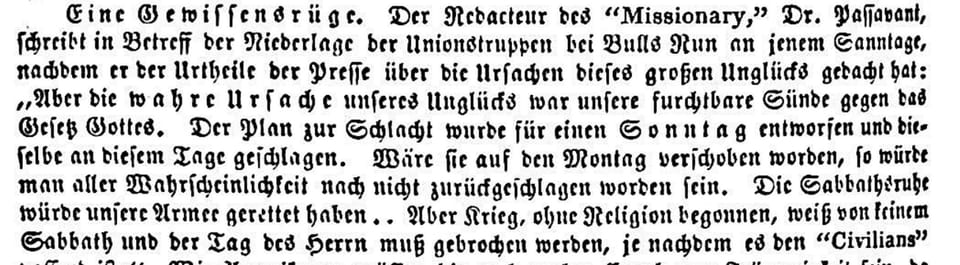
In St. Louis, the Missouri Synod's theological monthly Lehre und Wehre — "Doctrine and Defense" — watched the explanations arrive. Its September number carried a short item under the heading Eine Gewiſſensrüge, "a rebuke of conscience." Gewissen is conscience; a Rüge is an old word for a formal reprimand, the kind a guild or a court might enter into the record. The rebuke in question was not the journal's own. It was quoting one.
The editor of the Pittsburgh Missionary was Dr. William Alfred Passavant, and he deserves a paragraph before the argument, because American Lutheranism remembers him with something close to veneration. Born at Zelienople, Pennsylvania, in 1821, of Huguenot stock, trained at Gettysburg under S. S. Schmucker, he became pastor of Pittsburgh's First English Lutheran Church at twenty-three and then spent his life building things: the Pittsburgh Infirmary, the first Protestant hospital in America, for which he brought four deaconesses from Kaiserswerth in 1849 and so introduced the deaconess office to this country; hospitals at Milwaukee and Chicago; orphanages; in time a college. He had founded the Missionary in 1848 and edited it with the same energy. And the Missionary wore confessional colors: against the Lutheran Observer's broad Americanism it presented itself as the more churchly paper, the more Lutheran paper. Read from St. Louis, that claim was precisely the trouble. By 1861 the editors of Lehre und Wehre had given up on winning the Missionary; what remained was the duty owed their own readers. A paper that taught against the Confessions, as they judged this one did, while flying the confessional flag was more dangerous than an open opponent — a counterfeit does more harm than a foreign coin. So they wrote what follows as mockery and as warning, and the elaborate courtesies in it should be read with that in mind.
Surveying the press's postmortems of the battle, Passavant had found the true cause of the disaster, and it was not generalship:
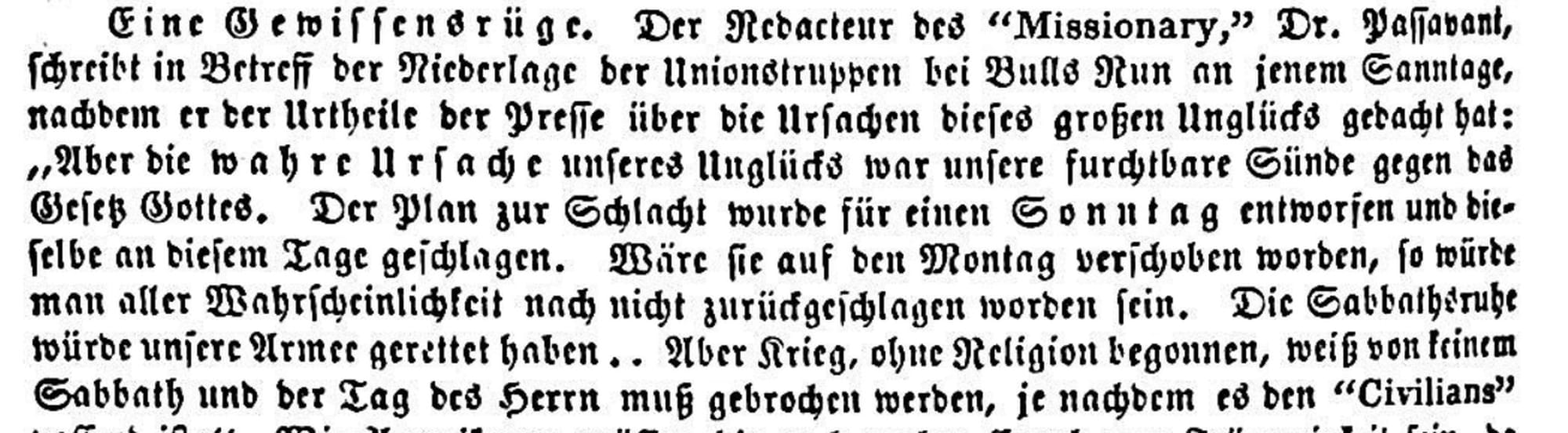
Aber die wahre Urſache unſeres Unglücks war unſere furchtbare Sünde gegen das Geſetz Gottes. Der Plan zur Schlacht wurde für einen Sonntag entworfen und dieſelbe an dieſem Tage geſchlagen.
But the true cause of our misfortune was our terrible sin against the law of God. The plan for the battle was drawn up for a Sunday, and the battle was fought on that day. Had it been postponed to Monday, in all likelihood we would not have been driven back. The rest of the Sabbath would have saved our army.
To this the St. Louis editors appended a single dry sentence: "We Americans, according to this, must be true angels of piety, since our worst sin is that our generals led us into battle on a Sunday." And there, for the moment, the matter rested.
The fast day
It did not rest long. President Lincoln had appointed a national day of humiliation, prayer, and fasting for September 26, and the pulpits of every denomination took it up. The journal's November number reprints, under the one-word heading Phariſäismus, a specimen from New York: Dr. George B. Cheever, the famous abolitionist preacher of the Church of the Puritans. Our teachers, Cheever told his hearers, earnestly assure us that God is angry with us for our atheism, our Sabbath-breaking, our worldliness, our intemperance — every sin, that is, except "the one crying sin so peculiarly our own as a nation." No people, he argued, had ever been judged with devastating war for those ordinary failings, "unless it be oppression."
The St. Louis comment runs one sentence: "So, then, the whole guilt which the North has to confess in the present war consists in this: that the South has sinned" — and the compositor spent two exclamation marks on it, the only ones in the column. The editors added just a citation: compare Ezekiel 13, the chapter about prophets who whitewash walls and cry peace. It is worth being fair to both sides here. The journal did not object to naming oppression a sin; its own October pages had carried an essay on the cause of the war that called slavery a national sin outright and named the Fugitive Slave Act while it was at it. The objection was to a day of repentance on which the sins confessed were, so conveniently, someone else's.
The whole document
Meanwhile Dr. Passavant had read the September number, and in the Missionary of October 3 he responded. After scattering — the journal's phrase — a little incense over the unusual skill with which Lehre und Wehre was edited, he brought the charge. As the St. Louis editors render him, word for word:
We regret to say, of necessity, that the customary honesty of the editors does not show itself in a short notice which was given concerning the cause of the defeat at Bull Run. By the omission of the most important part of our remarks, by which we intended to explain the preceding account, our statement has been given a sense wholly different from what was intended.
That is a serious accusation between religious editors — not that the critique was wrong, but that it was dishonestly made. (A note on the round trip: Passavant wrote in English; the journal translated him into German for its readers; and the English above is translated back out of that German. The reader is entitled to know the words have been through two translations on their way here.)
The reply, in the November number under the heading Antikritiſches ("in reply to a critic"), is a small masterclass in how to conduct a controversy. The editors observe that they had quoted the main sentences and marked the cut with ellipsis points; but rather than argue about what the omission did or did not change, they simply print the entire notice, "in a faithful translation," and let every honest reader judge. The old typography makes the gesture visible: the compositor opens every quoted line with its own quotation marks, so Passavant's document runs down the page behind a solid wall of them.
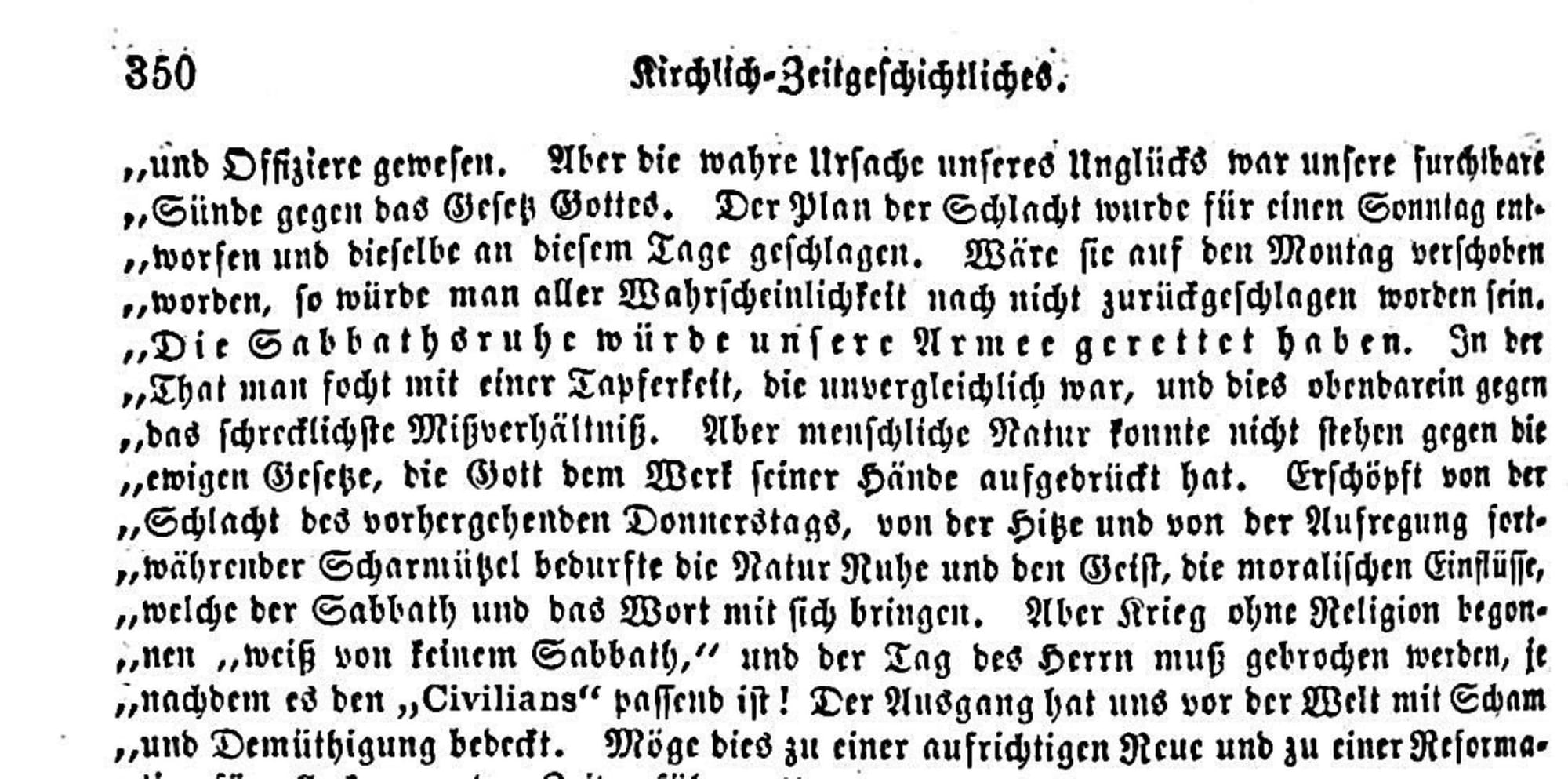
Read whole, the notice is in one way more humane than the excerpt. The men fought "with a bravery beyond compare," Passavant had written, against terrible odds, exhausted by the Thursday battle, the heat, the constant skirmishing; nature needed rest, and the spirit needed the influences of the Sabbath and the Word. But the added sentences do not soften the claim; they enlarge it. Human nature, the full text says, could not stand against the eternal laws God has impressed upon the work of his hands. The thesis of the excerpt was the thesis of the document. The omission had changed nothing, and printing the whole proved it.
Then comes the closing paragraph, and the reason this exchange belongs to the history of doctrine rather than the history of manners. Read it carefully, because under the elaborate courtesy the editors reach for the heaviest word in their vocabulary:
So erfreulich es ja immerhin iſt, daß der werthe Herr Dr. jetzt ſelbſt zu bereuen ſcheint, in Obigem die falſche, ſchrift⸗ und ſymbolwidrige Lehre vom Sabbath vertreten zu haben: ſo müſſen wir doch ſeinethalben ſehr bedauern, daß er ſich in der dargelegten unglücklichen Weiſe aus der Affaire zu ziehen geſucht hat.
However gratifying it may be that the worthy doctor now appears himself to regret having advocated, in the above, the false doctrine of the Sabbath, contrary to Scripture and to the Symbols, we must for his own sake deeply regret that he has sought to extricate himself from the affair in the unfortunate manner set forth.
Die falſche Lehre — false doctrine. In this journal that is not an insult; it is a category, the category its whole title exists to patrol, Lehre und Wehre, doctrine and defense. The verdict is not that Passavant was rude, or careless, or unfair to his critics. It is that the teaching itself — that God punished the army for fighting on the Lord's Day — is contrary to Scripture and to the church's Confessions. And this was not improvised for the occasion. The Augsburg Confession had said three centuries earlier that those who hold the observance of the Lord's Day to be necessary by divine command "err greatly"; days and seasons, in the Lutheran grammar, are matters of good order, not of merit. A theology in which God's favor rides on the calendar had been weighed long before anyone drew a battle plan for a Sunday. Note, too, the barb inside the compliment: if Passavant now insists his words meant something else, then he himself seems to repent of the doctrine — the editors accept his retreat and charge him for the ground given up. The verdict ends on a sentence with an audible click:
In die Sünde, die er auf Unſchuldige gewälzt hat, iſt er leider ſelbſt wirklich hineingefallen.
He has, unhappily, himself really fallen into the very sin which he rolled onto the innocent.
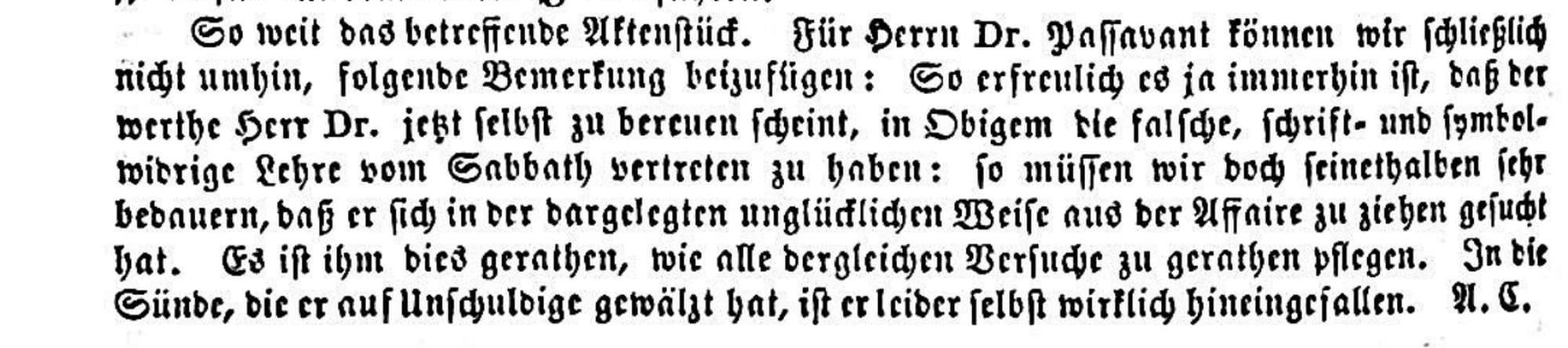
Passavant had rolled the army's defeat onto the innocent — onto soldiers whose sin was marching when ordered — and in accusing his critics of dishonesty he had, on the editors' reading, done the same thing again in miniature. The initials at the foot are A. C., most naturally read as Professor August Crämer, though the journal leaves them initials, and so shall I.
What strikes me most, reading the exchange at a century and a half's distance, is its speed. The battle was fought on July 21; the explanations were in print within days; the whole controversy — claim, mockery, counterclaim, full documentation, and doctrinal verdict — ran its course before the year was out. Explanations of catastrophe travel faster than casualty lists. And the shape of the explanations has not changed. After every national calamity the pulpits, and the platforms that have since taken their place, fill within the week; and the sins confessed are, with remarkable regularity, other people's. The fast-day sermon aimed at the enemy's conscience is not a nineteenth-century artifact. Ezekiel 13 still reads.
The whole exchange sits in the archive now, German and English side by side — the September item on page 282, the reply on pages 349 and 350 of the 1861 volume — at chi-archive.collver.biz, where you can watch a St. Louis monthly conduct an argument with Pittsburgh at the speed of the mails, and win it by quotation.
Note: the journal spells the battlefield "Bulls Run," and I have let its columns keep the old convention of opening every quoted line with fresh quotation marks. The scans were made by Google from a library copy; the transcriptions and translations are machine work corrected against the page, not yet human-reviewed.




Comments ()