
Through Woods and Prairies
Today is the twenty-first of October. In 1849 it fell on a Sunday, the twentieth after Trinity, and very early that morning a young pastor and his wife climbed into a farm wagon in Monroe County, Illinois, and drove north through woods and prairie to see a church dedicated. He wrote it up for Der Lutheraner, and the paper printed his letter on the eighth of January, at the foot of a page that had just finished with a quarrel. That is the whole of it: a column and a half, a hundred and seventy-seven years ago today. I want to spend the morning with it, because it is the kind of page the archive exists to keep, and because almost nobody since 1850 has had a reason to read it.
The page it shares
Page 78 of the sixth volume is two-thirds anger. A Protestant paper had called the pastor at Wapakonetta, Ohio, a wolf in sheep's clothing for introducing "auricular confession," by which it meant that he asked people to announce themselves before Communion, and the pastor and then his church council answered at length. The council's letter is dated the seventeenth of December 1849 and signed by five men whose names you can still find on gravestones in Auglaize County. We have that fight in the archive already. It is the sort of thing Der Lutheraner was for.
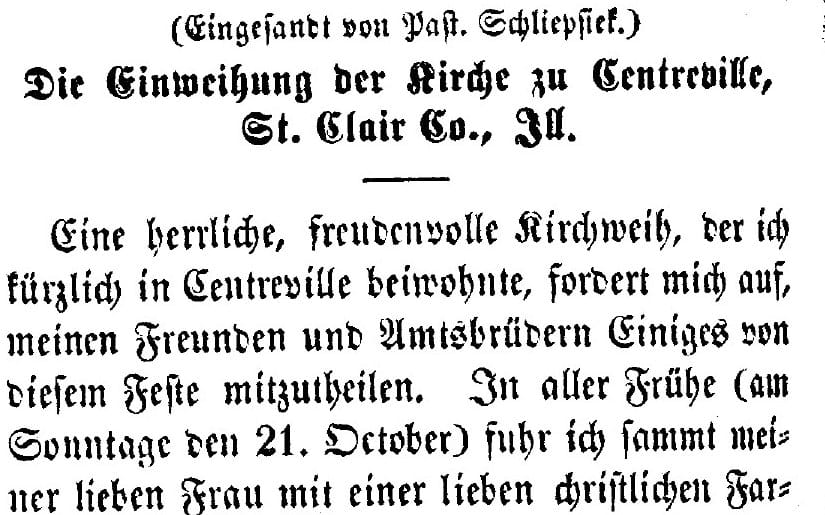
Then a rule, and a line in small type: Eingesandt von Past. Schliepsiek, submitted by Pastor Schliepsiek. And a heading in heavy black Fraktur: Die Einweihung der Kirche zu Centreville, St. Clair Co., Ill. The dedication of the church at Centreville. The tone changes so completely that you can feel the compositor's relief.
Eine herrliche, freudenvolle Kirchweih, der ich kürzlich in Centreville beiwohnte, fordert mich auf, meinen Freunden und Amtsbrüdern Einiges von diesem Feste mitzutheilen. In aller Frühe (am Sonntage den 21. October) fuhr ich sammt meiner lieben Frau mit einer lieben christlichen Farmerfamilie aus meiner Gemeinde durch Wald und Prairien jenem Städtchen zu.
"A glorious, joy-filled church dedication, which I recently attended in Centreville, prompts me to share something of this festival with my friends and brothers in the ministry. Very early in the morning, on Sunday, October 21, I drove, together with my dear wife, with a dear Christian farming family from my congregation, through woods and prairies toward that little town. Already we saw joyful guests hurrying in from every side on wagons and horses."
Farmerfamilie is one word, and so is Kirchweih, which is older than any synod and means the feast of a church's consecration, the day a village keeps once a year with a service in the morning and too much to eat in the afternoon. He is using the old word for a new thing. The congregation had no past yet to keep.
Who drove, and from where
Carl Heinrich Gottlieb Schliepsiek was from Mennighüffen, a village near Herford in Prussian Westphalia, and he had been a Lutheran pastor for eleven months. The paper carries his ordination too, in the number for the twenty-second of December 1848: on the twenty-third Sunday after Trinity, in the midst of the newly constituted congregation at Neu-Bielefeld in St. Louis County, Missouri, by the president of the Synod, who in 1848 was Walther, with Pastor Müller of Central Township assisting. He had first, the notice says, "sincerely and decidedly" renounced the united Evangelical church and its erroneous principles, and had been publicly examined. Within a year he had moved across the river to Holy Cross near Waterloo, in Monroe County, and it was from there that he set out on the twenty-first.
Centreville is perhaps a dozen miles north of Waterloo on the upland above the American Bottom. The town is still there. It changed its name to Millstadt in the next generation, and the congregation whose church was dedicated that Sunday is Trinity Lutheran Church, Millstadt, which is still in the Missouri Synod and still on the same ground.
The man waiting for him was Georg Albert Schieferdecker, and here the letter acquires a second story that its author could not have known. Schieferdecker had come over with the Saxons in 1839 as a candidate of theology, taught school in Perry County and St. Louis, and been ordained in 1841. He had gathered the Holy Cross congregation near Waterloo himself, so Schliepsiek was his successor there, and he had founded the congregations at Columbia and at Centreville in the same years. By October 1849 he had already accepted a call to Altenburg, Missouri, to succeed Gotthold Löber, who had died that summer. The church he dedicated that morning was a church he was leaving. He would be in Altenburg by the spring.
The third pastor arrived a day late. "On the following day Pastor Johannes still arrived among us," Schliepsiek writes, and preached the afternoon sermon of the after-celebration. The paper's receipts a year earlier place a Pastor Johannes at a St. John's congregation at Sulphur Springs, on the Missouri side of the river in Jefferson County. Three pastors for one dedication, in a district where a congregation might see one three times a year. That is what the word Fest means on this page.
What he saw
He had expected a Kirchlein, a little church, for a congregation he describes as still young and small, and he says plainly that he was astonished. "I found it very spacious, and my attention was drawn especially by the beautiful, tall, and broad windows, and even more by the well-dressed pulpit, charmingly adorned with wreaths, and by the altar. Very many people were present. The singing at the service was splendid, pure, and clear-toned."
Brother Schieferdecker, when the wagon pulled up, was already in the church holding the general confession with the communicants, so the day had begun with confession and absolution before any guest arrived. Then he saw Schliepsiek in his house, was very glad, and asked him on the spot to preach in the afternoon. Schliepsiek had prepared a short address for the evening and nothing else. He said yes. Anyone who has been a visiting pastor will recognize both halves of that sentence.
The main sermon was Schieferdecker's, on Exodus 20:24, "in all places where I record my name I will come unto thee, and I will bless thee." His outline was two points: wherein the blessing of the house of God consists, and on what it depends. The blessing, he said, is found only where God has established the remembrance of his name, which is to say where his word, his works and his wonders are preached, and nowhere else. And he drew the congregation's attention to something he thought a joyful sign: that the first church in Centreville was a church of the pure Lutheran confession. He hoped, Schliepsiek reports, "that God indeed intends to build his Lutheran Zion there, to set the word of his truth upon a lampstand, and to make that house a house of blessing extending to children and children's children."
Schliepsiek took Psalm 84 in the afternoon, the two verses that begin "How amiable are thy tabernacles," and tried, he says, to portray the glory of the house of God. The choir closed the day with "many songs, in several parts, fitting for the solemnity of the festival, sung in a tone of Christian cheerfulness." A village choir on the Illinois prairie, singing in parts, in 1849. On Monday Pastor Johannes preached on the Gospel of the day before, Matthew 22, the parable of the king's wedding feast, which is the appointed Gospel for the twentieth Sunday after Trinity and which Schliepsiek thought "very fitting for a church dedication." It is. The servants are sent out into the highways to compel them to come in.
"Wachet auf," according to Layriz
One detail in the letter is a small window onto something larger. After the main sermon, he writes, "the glorious hymn Wachet auf, ruft uns die Stimme was sung, according to Layriz." Nach Layritz. Friedrich Layriz was a Bavarian pastor who in 1844 published the Kern des deutschen Kirchengesangs, the kernel of German church song, in which the old chorales were restored to their original rhythms, the long and short notes that two centuries of organists had planed flat into the even quarter-notes of the isometric chorale. The Saxons in Missouri took Layriz up early and with conviction. By the end of the century the "rhythmic chorale" was one of the marks by which you could tell a Missouri Synod congregation from its neighbors, and it still is.
So when Schliepsiek specifies that "Wachet auf" was sung nach Layritz at Centreville in October 1849, he is telling his brothers in the ministry that the new congregation sang it in the old rhythm, dotted and springing, not in the smoothed-out form they would have grown up with in Westphalia or Saxony. It is a detail for insiders. A year later the paper would answer a reader's question about the Layriz chorale book, noting that it was set in four parts for organ but without preludes and interludes, which tells you that congregations were buying it and organists were asking.
What came after
Schliepsiek went home and wrote his letter, and the paper printed it in January. The following September Der Lutheraner reported that he had been called from Waterloo to the congregation at Pleasant Ridge in Madison County, Illinois, as successor to Pastor Lochner, and installed on the seventeenth Sunday after Trinity by Pastor Strasen. His post office was Collinsville. Holy Cross got a new pastor in 1850, and so did Centreville, a candidate named Wunder who stayed less than a year before Chicago claimed him for the next six decades.
Schieferdecker went to Altenburg. When the Western District was organized in 1854 he was its first president. In 1856 he asked the district to study the doctrine of the millennium, and it became clear that he held it. The ninth convention of the Synod, in 1857, opened his case in its second session and closed it in its eighteenth, and found that he no longer stood with the Synod on one ground of faith. The archive has that page too, in the convention proceedings. He took a third of his Altenburg congregation out with him and into the Iowa Synod, served in Illinois after 1866, recanted, was received back in the 1870s, and died at Hamel, Illinois, in 1891, a pastor of the Missouri Synod again. The man who preached on the blessing that is found only where God's name is remembered spent eighteen years outside the fellowship he had helped to found, and then came home to it.
None of that is on page 78. On page 78 it is a Sunday in October, the wagons are coming in from every side, the windows are tall, the pulpit is wreathed, and a pastor eleven months ordained is being asked, with no warning, to preach.
Now
I have sat through a good many church dedications and anniversaries, and I have noticed that the ones people remember are not the ones with the longest program. They are the ones where somebody drove a long way very early, and somebody else was asked to preach at the last minute, and the singing was better than anyone expected. Schliepsiek's letter is a hundred and seventy-seven years old and it is still the same letter a visiting pastor would write today, if visiting pastors still wrote to the synodical paper.
The two pages are in the archive, German and English side by side, at page 78 and page 79 of the sixth volume of Der Lutheraner, in the number for the eighth of January 1850. His ordination notice is on page 63 of the fifth volume, and the notice of his move to Pleasant Ridge, with the answer about the Layriz chorale book directly beneath it, is on page 24 of the seventh. The Synod's judgment on Schieferdecker, eight years on, is in the proceedings of 1857. If you are anywhere near Millstadt on a Sunday, the church is still there.
Note: the German text numbers the psalm verses as 84:2–3, which is 84:1–2 in the English Bible, and I have given the English. The transcriptions and translations are machine work corrected against the page, not yet human-reviewed. The spelling of the pastor's name follows the paper, which prints it Schliepsiek; later sources have Schliepsieck and Schliepsick.



Comments ()