
Grace, Set Upside Down

Sometime in 1845, in a print shop in St. Louis, a compositor stood at his case setting type for Der Lutheraner, the German-language paper edited by C. F. W. Walther. He was setting a sentence about grace. Somewhere in that sentence he picked up the letter n and seated it wrong way round — and the word Gnade ("grace") went out to the subscribers as Guade, and nobody caught it for one hundred and eighty years.
To see how such a thing happens, it helps to know how a page like this was actually made.
How a page was set in 1845
Every letter on every page of Der Lutheraner was a physical object: a small rectangular block of type metal — an alloy of lead, tin, and antimony — with a single character standing in relief on one end, cast in a mirror image so that it would print the right way round. A newspaper office kept tens of thousands of these, sorted into the compartments of a wooden type case. The compartments were not alphabetical; the letters a compositor reached for most — e, n, d, i — sat nearest his hand, in the largest boxes. A good compositor did not look at the case any more than a good typist looks at a keyboard.
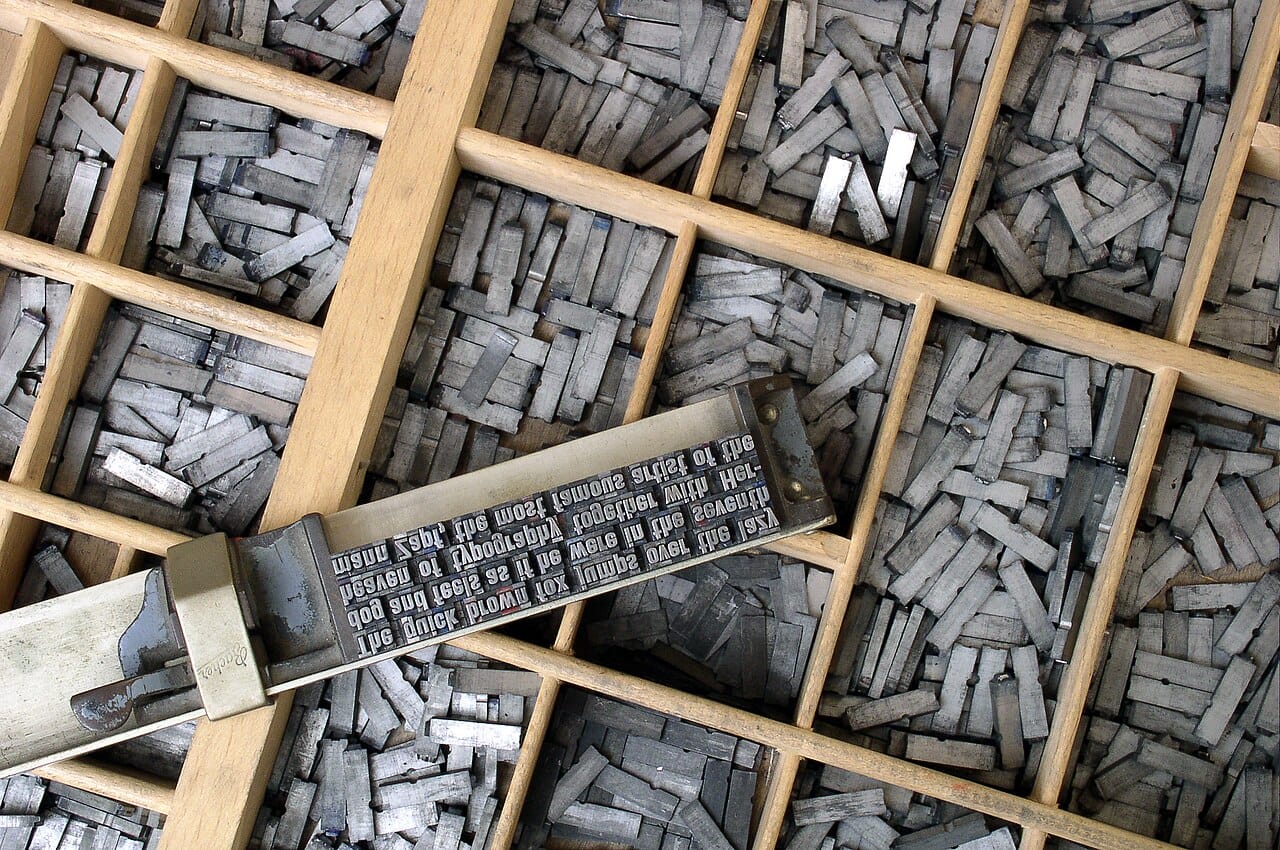
He worked with a composing stick in his left hand — a small adjustable steel tray, set to the width of one newspaper column — and picked type with his right, letter by letter, word by word, spacing each line out to exactly the column measure. And here is the part that matters for our story: the type in his stick stood upside down and backwards. The compositor read his work in mirror image as a matter of course. When the stick was full, he transferred the lines to a galley; when enough galleys were ready, the columns were locked tight into an iron frame called a chase, wedge by wedge, until the whole page of thousands of loose pieces could be lifted as one solid slab — the forme — and carried to the press.
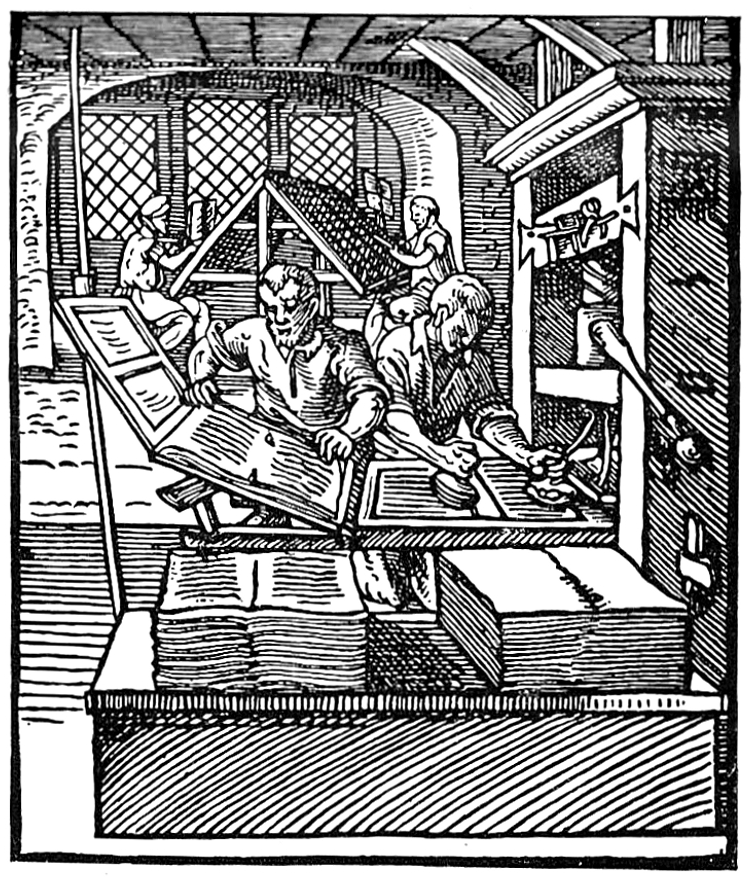
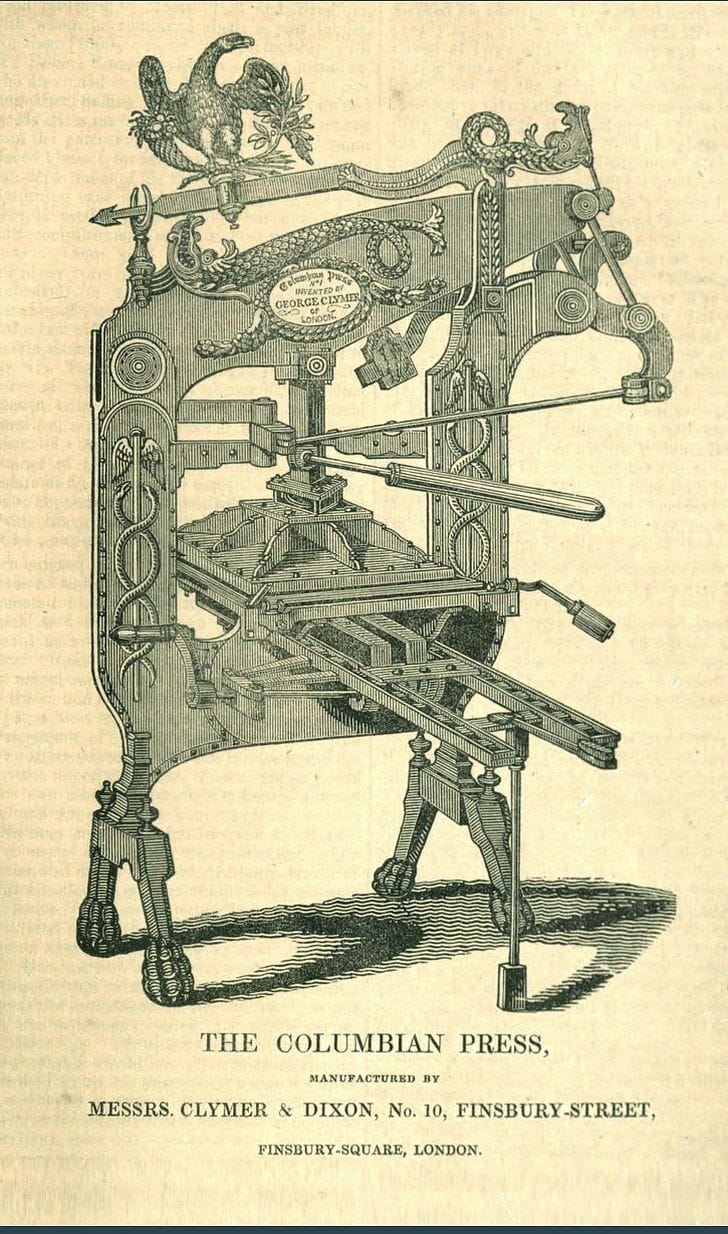
The press itself, by the 1840s, was an iron machine of the kind every American frontier town knew — a Washington or a Columbian handpress, worked by two men. One inked the forme with a roller, the other laid on the dampened sheet, ran the bed under the platen, and hauled the bar that pressed paper to type. A practiced pair could pull perhaps two hundred and fifty sheets an hour, and every impression of every copy of Der Lutheraner that survives was made this way, one pull at a time. When the run was finished, the forme was unlocked and every one of those thousands of letters was distributed — returned by hand to its proper compartment, ready to become next issue's words.
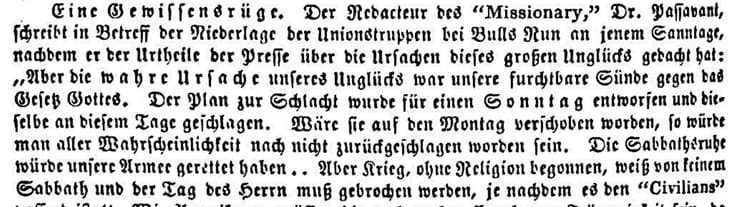
Now consider the letter n. Its type body is a plain rectangle; nothing about the block tells the fingers which way is up. In roman type, and in the German Fraktur ("broken" letter, the angular blackletter style German readers expected) that Der Lutheraner was set in, an n turned head over heels reads as a u. Printers even have a name for the error — a turned letter — and a proofreader's mark for it. Working at speed, reading mirror-image Fraktur upside down by lamplight, a compositor could seat one letter wrong way round and never see it; or a letter could have been thrown into the wrong box at distribution, waiting like a small landmine for the next hand that reached in.
The slip that waited 180 years
I have been building a demonstration digital archive for the Concordia Historical Institute: ten years of Der Lutheraner (1844–1854), roughly 1,800 pages, scanned, transcribed, and searchable in German — the first years translated and searchable in English as well. Each page shows the scan, the German transcription, and the English side by side, and every text is labeled for what it is: machine transcription, machine-corrected, or human-reviewed. Nothing pretends to be more finished than it is.
The transcription pipeline is a hybrid. A conventional OCR engine trained on Fraktur reads every page first and provides a complete, deterministic backbone. Then an AI re-reads the page image and corrects the machine's mistakes against what is actually printed — under one strict rule: correct, never compose. The AI may fix what the machine misread. It may not "fix" what the printer set. If the page says something odd, and the image confirms the page says it, the transcription says it too.
That rule is what surfaced the compositor's slip. On page 68 of the first volume, the correction pass flagged Guade as a likely OCR error, zoomed in on the letterforms, and found that the print itself reads Guade — a turned letter, confirmed by the same word set correctly one line below:

As printed, and as the archive records it:
Wo Sehnsucht nach Guade ist, da ist auch der Mensch der Gnade fähig.
As the compositor intended, and as the English translation renders it:
Where there is longing for grace, there the person is also capable of grace.
The archive keeps turning up things like this. A scripture citation printed with the wrong chapter number, preserved exactly as set, because the page is the page. A line of type the OCR engine skipped entirely, restored because the AI could see it on the image even though the machine's text never had it. And the September 1846 draft of the Synodal-Verfassung — the constitution discussions that preceded the founding of the Missouri Synod — now full-text searchable in English for the first time.
None of these finds required a scholar to spend a week with a microfilm reader. They required the pages to be readable by machines that have been taught, above all, to leave the past alone — to fix their own mistakes and respect everyone else's. There is a certain humility in that arrangement that the compositor of 1845, reading his type upside down and backwards at the end of a long day, might have appreciated.
The demonstration archive is at chi-archive.collver.biz. The turned letter is still there, on page 68, where it has been all along. Now anyone can zoom in and see it.


Comments ()