
As Long as the Pope Believes It
Hermann Sasse, Norman Nagel, and the Other Danger at St. Louis
In July 1968 Hermann Sasse wrote from North Adelaide to a man he scarcely knew. Norman Nagel, born in China to missionary parents and raised in Australia, had just left Westfield House in Cambridge to become Dean of the Chapel of the Resurrection at Valparaiso University. Sasse wished him well in the move “from your cloister at Cambridge to the battlefield in America,” and then, over three closely typed pages, told him what he thought of the battlefield. Near the end he set down a conversation with John W. Behnken, for twenty-seven years president of the Missouri Synod, about a professor at Concordia Seminary, St. Louis:
On one occasion I spoke with Dr. Behnken about this strange Lutheranism in which the articulus stantis et cadentis ecclesiae has evaporated. “But he teaches the inerrancy of Scripture”, he replied. Yes, I said, because the pope teaches that.1
The articulus stantis et cadentis ecclesiae is the article by which the church stands or falls: justification by faith alone. Sasse told the story more than once. Writing in German to his friend Friedrich Wilhelm Hopf in 1970, he gave Behnken’s words as “Aber er ist doch ganz orthodox, er glaubt an die Irrtumslosigkeit der Heiligen Schrift” (“But he is quite orthodox, he believes in the inerrancy of Holy Scripture”) and his own reply as das tut er, solange der Papst daran glaubt: “so he does, as long as the Pope believes it.”2
Two Dangers, Not One
The usual account of Missouri in those years has one danger. A new way of reading the Bible came into St. Louis, the synod resisted it, and in February 1974 the majority of the seminary faculty walked out and formed Concordia Seminary in Exile, Seminex. Sasse saw that danger clearly and said so often. But he saw a second one beside it, and it was harder to see, because it passed the tests Missouri usually applied.
In May 1957 he wrote to Hopf that Missouri, if things went on as they were, would be “ground to pieces between Piepkorn’s high church and fundamentalism” (zwischen der Piepkornschen Hochkirche und dem Fundamentalismus zerrieben).3 The professor in the Behnken story was Arthur Carl Piepkorn, army chaplain, liturgical scholar, and from 1951 a systematic theologian at St. Louis. Sasse had welcomed his call.4 Within a few years he was warning that the circle around the American journal Una Sancta was carrying Lutherans toward Rome. “Catholic ideas which were rejected by the Reformation,” he wrote to Herman Preus in 1957, “penetrate again into the Lutheran Church via the liturgical movements and High Church tendencies of our age.” And: “The old rule is being confirmed that with the border-line against Calvinism also the border-line against Romanism disappears.” In the same letter he still called Piepkorn “our common friend” and asked Preus to help him “out of the predicament in which he finds himself through his connections with the Una Sancta people.”5 Three months later, writing in German to C. E. Hoopmann, he was less patient. “A difficult problem for me is also the Concordia Monthly,” he wrote, “where Piepkorn suppresses everything that could mean a criticism of the ecumenical movement or of Sweden. He would certainly not have inaugurated the 450th anniversary of Luther’s ordination if it had not been a Catholic ordination to the priesthood.” Then he passed on a harsher word from Piepkorn’s own faculty: Franzmann meint, er sei dämonisch, “Franzmann thinks he is demonic.”6
It would be easy to make Sasse an enemy of liturgy. He was nothing of the kind. In 1948 he sent Una Sancta an essay, “Liturgy and Lutheranism,” in which he wrote that “there is no more damning an indictment of a theologian than to say that he knows nothing about the liturgy.”7 “There is a truth in Dr. Piepkorn’s attempt,” he told Paul Burgdorf in 1958, “to call back your church to the great liturgical heritage of the Lutheran Reformation.”8 In print, in his Letter to Lutheran Pastors of July 1952, he insisted that Bekenntnis und Liturgie gehören ja unlösbar zusammen: confession and liturgy belong inseparably together. What he feared was liturgy cut loose from doctrine. He named both dangers in one sentence in February 1956, writing to Ralph Gehrke at Watertown, Wisconsin, about the book on the Lord’s Supper that Augsburg would publish in 1959 as This Is My Body: “There is a great danger that our young Lutheran ministers go either high-church and lose their Lutheran faith, or that they go into the opposite direction and lose the precious heritage of our Church concerning sacraments and liturgy. This was the practical idea of my book.” If Augsburg would not take it, he added, he would offer the manuscript to Concordia, “following an advice by Dr. Behnken.”9 A year later, again to Gehrke, the American high church circles recalled “the later stages of the Oxford Movement in England when theology had evaporated and mere ritualism remained.”10 The same Letter of 1952 named “the circles around Dr. A. C. Piepkorn, St. Louis,” and ended with a warning: unless the liturgical movement submitted to Scripture and the Confession, it would become das Ende des Luthertums und der Weg nach Rom, “the end of Lutheranism and the way to Rome.”11
The cost was not abstract to him. In 1956 he turned to Piepkorn himself for advice about “a student of mine who was in danger of going over to Rome,” and when no answer came he wrote again in September: “it is my own son who was and still is in that danger.” Piepkorn replied kindly and plainly: “Neither Rome nor Canterbury has ever had any attraction for me.”12 Two years later, in the letter to Burgdorf, Sasse added that his own younger son had been “led through the Una Sancta and the publications of that circle to Rome.”13
What Sasse found most damaging was a single article. In The American Lutheran for February 1964 Piepkorn asked what the Lutheran Church is, and Sasse read his answer as this: the mark of Lutheranism is neither sola fide nor sola scriptura (faith alone, Scripture alone) but what the Lutheran Confessions have in common with Rome.14 Piepkorn’s own words were more guarded than that summary. He wrote that Lutheran theology “cannot be comprehended in any oversimplification of any shibboleth,” and he counted even the solae among the shibboleths.15 His student Philip Secker later protested that the weight of the sentence fell on the word “comprehended,” and that Piepkorn “said repeatedly that Lutheran doctrine is that which is taught in the Lutheran Symbols.”16 Piepkorn had also written on the Virgin Mary, and Sasse charged him with ascribing to Luther the dogma of the Immaculate Conception in the very form Pius IX defined in 1854. In Germany, Sasse complained, high-church Lutherans took all this home as “the theology of Missouri,” and therefore as sound.17 That is why he raised it with Behnken. And that is why Behnken’s answer, that the man believed in inerrancy, struck him as the whole problem in a sentence. A test of orthodoxy that a Roman theologian could pass was no test of Lutheran orthodoxy.
Valparaiso
Nagel came to Valparaiso as that argument was reaching its height. Sasse’s first mention of him in the papers is a shrug. In 1951 he told Hopf, Norman Nagel kenne ich nicht, er ist nicht aus unserer Kirche: “Norman Nagel I do not know; he is not from our church.”18 (Sasse was then in the United Evangelical Lutheran Church in Australia, Nagel in the Missouri-related Evangelical Lutheran Church of Australia.) Two years earlier J. T. Mueller, on his way home from the Bad Boll conferences of 1949, had found Vikar Norman Nagel von unserm Seminar in St. Louis, “Vicar Norman Nagel of our seminary in St. Louis,” assisting Pastor Edward Pearce in London.19 In 1965 and 1966 Nagel translated Sasse’s Letter on the Lord’s Supper for a Festschrift in Sasse’s honor that was never published.20
Nagel had already named two dangers of his own, and in the same shape. His Cambridge dissertation of 1961 was on Luther’s understanding of Christ in his doctrine of the Lord’s Supper, and in February 1963, still preceptor of Westfield House, he gave its argument as a lecture at Concordia Seminary, Springfield. “The assertion that man has some effective role to play,” he said, “takes various forms. There are basically three: works, mysticism and reason. Luther met these in Rome, Karlstadt and the Swiss.” When Karlstadt stripped the churches of crucifix, altars and vestments, Luther saw in it “a new monkery and helping the pope back up again.” Then Nagel gave Luther’s own summary: “The pope,” he said, “drives Christ out of the front door, while Karlstadt drives Him out the back.”21 Rome and the radical reformer looked like opposites. Luther saw them making the same mistake.
The 1968 letter also carried an invitation. O. P. Kretzmann, Valparaiso’s president, had asked Sasse to come. Sasse declined, pleading age and his duties at the new seminary in Adelaide.22 Six days later he was franker with his Swedish friend Tom Hardt: “I had an invitation from Valparaiso, Indiana to come and help to solve the problem of Missouri. Aside from all other considerations, I had to tell them that I was the wrong man.”23
October 1974
Six years later the two men collided over a single phrase. On 7 October 1974 Sasse wrote to Herman Otten, editor of Christian News, in defense of Tom Hardt, whom Professor Becker of the Wisconsin Synod seminary at Mequon had accused of Romanizing. Sasse’s answer was that Becker was looking in the wrong country:
If Prof. Becker wants to criticize Romanism, he has ample opportunities in America where this plague is spreading from the center of the forty self-canonized martyrs in St. Louis and Valparaiso through the Lutheran world.24
The “forty” were the faculty who had walked out of St. Louis that February. Sasse said as much to Robert Preus three months later. They were “forty individuals with very different ideas, held together only by the rejection of the old theology of Missouri,” and among them “the late Professor Piepkorn” had been “one of the most representative men of that group.”25 Piepkorn had died in December 1973. Martin Scharlemann wrote to Sasse from St. Louis that the funeral had been “a Roman Req[u]iem Mass for all intents and purposes,” and that Sasse had “already warned against the crypto-Romanism of our deceased colleague” years before.26 Scharlemann was the man Sasse had once called “the Modernist Scharlemann.”27 By 1973 the two were on the same side of the argument.
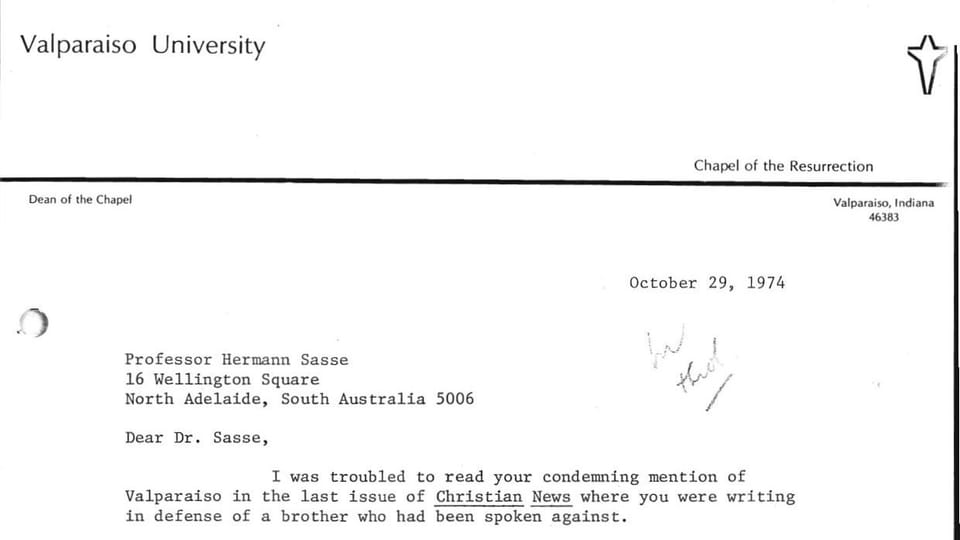
Otten printed the letter. Nagel read it in Valparaiso and wrote on 29 October:
I was troubled to read your condemning mention of Valparaiso in the last issue of Christian News where you were writing in defense of a brother who had been spoken against.
“While there are indeed things we have to repent of,” he went on, “I do not think that if you would visit us and examine the preaching and the administration of the Sacraments of the Chapel of the Resurrection you would find Romanism.” He added that in the course he taught on the Sacraments “we have had very fruitful use of your This Is My Body.”
He had met Sasse only twice, he said, once in Adelaide and once at Oberursel, and he had heard him lecture at St. Louis “in the days when you were so poorly treated by the then President there.” Still, “I have always regarded you as my teacher whom I have to thank for so much. It was therefore very painful that the ministry of Word and Sacrament that I serve here should be charged with Romanising. If there are things for which I should be admonished, I would be grateful if you would admonish me about them.”28
It is a remarkable letter: wounded, exact, and without a trace of self-pity. Sasse answered on 6 November. He had not yet seen the issue. The letter “did not contain a criticism of you and your work,” he wrote, but he had named Valparaiso with St. Louis “because both places … had been centers of that Romanizing type of High Church which has exercised a great influence on the Lutheran churches in your country and abroad.” He described, without naming him, a St. Louis professor who had taught that Lutheran doctrine was what the Confessions share with Rome and who had defended the Immaculate Conception: “I do not mention names, especially since the main culprit is dead.” Then he drew the line that joins the two dangers:
This is one of the incidents which were bound to lead to the catastrophe of St. Louis. For nobody dared to criticize that erring colleague.29
Nagel needed no name. Sasse had already given it to him in 1968.
Then Sasse turned to Nagel himself. “I am convinced that you do what you can to maintain sound Lutheranism at Valparaiso,” he wrote. He had seen many services in America and was “astonished how the Lutheran worship becomes more and more like the Episcopalian and even Roman,” but the charge was not meant for the man in front of him. “So be a good confessor.”
One small detail of the exchange is worth recording, because it shows how carefully these letters must be read. Sasse’s reply survives in three copies. On the Adelaide copy his opening line reads, as typed, “Thank you for your letter of Oct. 31.” On the other two someone has corrected the 31 in pen to 29, the date Nagel’s letter actually bears.30
The Conversation About Missouri
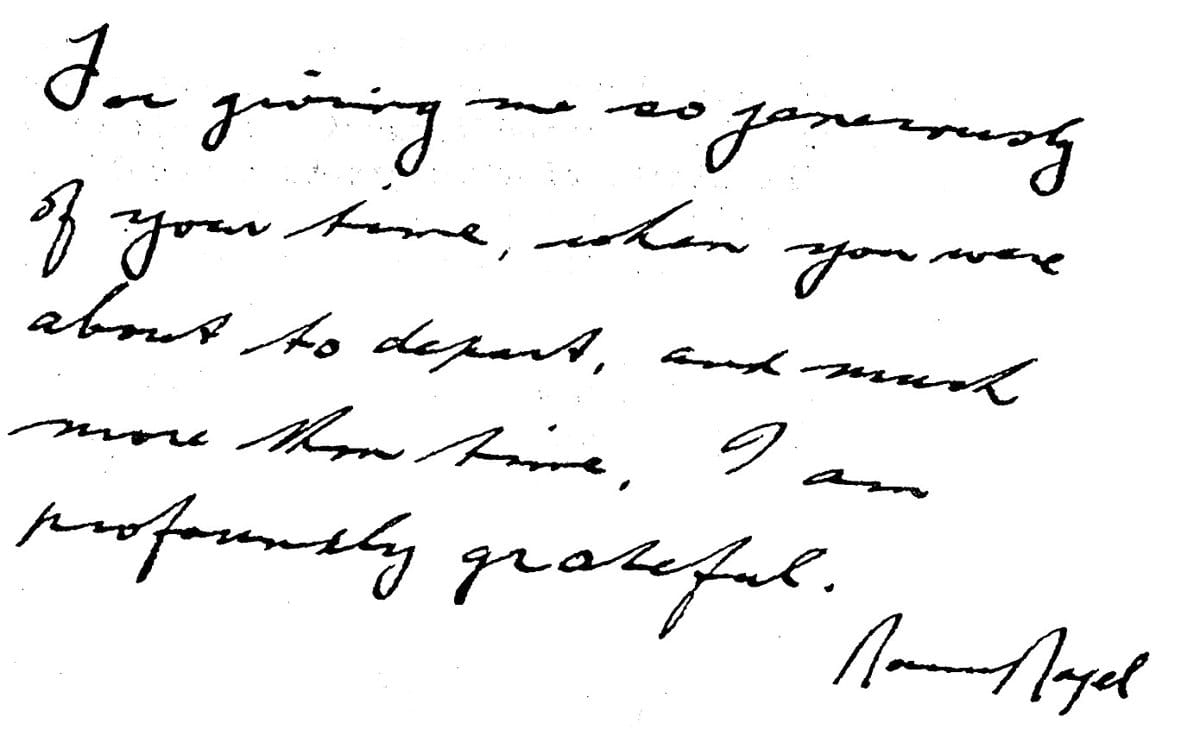
The quarrel did not last. In July 1975 Sasse turned eighty, and among those at the celebration in Adelaide was Norman Nagel. Sasse told Hopf that “Norman Nagel from Valparaiso was also present,” and that the two of them had “a conversation about Missouri, whose convention ended on the 14th.”31 That Christmas the Nagels’ family letter came to North Adelaide with a line in Nagel’s own hand: “For giving me so generously of your time, when you were about to depart, and much more than time, I am profoundly grateful.”32
Sasse died in August 1976. Four years later Nagel was gathering Sasse’s essays for an English anthology. Ralph Gehrke wrote to him urging the letters on Holy Scripture and recalled Sasse telling him in Adelaide that, if he could not finish his book on Scripture, “then he wanted his Brief published –in my translation!”33 The anthology became the We Confess series published by Concordia Publishing House from 1984, with Nagel as its translator. Nagel himself went to Concordia Seminary, St. Louis, in 1983 and taught there until 2006. He died in 2019 at ninety-four.
Asked in 2000 about the liturgical world he had known, Nagel granted part of what Sasse had seen. O. P. Kretzmann’s “own sympathies liturgically were rather more along the Anglican lines,” he said, and among Missouri’s devotees of the liturgy “mostly in that generation there were those who saw the way the Anglicans did things as the better way to go.” He declined to be part of the liturgical institute at Valparaiso, which in “its earlier stage” showed “heavy influence also from Anglican or the Episcopalian models.” Between the Anglican way and the Roman he saw a third: “there is still the possibility of doing them the Lutheran way. … When you say, let’s do it the Lutheran way, you come to the Gospel.”34 Many of the English-speaking Lutherans who read Sasse today read him in the translations of the man whose chapel he had once named among the centers of Romanism.
Since the Warning
Sasse’s warning did not end with Sasse. The liturgical movement he watched in Missouri has heirs today, and the most articulate of them write for Gottesdienst, which calls itself “the journal of Lutheran liturgy.”35 It is fair to begin with what they share with him, and they share a good deal. They honor Sasse as one of their own. They hold, as he did, that worship is confession: “Worship is not a matter of adiaphora, but a matter of confession,” one of them wrote this spring, which is close to Sasse’s own judgment of 1957 that liturgical innovations threatening the Lutheran heritage are keine Adiaphora mehr, “no longer adiaphora.”36 They call the Assumption and the Immaculate Conception pious opinions, not dogma. They quote Augsburg Confession IV on justification. And they use Sasse’s own word as a reproach: “Let us strive for Evangelical balance,” Larry Beane wrote in 2025, “and not fall prey to a Romanizing imbalance that would rob our people of Jesus.”37 Burnell Eckardt has long insisted that it is “not … a love of Rome which drives this liturgical renewal among us.”38 Ronald Feuerhahn, who wrote the fullest study of Sasse’s quarrel with Piepkorn, drew the distinction himself in 2002: in the middle of the century “the advocates of liturgical renewal were perceived to be the ‘liberals,’ ” while today they “are more likely to be seen as ‘confessional’ pastors who give emphasis to a churchly and sacramental theology and practice.”39
They are also candid about their lineage, and that is where the story of this essay comes back. Writing of the Liturgical Society of St. James, the circle of the 1920s and 1930s, Beane said in 2024 that the ceremony in his own congregation “is because of the work of men like Pastor Wismar and the others in the Society of St. James.” (Adolph Wismar, his post adds, later taught at Valparaiso.)40 Stefan Gramenz in 2025 traced LCMS liturgical renewal from Lochner “to the Liturgical Society of St. James and its eventual evolution (and devolution) into the Institute of Liturgical Studies at Valparaiso University,” and named Una Sancta in the same breath with Gottesdienst.41 Piepkorn’s The Conduct of the Service (1965) is still in print. A paper first read at their St. Michael’s Conference in 2011, and posted again in 2024, takes its title from that book. Its author, Charles McClean, who knew Piepkorn and revised his book in 1972, mentions “Dr. Sasse’s misgivings concerning Dr. Piepkorn” and answers them: “this is not Dr. Piepkorn as I knew him.”42
That is the line Sasse drew in 1974, “St. Louis and Valparaiso,” drawn this time by the heirs themselves.
The society Beane names kept a journal, Pro Ecclesia Lutherana, and its first number, of December 1933, is worth reading beside theirs. The chairman, Berthold von Schenk, wrote the opening statement of policy: “We are promulgating no new doctrines, nor are we denying any of them,” and so no one could fairly bring “the charge … of Romanizing tendencies.” About ceremony he was plain: “We fully realize that these things are adiaphoristic, and it is not unknown to us that of greater worth than all form is the matter of pure doctrine in every point and particular.”43 In the same number a young pastor in Chisholm, Minnesota, Arthur Carl Piepkorn, who wrote for the journal but never joined the society, set out the aim of the movement: “We desire to re-introduce the maximum of common Occidental formulae and ceremonies, whatever their source, consistent with the Holy Scriptures and the Holy Confessions of our Church.”44 The Lutheran Missal project, presented on gottesdienst.org in 2022, still cites that article. The motto at the foot of every page of the site reads Leitourgiae propria adiaphoria non est: indifference is not proper to the liturgy.45 The heirs have reversed the first half of von Schenk’s sentence, for a reason close to the one Sasse gave in 1957. Sasse’s own rule kept both halves together. Writing to Piepkorn in October 1956 about the eucharistic prayer, he called it “an adiaphoron, like the ‘apostolic succession.’ Both cease to be adiaphora as soon as they are used to lead the Lutheran Church back from the truth of the Gospel.”46 Whether the heirs keep the second half of von Schenk’s sentence, pure doctrine above all form, is the question Sasse kept asking.
Read across a decade of their writing, and not one post at a time, a trend appears, and it runs where Sasse said such movements run. The phrase lex orandi, lex credendi (“the law of prayer is the law of belief”) recurs constantly. “Those who want change in a church’s doctrine,” Beane wrote in 2025, “understand that it is necessary to change the practice. And the changed practice will serve to establish the changed doctrine.”47 In 2026 he put it in four words: “our orandi will shape our credendi.”48 Sasse would have granted the observation and turned the rule around. In a statement written in 1959 for the liturgical congregation of Brüdern in Braunschweig, Eine brüderliche Mahnung, “A Brotherly Admonition,” printed that Christmas in Lutherische Blätter as Liturgie und Bekenntnis, he wrote that the old saying holds “only if it also holds the other way round: ‘Lex credendi lex orandi.’ Die Liturgie bestimmt die Lehre nur, wenn die Lehre die Liturgie bestimmt”: the liturgy determines doctrine only if doctrine determines the liturgy.49 In the same statement he said of Missouri that “in many cases the liturgical movement became a substitute for what doctrine had been for the old Missouri.”50 Piepkorn himself had granted the point. “I agree with you,” he wrote to Sasse in October 1956, that the rule “has to read both ways if used as a criterion.”51 The second half of that rule, doctrine governing prayer, is rarely stated on their pages. The self-description has grown: “We are Evangelical Catholics, those who have restored the more ancient biblical Catholicism of our ancestors” (2023).52 Marian attention has risen since about 2019, from the Assumption and Immaculate Conception as things “we are free to believe or deny” (2019), to a sermon for the Feast of the Assumption (2024), to the judgment that denying Mary’s perpetual virginity “is something of a red flag” (2025).53 The Roman Canon has been studied, though not adopted, as “the kernel of a fine intercession” once separated from the consecration (2020).54
Every one of those Marian posts also calls the teaching a pious opinion, not a dogma, and that is a real safeguard. It is also the distinction Sasse trusted least. In the same Mahnung he wrote, Fromme Meinungen in allen Ehren. Aber eine Meinung, die falsch ist, kann nicht fromm sein: “Pious opinions in all honour. But an opinion that is false cannot be pious.”55 He counted it a sickness that Lutherans now distinguished “dogmas which one must accept” from “pious opinions” which one may preach from the pulpit, “provided that one only recommends their acceptance but does not make it a condition of salvation. That is the end of the preaching of the Gospel.”56
None of this is Piepkorn’s Mariology, and nothing I found on their pages teaches what Sasse charged Piepkorn with teaching. Sasse’s question was never whether a pastor chants or genuflects. It was which way the authority runs. “Nothing can be liturgically correct,” he told the readers of Una Sancta in 1960, “which is not dogmatically correct.”57 Five years later he said it at Concordia Seminary itself, in a lecture on Luther and the ecumenical creeds on 11 February 1965, and he ran it both ways: “Nothing can be correct in the liturgy which is not correct in doctrine. Nothing can be correct in doctrine which is not correct in the liturgy.” Every dogma, he told them, appears first in the liturgy and only then is defined, and that is true of the false dogmas as well: “The Mariological dogmas, for instance, are first in the liturgy, and then they are defined.” Even Pope Pius XII, he added, “knew what he wanted” when he said that the old rule “can also be and must be inverted.”58 When the liturgy is defended as confession, does the confession, above all the sola fide, judge the liturgy? Or does the liturgy, as it grows older and richer, begin to judge the confession? Sasse spent a quarter of a century asking that question of St. Louis and Valparaiso. It has not gone away.
What Remains
Sasse’s warning still applies. The two dangers he named for Missouri are both alive, and each is still offered as the cure for the other. One is a reading of Scripture that keeps the words and loses the authority. The other is a liturgy that keeps the vestments and loses the sola fide. His remedy was neither. It was the article by which the church stands or falls, held as doctrine and prayed as liturgy. And it was the kind of letter Nagel wrote in October 1974: if there are things for which I should be admonished, admonish me.
Epilogue
With Sasse the story comes full circle, and the circle begins in America. Sasse was born and educated in the Prussian Union, the church that King Frederick William III created in 1817 by joining Lutherans and Reformed in one communion. The First World War broke the liberal theology of Adolf von Harnack in which he had been trained, and on a visit to Sweden he first became conscious of his Lutheranism. “However, I did not understand at that time as a young pastor that Lutheranism implied the rejection of the union,” he told a Missouri pastor in 1957. “This I have learned in America where I stayed for a year at Hartford Seminary in 1925/26.” At Hartford he studied among students “from more than 30 denominations,” and on Sundays he “worshipped in a church belonging to the ULC,” the United Lutheran Church in America.59 Twelve years later, in his foreword to the American edition of Here We Stand, he said it again: “Personally I must confess that it was in America that I first learned fully to appreciate what it means to be loyal to the Lutheran Confessions.”60
He reported what he had seen to German pastors in two lectures at Frankfurt an der Oder in August 1926, printed the next year as Amerikanisches Kirchentum, “American Church Life.” Dietrich Bonhoeffer read the little book before his own year at Union Theological Seminary in New York. Paul Hoh summarized it for American Lutherans in 1927. Sasse found American Christianity held together less by a common confession than by common work: “The essence of Christianity, so says the American, is service. What one believes, what Christology one holds, how one worships God, and what one’s doctrine of the sacraments is—all that is of no consequence.” Against this he set the Lutheran church, which, in Hoh’s rendering, “unlike the fundamentalists,” thinks of “the Word of God as a living thing, because she thinks primarily of the spoken and incarnate Word, and only secondarily of the written.” And Hoh put Sasse’s remedy in one sentence: the questions America raised should be thought through “upon the basis of the two fundamental pillars of our religious thought: justification by faith and the Lutheran conception of the church.”61
Ten years later Sasse wrote Union and Confession (1936) against the union of Lutheran and Reformed that was then swallowing the German churches. There he named each church’s temptation in turn: “Anglicanism’s temptation is canon law and the liturgy. Modern American Protestantism’s temptation is so-called ‘practical Christianity.’ ” His own church’s temptation was the false union, and he described how it had won. Such lies, he wrote, “have entered the church in an hour of deepest emotion and holiest enthusiasm,” to the singing of the Veni Creator Spiritus (“Come, Creator Spirit”) and the Te Deum (“We praise thee, O God”). The union movements of the nineteenth century were “not victorious because of truth, but because they satisfy emotional desires.” And where a church no longer asks what is true, “in place of the objective message of that which God has done in Christ, subjective religious feelings and convictions soon form the essential content of the sermon. Thus the church sinks to the level of an institution for the satisfaction of the manifold religious needs of men.”62 He wrote that of the church he had grown up in, not of an American revival. But he had learned in America to recognize it, and it describes well the worship that is built chiefly to produce a feeling.
Nagel found the same thing in Luther’s quarrel with Karlstadt. Karlstadt’s exercises of devotion, he told the Springfield students in 1963, were “heavily emotional”: Karlstadt spoke of “burning remembrance of Christ” and “passionately tasting the sufferings of Christ.” Luther, said Nagel, saw this “as upside down and looking in the wrong direction. We are not to look inward to watch for emotions which prove us spiritual. This self-regard is in the direction of works, something we feel and do to secure our salvation.”63
Sasse knew that ceremony can move people as surely as a revival can. In August 1971 he wrote to the leaders of the German Lutheran free churches, who were about to unite in a single church, and asked what had won the pagan world for Christ. It was not splendor. “The sacred rites of the mystery religions were perhaps more impressive than the simple sacramental celebrations of the Church,” he wrote. “But one thing none of them had: the forgiveness of sins.” So “not new methods of proclamation will help us to find the ear of the congregation, but a new, deepened understanding of the Gospel,” for “the Gospel is in its deepest nature the forgiveness of sins, not only a doctrine of forgiveness, but forgiveness itself, the absolution.” In the same letter he described a Lutheran service in America. At first glance all seemed in order: “The old hymns are still sung, the old liturgy is still there.” Look closer, and confession and absolution “get very short shrift,” because “the service must be over in an hour.” The absolution falls away, he wrote, “even in churches of the Missouri Synod.”64
Sasse’s answer, then, was neither no liturgy nor more liturgy. It was worship in the service of the Gospel, and above all of the article by which the church stands or falls, justification by grace through faith. He feared that this was the teaching being lost, and he knew it could be lost from either side. “The deeper reason that High Churchism has brought down so many,” he wrote in 1959, “appears to me to be that we modern Lutherans no longer correctly understand the article of justification. … Thus we lack the compass which directs our course with certainty.”65 Without that compass a church can drift in any direction, and the drift feels like devotion.
Nagel gave the same answer in two Latin words. Writing in Logia in 1998, he asked of the liturgy: “Is it something we do; is the movement from us to the Lord, or from the Lord to us, sacrificium (sacrifice) or beneficium (gift)? If one would attempt to sum up what happened with the liturgy by way of the Reformation, one might say, beneficium, not sacrificium.” Whatever goes wrong with the liturgy goes wrong at that point, “where we would take over, where we act as if it belonged to us, to do with as we reckon would be good for it. That is a denial of its being a gift, a denial of its being gospel. It is turning it into work-righteousness.” The danger he named can come in with a new order of service or hide inside an old one. Of the liturgy the church has always used he wrote, “it is quite another kind of ecclesiology going on when people can shove that aside and dial-a-liturgy.”66
The two forms Sasse watched are with us today under other names. One is usually called contemporary worship, for want of a better term; historians have not yet settled on one. The other is the high liturgical worship whose heirs this essay has followed. Either can lose the central teaching of the Reformation, and in the same way: by letting something else stand where the absolution belongs, whether a feeling to be produced or a ceremony to be admired. People in each camp are quick to name the faults of the other. They are slower to ask whether their own practice distracts from, or even harms, the one teaching that matters most.
When did you last hear a sermon, or an argument, chiefly about justification by faith? It is far more likely that the last one you heard was against “liberalism,” or about a social issue of the day, a political figure, or the way other people worship, than a sermon on justification and the danger of losing it. Sasse put the same question to every Lutheran church in the world in February 1957, before the Lutheran World Federation met at Minneapolis. The first question, he wrote, is whether we still teach the sola fide rightly, and “that means not only: Do we have a correct theological doctrine of justification, but: Do we still rightly preach the saving article, which is the Gospel itself?” Then he made it concrete: “What is preached in our pulpits? What do our children learn in the church’s instruction? Do we bring them up to be people who live sola fide, sola gratia, in daily repentance, from the daily forgiveness of sins?”67
For more than fifty years the Missouri Synod has seemed more concerned with inerrancy, and readier to use it as the test of orthodoxy, than with the article by which the church stands or falls. Sasse and Nagel both warned against exactly this. Sasse did not give up inerrancy. Of plenary inspiration and the other “fundamental doctrines” he wrote to President Oliver Harms in December 1967: “Of course, all this is fundamental and cannot be given up. But it can be maintained only if the ‘pro nobis,’ the fact that Christ is my saviour, retains its place. I believe in Christ, and therefore I accept the Bible as he did it, as the apostles did it and the entire orthodox Christian Church. My faith does not begin with the faith in the Bible. This distinguishes orthodox Lutheranism from modern Fundamentalism.” (Pro nobis means “for us.”) And then: “Sometimes it seems to me that not the sola fide is the article of the standing and the falling church for modern Lutherans, but the theory that the day of creation had 24 hours.”68 Two years earlier he had told Behnken that Missouri had taken over from American Fundamentalism a theology “in which the inspiration and inerrancy became the articulus stantis et cadentis ecclesiae,” while in “the theology of the Lutheran Reformation” the doctrine of Scripture “is subordinated to the articulus stantis et cadentis ecclesiae, the sola fide.”69 In 1969 he gave President J. A. O. Preus the reason. According to the Apology’s article on justification, “the key which opens the door into the entire Scripture is the sola fide, is the firm belief in Christ as my saviour. The Sola fide explains the Sola Scriptura.”70
Nagel said the same in his own way. In 1956, in a paper read to the Lutheran Council of Great Britain, he wrote: “It is the first apprehension which saves and not the second. A man is saved by Christ and not by the Scriptures.” And: “Fundamentalism is thought by some to provide the necessary certainty. From Fundamentalism Lutherans are safeguarded by the distinction of Law and Gospel.”71 In 1973, as dean of the chapel at Valparaiso, he wrote that our final reliance rests on nothing in ourselves: “This is all from him and as sure as he is sure. There is nothing anterior to him which makes him sure. At no point may we insert some factor of ourselves as decisive or guaranteeing.”72 In 1998 he opened an essay on Luther’s liturgical reform by quoting a common summary of the Reformation and rejecting it: “‘The heart of the Reformation is that the pope is not the boss; the Bible is the boss.’ That is to quite miss the heart of it!” The question, he went on, is where Luther points: “Where and to what does he point? That is the question.”73 A year earlier, writing on the priesthood of all believers, he had given the rule: “As always we may not stop short of the Christ point; each doctrine is worth what it confesses of him.”74
Nearly twenty years after Sasse’s death, Nagel wrote an essay on Ignatius of Antioch’s name for the Lord’s Supper, “medicine of immortality.” “For inciting such exegetical faithfulness,” he wrote, “Dr. Sasse is surely the prime suspect.” And: “In the liturgy Sasse betrays perfect pitch.” In a note he allowed that his own approach was “something a bit more liturgical” than the doctrinal treatments of others, “a distinction that would simply appall Dr. Sasse,” and he gave Sasse’s rule in Sasse’s own words: Liturgie gebetetes Dogma, the liturgy is prayed dogma.75
In his foreword to Here We Stand, Sasse wrote that “in the Reformation’s sola fide our church has been entrusted with a heritage which it must preserve for all Christendom, even for those who still do not understand it today.”76 That heritage is not kept by a style of worship, high or low. It is not kept by a doctrine of Scripture, however correct, held apart from it. It is kept where the forgiveness of sins is preached and given, plainly, for Christ’s sake. Sasse spent fifty years asking Missouri whether that was still happening. The question is now ours, and it is put to every congregation, whatever it sings.
- Hermann Sasse to Norman E. Nagel, 2 July 1968, 1–2, LCAA. Letters are cited from the Hermann Sasse papers as digitized by the 2012 Sasse Scanning Project, by the archive that holds them: Lutheran Church of Australia Archives, Adelaide (LCAA); the Gehrke Collection; the Herman A. Preus files; the Tom Hardt papers, Stockholm; and the Lutheran Archives Center at Philadelphia (LAC). Letters to and from Friedrich Wilhelm Hopf are from the Sasse–Hopf correspondence scanned for the Erlangen project in 2017 (Erlangen). Letters in the Concordia Theological Seminary files are cited from Ronald R. Feuerhahn’s transcripts. Page numbers are those of the scans. Each quotation has been read against the scan of the original; obvious typing slips (Sasse typed his own letters, often in haste) are silently corrected, and the wording is unchanged. Translations from the German are mine.↩︎
- Sasse to Hopf, 30 September 1970, 2, Erlangen. He told it also to J. A. O. Preus, 16 December 1967 (Feuerhahn transcripts), and to Herman Otten, 22 March 1971, 3, LCAA.↩︎
- Sasse to Hopf, 15 May 1957, 1, Erlangen.↩︎
- “Eventually he has found the real work of his life”: Sasse to Herman A. Preus, 2 December 1951, 2, Herman A. Preus files.↩︎
- Sasse to Herman A. Preus, [June 1957], continuation sheet, 1–2, Herman A. Preus files (Preus 276–277). The first part of the letter (Preus 260–261) is dated 26 June 1957; the continuation, posted in Adelaide in June, was received at Danbury, Wisconsin, on 2 July 1957. Feuerhahn, as Secker quotes him, dates the “common friend” letter 27 June 1954: Philip J. Secker, “A Closer Look at Sasse’s Critique of Piepkorn,” Lutheran Forum 38, no. 1 (Spring 2004): 31. The original is headed 26 June 1957.↩︎
- Sasse to C. E. Hoopmann, 27 September 1957, 3, LCAA (handwritten, in German): Ein schweres Problem ist für mich auch das Concordia Monthly, wo Piepkorn alles unterdrückt, was eine Kritik an der Oekumene oder an Schweden bedeuten könnte. Die 450 Jahrfeier von Luthers Ordination hätte er gewiß nicht inauguriert, wenn es nicht eine katholische Priesterweihe gewesen wäre.↩︎
- Hermann Sasse, “Liturgy and Lutheranism” (1948), quoted in John T. Pless, “Hermann Sasse and the Liturgical Movement,” Logia 7, no. 2 (Eastertide 1998): 47.↩︎
- Sasse to Paul H. Burgdorf, 25 November 1958, 1, LCAA.↩︎
- Sasse to Ralph D. Gehrke, 13 February 1956, 2, Gehrke Collection. The book is Hermann Sasse, This Is My Body: Luther’s Contention for the Real Presence in the Sacrament of the Altar (Minneapolis: Augsburg, 1959).↩︎
- Sasse to Ralph D. Gehrke, 5 September 1957, 1, Gehrke Collection. The letter is in Sasse’s hand; a later typed transcript of it misreads the year as 1951.↩︎
- Hermann Sasse, “Zum lutherischen Verständnis der Konsekration,” Briefe an lutherische Pastoren 26 (end of July 1952): 1, 3–4.↩︎
- Sasse to Arthur Carl Piepkorn, 16 February and 30 September 1956, and Piepkorn to Sasse, 16 October 1956, Piepkorn Papers, Archives of the Evangelical Lutheran Church in America, quoted in Secker, “A Closer Look,” 32, 35.↩︎
- Sasse to Burgdorf, 25 November 1958, 1.↩︎
- Arthur Carl Piepkorn, “What Is the Lutheran Church?” The American Lutheran 47 (February 1964): 8–11. For Sasse’s reading see, for example, Sasse to Robert D. Preus, 19 January 1975, 5, LCAA. In later years Sasse remembered the article as “What is Lutheran in Doctrine?” and dated it to the Reformation jubilee of 1967.↩︎
- Piepkorn, “What Is the Lutheran Church?” as quoted in Ronald R. Feuerhahn, “Arthur Carl Piepkorn and Hermann Sasse,” Lutheran Forum 35, no. 4 (Winter 2001): 27.↩︎
- Philip J. Secker, “The Tragedy of Sasse’s View of Piepkorn,” Lutheran Forum 36, no. 3 (Fall 2002): 38.↩︎
- Sasse to Nagel, 2 July 1968, 2. The same charge on the Immaculate Conception is in Sasse to Robert D. Preus, 19 January 1975, 5.↩︎
- Sasse to Hopf, 6 April 1951, 2, Erlangen.↩︎
- J. T. Mueller, “Bad Boll 1949,” Der Lutheraner 105, no. 18 (30 August 1949): 286–289, here 289.↩︎
- Heino O. Kadai to Nagel, 13 August 1965 and 13 January 1966, Feuerhahn transcripts. The second letter thanks Nagel for his translation of Sasse’s “Zum Verständnis des Heiligen Abendmahls in der Luth. Kirche.”↩︎
- Norman E. Nagel, “Luther on the Lord’s Supper,” The Springfielder 27, no. 3 (Autumn 1963): 40–50, here 43–44. The lecture was given on 22 February 1963. Compare Norman E. Nagel, “Luther’s Understanding of Christ in Relation to His Doctrine of the Lord’s Supper” (Ph.D. diss., University of Cambridge, 1961), 314–315.↩︎
- Sasse to Nagel, 2 July 1968, 1.↩︎
- Sasse to Tom Hardt, 8 July 1968, 1, LCAA.↩︎
- Sasse to Herman Otten, 7 October 1974, 3, Tom Hardt papers; also in the Feuerhahn transcripts.↩︎
- Sasse to Robert D. Preus, 19 January 1975, 5.↩︎
- Martin H. Scharlemann to Sasse, 24 December 1973, 1, LCAA.↩︎
- Sasse to Carl F. H. Henry, 11 November 1965, 1, LCAA.↩︎
- Nagel to Sasse, 29 October 1974, 1, LCAA.↩︎
- Sasse to Nagel, 6 November 1974, 1, LCAA. The letter is a single aerogramme.↩︎
- The other two copies are photocopies of the same pen-corrected aerogramme: LAC, and “Letters – Various,” 2012 Sasse Scanning Project.↩︎
- Sasse to Hopf, 18 July 1975, 1, Erlangen.↩︎
- Nagel family Christmas letter, 1975, with a handwritten note from Norman Nagel to Sasse, LCAA.↩︎
- Ralph D. Gehrke to Nagel, 1 July 1980, Gehrke Collection (carbon copy).↩︎
- Norman Nagel, interview by D. Richard Stuckwisch, St. Louis, 22 August 2000, printed as Appendix 27 of Stuckwisch’s dissertation (2004), 1058, 1065.↩︎
- https://www.gottesdienst.org. Quotations from the journal’s website were checked against the published pages on 1 November 2026.↩︎
- “Liturgy: Adiaphora or Confession?” Gottesblog, 10 May 2026, https://www.gottesdienst.org/gottesblog/2026/5/10/liturgy-adiaphora-or-confession; Sasse to F. W. Noack, 6 July 1957, 4, LCAA. On adiaphora and liturgy in the Lutheran Confessions see John T. Pless, “The Relationship of Adiaphora and Liturgy in the Lutheran Confessions,” in And Every Tongue Confess: Essays in Honor of Norman Nagel on the Occasion of His Sixty-fifth Birthday, ed. Gerald S. Krispin and Jon D. Vieker (Dearborn, MI: The Nagel Festschrift Committee, 1990), 195–211.↩︎
- Larry Beane, “The Balance of Gottesdienst,” Gottesblog, 29 March 2025, https://www.gottesdienst.org/gottesblog/2025/3/29/21q6ue6i0nodezqlb4p299dch0t5oy.↩︎
- Burnell Eckardt, “Responding to Romaphobia” (2000), reposted on Gottesblog, 18 September 2018, https://www.gottesdienst.org/gottesblog/2018/9/18/tbt-responding-to-romaphobia-the-reason-for-liturgical-piety.↩︎
- Ronald R. Feuerhahn, “Hermann Sasse’s Critique of Arthur Carl Piepkorn,” in Shepherd the Church: Essays in Pastoral Theology Honoring Bishop Roger D. Pittelko, ed. Frederic W. Baue et al. (Fort Wayne: Concordia Theological Seminary Press, 2002), 98–99, quoted in Secker, “A Closer Look,” 31. See also Feuerhahn, “Arthur Carl Piepkorn and Hermann Sasse,” 25–27; and, for Piepkorn’s side, Secker’s two articles and Paul Sauer, “Setting the Record Straight: Arthur Carl Piepkorn, Non-Roman Catholic,” Lutheran Forum 36, no. 3 (Fall 2002): 38–40.↩︎
- Larry Beane, “The Society of St. James,” Gottesblog, 16 May 2024, https://www.gottesdienst.org/gottesblog/2024/5/16/the-society-of-st-james.↩︎
- Stefan Gramenz, “The Office of Septuagesima,” Gottesblog, 16 February 2025, https://www.gottesdienst.org/gottesblog/2025/2/20/the-office-of-septuagesima.↩︎
- Charles McClean, “Ad Orientem: Why the Celebrant Should Face East,” St. Michael’s Conference, 2011; Gottesdienst 20, no. 2 (2012); reposted on Gottesblog, 28 October and 4 November 2024, https://www.gottesdienst.org/gottesblog/2024/11/4/from-the-archives-ad-orientem-why-the-celebrant-should-face-east-part-ii-1.↩︎
- B. von Schenk, “Policies of the Society,” Pro Ecclesia Lutherana 1, no. 1 (December 1933): 1, 3.↩︎
- A. C. Piepkorn, “Lutheran Rubrics of the Sixteenth Century,” Pro Ecclesia Lutherana 1, no. 1 (December 1933): 67–89, here 89. On Piepkorn and the society see Sauer, “Setting the Record Straight,” 38–40.↩︎
- Stefan Gramenz, “Lutheran Missal Presentation,” Gottesblog, 10 October 2022, https://www.gottesdienst.org/gottesblog/2022/10/10/lutheran-missal-presentation, citing Piepkorn’s article at p. 68.↩︎
- Sasse to Piepkorn, 29 October 1956, Piepkorn Papers, quoted in Secker, “A Closer Look,” 36.↩︎
- Larry Beane, “Lex Orandi, Lex Credendi in the News,” Gottesblog, 12 June 2025, https://www.gottesdienst.org/gottesblog/2025/6/12/lex-orandi-lex-credendi-in-the-news.↩︎
- Larry Beane, “We Should Not Argue Over Adiaphora,” Gottesblog, 15 August 2026, https://www.gottesdienst.org/gottesblog/2026/8/15/we-should-not-argue-over-adiaphora.↩︎
- Hermann Sasse, “Eine brüderliche Mahnung” (typescript, signed, after July 1959), 1, Gehrke Collection; printed as “Liturgie und Bekenntnis,” Lutherische Blätter 11, no. 62 (Christmas 1959); in English as “Liturgy and Confession: A Brotherly Warning Against the ‘High Church’ Danger,” trans. Matthew C. Harrison, Lutheran Forum 35, no. 4 (Winter 2001): 29–36, here 29. The quotations are from the typescript.↩︎
- Sasse, “Eine brüderliche Mahnung,” 6; Harrison, 34.↩︎
- Piepkorn to Sasse, 16 October 1956, quoted in Secker, “A Closer Look,” 35.↩︎
- Larry Beane, “Liturgical Supremacy,” Gottesblog, 29 May 2023, https://www.gottesdienst.org/gottesblog/2023/5/29/we-are-supremacists.↩︎
- Larry Beane, “The Feast of the Blessed Virgin Mary,” Gottesblog, 15 August 2019, https://www.gottesdienst.org/gottesblog/2019/8/15/the-feast-of-the-blessed-virgin-mary; Stefan Gramenz, “A Sermon for the Feast of the Assumption of the Blessed Virgin Mary,” Gottesblog, 15 August 2024, https://www.gottesdienst.org/gottesblog/2024/8/15/a-sermon-for-the-feast-of-the-assumption-of-the-blessed-virgin-mary; Stefan Gramenz, “The Blessed Virgin Mary, Semper Virgo, and the Perennial Nature of Helvidiocy,” Gottesblog, 29 December 2025, https://www.gottesdienst.org/gottesblog/2025/12/29/the-blessed-virgin-mary-semper-virgo-and-the-perennial-nature-of-helvidiocy.↩︎
- William Weedon, “The Remember Prayer,” Gottesblog, 21 October 2020, https://www.gottesdienst.org/gottesblog/2020/10/21/the-remember-prayer.↩︎
- Sasse, “Eine brüderliche Mahnung,” 5; Harrison, 34.↩︎
- Sasse, “Eine brüderliche Mahnung,” 7; Harrison, 35.↩︎
- Hermann Sasse, “The Liturgical Movement: Reformation or Revolution?” Una Sancta (St. Luke 1960), quoted in Pless, “Hermann Sasse and the Liturgical Movement,” 50.↩︎
- Hermann Sasse, “Luther and the Ecumenical Creeds,” lecture at Concordia Seminary, St. Louis, 11 February 1965, audio recording, 38:05–39:00. Pius XII had written in Mediator Dei (20 November 1947), §48: Lex credendi legem statuat supplicandi, “let the rule of belief determine the rule of prayer.”↩︎
- Sasse to Martin F. Kuegele, 30 September 1957, 2, LCAA.↩︎
- Hermann Sasse, Here We Stand: Nature and Character of the Lutheran Faith, trans. Theodore G. Tappert (New York: Harper & Brothers, 1938), x–xi.↩︎
- Hermann Sasse, Amerikanisches Kirchentum (Berlin-Dahlem: Wichern-Verlag, 1927), as summarized by Paul J. Hoh, “The American Church,” The Lutheran Church Review (April 1927): 163–170, here 164, 167, 169. On Bonhoeffer, Ronald R. Feuerhahn, “Hermann Sasse and North American Lutheranism,” Logia 4, no. 4 (Reformation 1995): 12.↩︎
- Hermann Sasse, Union and Confession, trans. Matthew C. Harrison, Christ and His Church 1 (St. Louis: Office of the President, The Lutheran Church—Missouri Synod, 1997), 7, 11, 4.↩︎
- Nagel, “Luther on the Lord’s Supper,” 43.↩︎
- Sasse, circular letter to W. Günther, G. Rost, H. Kirsten, F. W. Hopf, W. M. Oesch, and the faculty of the Lutheran Theological Seminary, Oberursel, August 1971, 3–4, Erlangen.↩︎
- Sasse, “Eine brüderliche Mahnung”; Harrison, 30.↩︎
- Norman E. Nagel, “Luther’s Liturgical Reform,” Logia 7, no. 2 (Eastertide 1998): 23–26, here 23–24.↩︎
- Hermann Sasse, Briefe an lutherische Pastoren 44 (February 1957): 14–15.↩︎
- Sasse to Oliver R. Harms, 13 December 1967, 1, LCAA. A copy went to Robert D. Preus with Sasse’s letter of 16 December 1967.↩︎
- Sasse to John W. Behnken, 20 November 1965, 2, LCAA.↩︎
- Sasse to J. A. O. Preus, 30 August 1969, 2, LCAA.↩︎
- Norman Nagel, “The Authority of Scripture,” Concordia Theological Monthly 27, no. 6 (June 1956): 693–706, here 693, 705.↩︎
- Norman E. Nagel, “The Gospel Is What Lutherans Care About,” The Springfielder 37, no. 2 (September 1973): 118–120, here 119.↩︎
- Nagel, “Luther’s Liturgical Reform,” 23.↩︎
- Norman E. Nagel, “Luther and the Priesthood of All Believers,” Concordia Theological Quarterly 61, no. 4 (October 1997): 277–298, here 293 n. 20.↩︎
- Norman E. Nagel, “Medicine of Immortality & Antidote against Death,” Logia 4, no. 4 (Reformation 1995): 31–36, here 31, 34, and 35 n. 1, citing Hermann Sasse, Vom Sakrament des Altars (Leipzig: Dörffling & Franke, 1941), 84.↩︎
- Sasse, Here We Stand, x.↩︎


Comments ()