
The Covenant of Salt
On a Sunday morning in August 1731, before it was light, more than a hundred men came down the rock paths of the Salzach valley to a lonely place called Schwarzach. Der Lutheraner tells what they did there, more than a hundred and twenty years later, in the number for the twenty-eighth of February 1854:
"A deep stillness hovered over their circle; they uncovered their heads and folded their hands. In the midst of the assembly stood a large salt cask. Around this they knelt down, dipped their moistened fingers into the salt and raised their right hands toward heaven. They swore to the triune God that they would hold to the Lutheran faith unbrokenly in life and in death, and would show one another, in their common misery, brotherly love and unshakable fidelity. Then they swallowed, under silent tears, the salt as a memorial of their covenant."
The writer gives three reasons for the salt. It was the most valuable thing their country produced, which is why the country is called Salzburg. It was bitter and yet necessary and wholesome, like what they were about to do. And it does not spoil: the Old Testament calls God's covenant with Israel a covenant of salt, in Numbers 18 and 2 Chronicles 13. "That is the great Council," the paper says, "or the Covenant of Salt, of the fifth of August, 1731."
Saturday is Reformation Day. The edict that drove these people out of their mountains was signed by their archbishop on the thirty-first of October, 1731, and the ninety of them who went on to Georgia set out, by the paper's own account, "on the Feast of the Reformation 1733." I want to spend this week's essay with them.
A story sent in
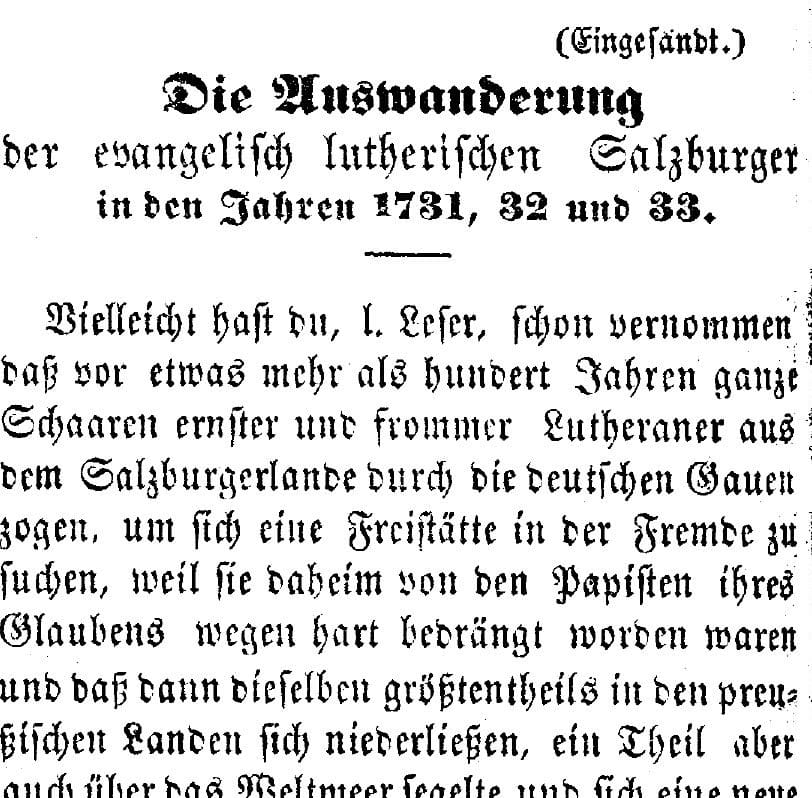
The series began in the number for the third of January 1854 under the plain heading "The Emigration of the Evangelical Lutheran Salzburgers in the Years 1731, 32 and 33," with the small word Eingesandt, submitted, above it. It ran in six installments through the end of July and was signed at the end only with initials, M. F. L. The paper never says whose they are.
He was honest about his source. "I have before me a little book which a descendant of the same has written. From it, and mostly in his words, let me tell thee." A footnote names it: a Geschichte der evangelischen Salzburger, "arranged for the people" from Karl Panse's learned history of 1827, which had reached its seventh edition at Nuremberg in 1848. So this is a popular German retelling, retold again for German Lutherans in Missouri and Ohio and Wisconsin, most of whom had themselves left a homeland within the last twenty years. He addresses the reader as du, the familiar "thou," the whole way through, and he assumes that reader may already know the story, from old Joseph Schaitberger's Sendbrief, his "letter to the exiles," or from a sermon to "the Salzburg emigrants" in some family devotional book of the last century. It was that kind of story. People had it in the house.
At the beginning of November
The trouble had been building since 1727, when Leopold Anton von Firmian became Prince-Archbishop. The paper does not spare him: "a man of proud mind, hard heart and gloomy countenance." His chancellor, Christian von Röll, went from district to district with kind words and promises, writing down the names of everyone who would admit to the Lutheran faith. People came in from the farthest huts to give their names. When he had finished he had 20,678 of them, more than he had expected, and the promises were withdrawn. The paper calls it "a bitterly wicked, poisonous, devilish jest," which is about as strong as Der Lutheraner ever gets.
In the autumn the Emperor sent six thousand infantry and cavalry. Here the series pauses for one of its best pages. The dragoon regiment quartered among the Lutherans was Prince Eugene's, and it was made up mostly of Lutherans.
"Many a fearsome, bearded rider would set the children around him there, take a smaller one upon his lap, and go through the Lutheran catechism with them. And the little ones, who at first had looked shyly at the man with the sword and his dreadful beard, soon perceived that he must have a milder heart than the sneaking Jesuit."
The archbishop heard of it, and the regiment was moved.
Then the edict. The paper says only that it was posted "at the beginning of November," which is when the country read it; the document itself is dated the thirty-first of October. Its terms are printed in full. Servants, day laborers and everyone without land were to be across the border within eight days, "with bag and baggage." Miners and salt workers were dismissed on the spot. Landholders had one to three months to sell. On the twenty-fourth of November the cavalry rode into the district of St. Johann. "From the plow farmhands were driven, and maidservants from their cattle." Where one spouse was Catholic and stayed, the other went alone.
What they carried
The paper keeps the scale in view, about thirty thousand people by its count, but what it remembers are single scenes. A woman left her travelling bundle with her Catholic husband to keep until she came back, took her baby of twenty-one weeks in her arms, went out, and did not come back. Some three hundred crossed the Tyrolean mountains in winter, "children were bound on the backs of their parents."
The landholders had until spring. On the first of May, a week before they had to go, many of them drove their cattle up to the high pasture one last time for the May festival, the animals hung with green wreaths and bells. At sunset, when the snow began to turn red, "they fell upon their knees and prayed with weeping soul the last Alpine prayer." Then they turned loose the animals no one would buy.
One family stands for the rest. Rupert Aesteck of the district of Werfen was still outwardly Catholic. He stood in his doorway with his pregnant wife and three children while a company of Lutherans went by, and wanted to go with them. His wife held him back. When the last of them had passed he went to find his children, and they were gone: "the little ones had gathered up a few articles of clothing and bread crumbs and had gone after the procession." He said, "Dear wife, we will go along." And she answered, "Yes, whither thou wilt, in God's name."
The archbishop had not reckoned on numbers like these. "I will have no heretics more in the land," he said, according to the paper, "even if thorns and thistles should grow on the fields." The seven hundred and fifty miners of the Dürrenberg, the salt mountain that paid him nearly more than all his gold and silver together, declared themselves Lutheran to a man. On the ninth of November they went down the river by boat with their wives and children. "The Archbishop stood at a window of his castle, and as he saw his whole mining office glide down the stream, he gnashed his teeth."
A mighty fortress at the gate
The second half of the series is a different kind of story. Through the Catholic lands the exiles were watched. In the Protestant towns the bells were rung.
The first company, eight hundred people, reached Kaufbeuren in Swabia on the third day of Christmas, 1731, after the gates were shut. "They came late in the evening to the town and announced their arrival by the singing of 'A mighty fortress is our God.'" The gates were opened. At Gera the women met them at the fountains and took the babies out of their mothers' arms to wrap them in clean linen, and the road to Schleiz was lit with lanterns for the next company. At Potsdam King Frederick William I of Prussia, who had offered them land in plague-emptied Lithuania, questioned a boy of fourteen who had left his father and mother for his faith. The boy answered him with the Psalm: "Father and mother forsake me, but the LORD taketh me up." Two months later the King came out from Berlin to meet another eight hundred and asked them to sing "Auf meinen lieben Gott." They did not know the tune as it was sung in Prussia, so the King started it himself and lined it out to them verse by verse, and they went past him singing.
Ebenezer
The last installment, in the double number for the twenty-ninth of July 1854, turns west, and the contributor says plainly that from here on he is not following his little book but "other trustworthy accounts," because the part of the story that touched America was the part his readers would most want.
In 1733 a company of ninety, under two young pastors trained at the orphan house in Halle, Johann Martin Boltzius and Israel Christian Gronau, accepted an invitation to the new colony of Georgia. "Refreshed by a farewell sermon preached to them, richly supplied with Bibles, catechisms, hymnbooks and other devotional writings, and with three wagons, of which one carried their few belongings and each of the other two the aged, infirm and children, they began their pilgrimage on the Feast of the Reformation 1733."
They went down the Main and the Rhine, a boat the paper calls "a floating church," met their pastors at Rotterdam, kept Christmas at Dover, and sailed in January. On the eighteenth of February a storm took in every sail, "and in the midst of the howling of the storm and the roaring of the sea, songs of praise rose from their lips." After a hundred and four days at sea they landed at Charleston in March 1734 and knelt on the beach. Twenty-five miles up the Savannah River they found a place to settle, "and named this their first dwelling place, which later blossomed into a town and remained the chief place of the Salzburgers, Ebenezer, that is, Hitherto hath the LORD helped us."
Why the paper printed it
The series does not end in Georgia. It ends with the contributor turning to his own readers. The descendants of the Salzburgers, he says, are many, in the old world and the new, but many of them no longer hold the faith their grandparents went into exile for; it was lost to the Union church in Prussia and to the sects here. That, he thinks, is the lesson for a church of recent immigrants: guard what you have for your children, support "our two preachers' seminaries," and do not suppose that freedom from trouble is permanent. The last thing he prints before his initials is a stanza asking God to make His church rich in faith, "That the end may equal the beginning."
It is easy to hear only the warning and miss what is underneath it. He was writing to people who had crossed the same ocean, some of them for the same reason, and had built their own Ebenezers in Perry County and Frankenmuth and Fort Wayne. He wanted them to know they were not the first.
Now
The brick church the Salzburgers finished at Ebenezer in 1769 is still standing near the Savannah River, and a Lutheran congregation still worships in it. The town around it is long gone. What remained was the congregation, which is the thing the people at Schwarzach had sworn over the salt cask to keep.
This Saturday a good many Lutheran congregations will sing "A mighty fortress is our God" because it is Reformation Day. The eight hundred at the gate of Kaufbeuren sang it because it was the one hymn everyone knew, and because it was dark, and they wanted to be let in.
The six installments are in the archive, German and English side by side, in the tenth volume of Der Lutheraner: the opening on page 78 (3 January 1854), the covenant of salt on page 110, the edict on page 117, the May festival and Rupert Aesteck on page 147 and the miners on page 148, Kaufbeuren on page 162 and Potsdam on page 164, and the voyage to Georgia on page 195, ending on page 197.
Note: the paper gives no day for the edict, only "the beginning of November"; the date of 31 October 1731 is the one the document bears. It prints Gronau's initials as "G. C."; he was Israel Christian Gronau. And it gives three different years (1684, 1685 and 1686) for Schaitberger's own expulsion, which I have left alone. The transcriptions and translations are machine work corrected against the page, not yet human-reviewed.



Comments ()