
Compiled with Loving Diligence
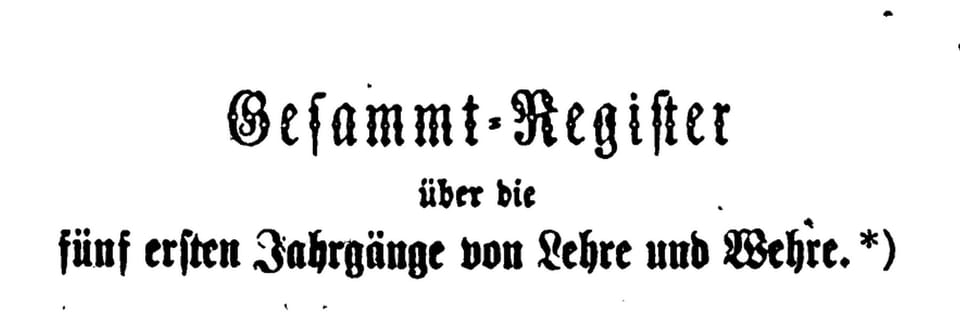
The title has a footnote. That is the first thing worth noticing. Across fourteen printed pages of the cumulative index to Lehre und Wehre — the theological monthly the Missouri Synod began publishing at St. Louis in 1855 — the heading reads Geſammt-Regiſter über die fünf erſten Jahrgänge von Lehre und Wehre, "Complete Register of the First Five Volumes," and then, where no title expects one, an asterisk. Titles do not usually explain themselves. This one had something it wanted to say.
We treat indexes as furniture. They come with the book, like the spine and the page numbers, and nobody asks who made them, for the same reason nobody asks who made the spine. An index to a nineteenth-century journal seems if anything less authored than most: surely the editors compiled it, or the printer's boy, or nobody at all — surely it simply accumulated, the way dust does.
Follow the asterisk to the foot of the page and the editors correct that impression in six-point type:
Die geehrten Leſer verdanken dieſes die Benutzung gegenwärtiger Zeitſchrift ſo erleichternde Regiſter dem liebevollen Fleiße Hrn. P. Keyl's in Baltimore. — D. Red.
Our esteemed readers owe this register, which so eases the use of the present journal, to the loving diligence of Pastor Keyl in Baltimore. — The Editors.

The word to sit with is Fleiß. English renders it "diligence" or "industry," and both are too cold. Fleiß is the virtue of the workbench and the copybook, the daily application that nineteenth-century Germans praised in schoolchildren and craftsmen; a fleißige Hand is a hand that keeps working after the interesting part is over. And the editors did not leave it alone. They wrote liebevoller Fleiß — loving diligence, industry with affection in it. It is not a phrase one wastes on furniture.
Who he was
The journal names its indexer in full, in another footnote, advertising a book of his: Ernſt Gerh. Wilh. Keyl, Paſtor der evangeliſch-lutheriſchen St. Paulus-Gemeinde in Baltimore — a working parish pastor, several hundred miles and a mountain range from the editorial office in St. Louis. He appears throughout the journal's first decade as a contributor; pieces arrive headed Eingeſandt von Paſtor Keyl, "sent in by Pastor Keyl," in volume after volume. And when the journal reviewed his compilation of Luther's writings on the catechism, it reached for a figure that tells you everything about how the man read:
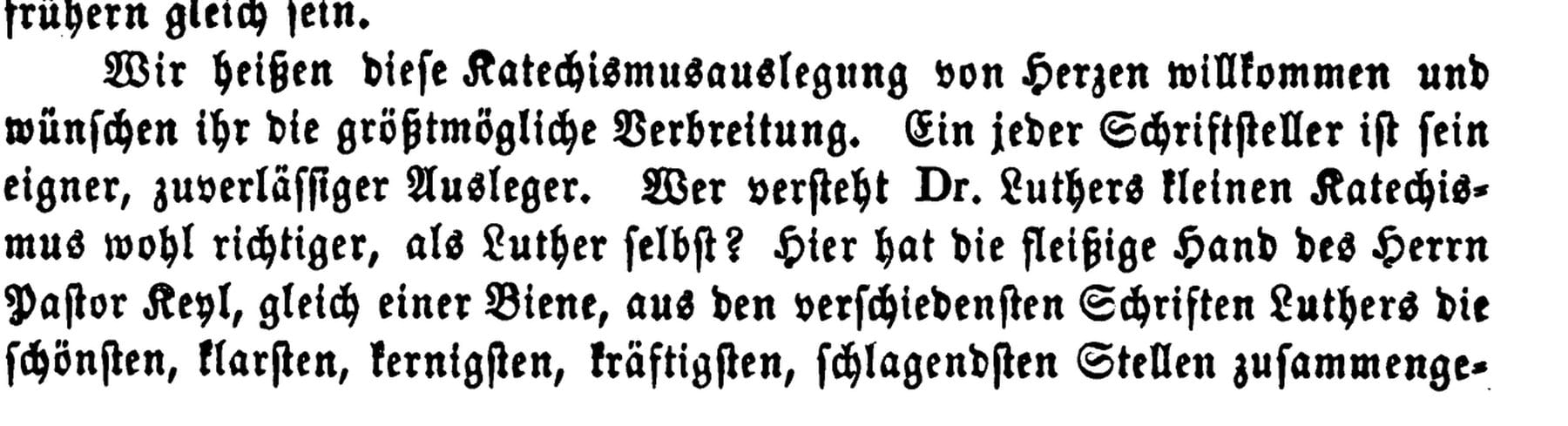
Hier hat die fleißige Hand des Herrn Paſtor Keyl, gleich einer Biene, aus den verſchiedenſten Schriften Luthers die ſchönſten, klarſten, kernigſten, kräftigſten, ſchlagendſten Stellen zuſammengeſtellt.
Here the diligent hand of Pastor Keyl has gathered, like a bee, from the most various of Luther's writings the finest, clearest, pithiest, most forceful, most telling passages.
There is the fleißige Hand again — and five superlatives in a row, which for this journal's reviewing style amounts to throwing a parade. An earlier volume had put the matter more flatly: hardly anyone, it said, has studied Luther's writings as Keyl has. A man who reads that way — gathering, sorting, carrying home — will index a journal for the same reason a bee makes honey. It is what the reading was for.
He did it twice. The first register, covering 1855 through 1859, was mailed to St. Louis around 1860. The second, covering 1860 through 1864, followed five years later, and its own footnote thanks him again: durch die Güte Hrn. Paſt. Keyl's ſen. uns zugeſtellt, "conveyed to us through the kindness of Pastor Keyl senior." Between them the two registers hold 1,710 references, every one keyed by volume and page, every one gathered by hand from a decade of dense Fraktur — evenings of work, one imagines, at a parsonage desk in Baltimore, after the sermon was written and the sick were visited and the interesting part of the day was over.
The compiler's ear
The register is not perfect, and its imperfections are the most human thing in it. Keyl indexed a few people the way he heard them rather than the way they signed themselves. A Swabian sect appears as the Pregegianer; the standard books call them Pregizerianer. The American convert-philosopher Orestes Brownson is filed as Bravenſon — and out of alphabetical order besides, as though added on a second pass. Bishop Colenso of Natal, whose critical work on the Pentateuch scandalized the 1860s, becomes Calenſo. These are the spellings of a man taking down names from conversation and memory, told with complete confidence by someone whose first language they were not. Anyone who has read a family Bible's flyleaf knows the genre. We have kept every one of them as printed, because they are evidence: an index records not only what a journal said but how its most devoted reader heard the world.
What an index confesses
Nobody indexes ten years of a theological journal out of duty. Duty gives out somewhere in the C's. What carries a man through 1,710 entries is the conviction that the thing indexed will be needed — that some pastor in Iowa or 1890 or an age he could not picture would want to know where the journal had treated absolution, and deserved to find it in a minute rather than an afternoon. An index is a wager on future readers, placed by a present one. The editors saw the nature of the gift, which is why they wrote liebevoll.
The wager is still paying. Keyl's two registers were scanned with the volumes they were bound into, and this month, as we built a modern article index to the same journal at the CHI digital archive, his fourteen pages served as our cross-check — the journal's own compiler, auditing our work across a hundred and sixty years, and we his. The audit ran both ways. Each register, it turns out, contains exactly one reference that points nowhere: the entry for Oeſtreich (Austria) sends the reader to volume 3, page 387, and the entry for Sternberg to volume 10, page 387 — and both volumes end at page 384. Both are slips of the printer's, not of Keyl's hand, and both could be repaired from the work itself: Austria is discussed on exactly one page of volume 3, which is 287, and Sternberg's other entries on the same line land so precisely that the stray 387 can only be 381. That the two ghost references share a number is pure coincidence — we checked, resisting the temptation to build a theory on a pattern of two. His entries answer search queries now, which is only the old wager in new type. The loving diligence still eases the use of the present journal. The footnote, it turns out, was not a credit. It was a prophecy.


Comments ()