
Every Day of Lent: The Historic Lenten Weekday Lectionary and the Passion History
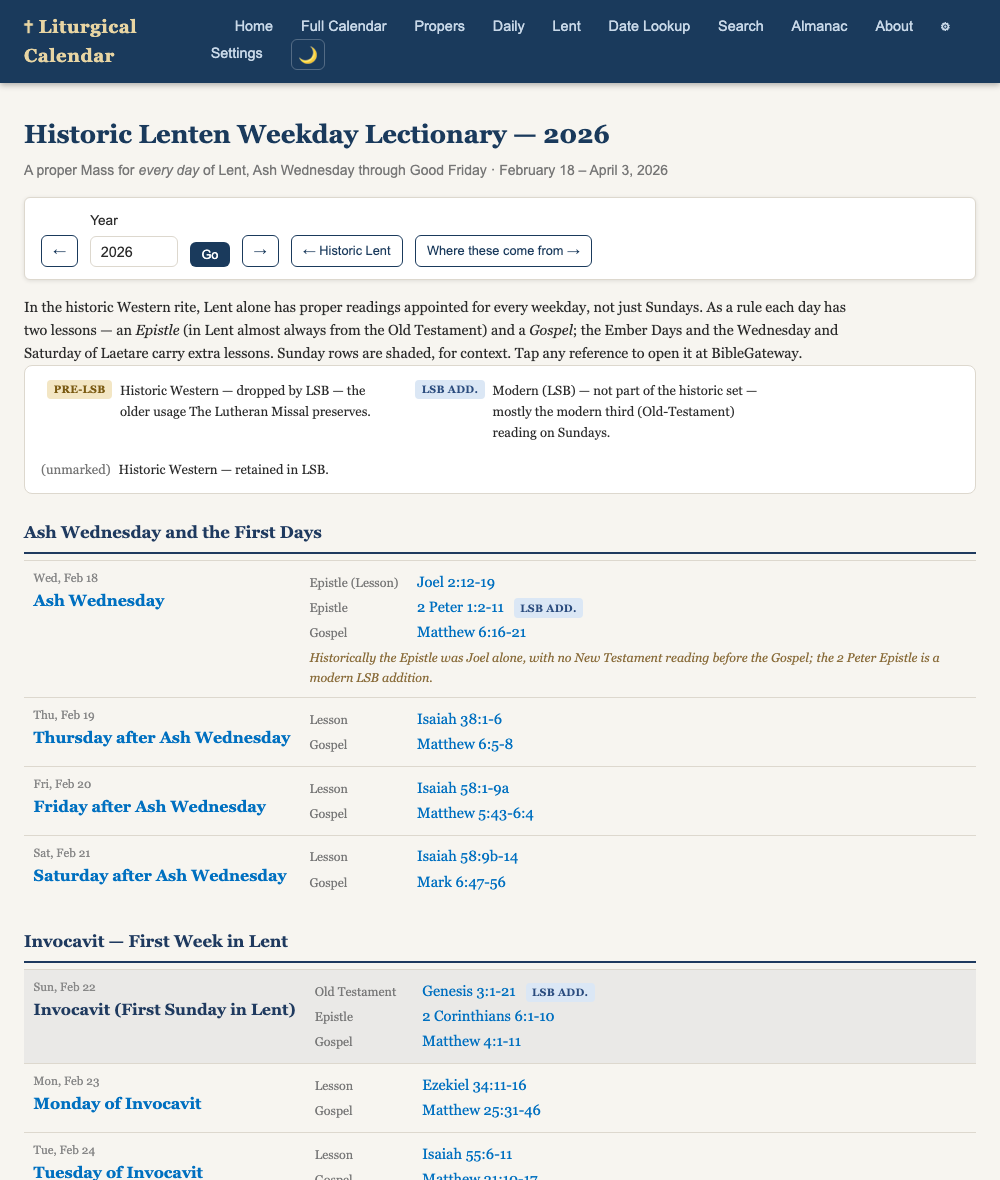
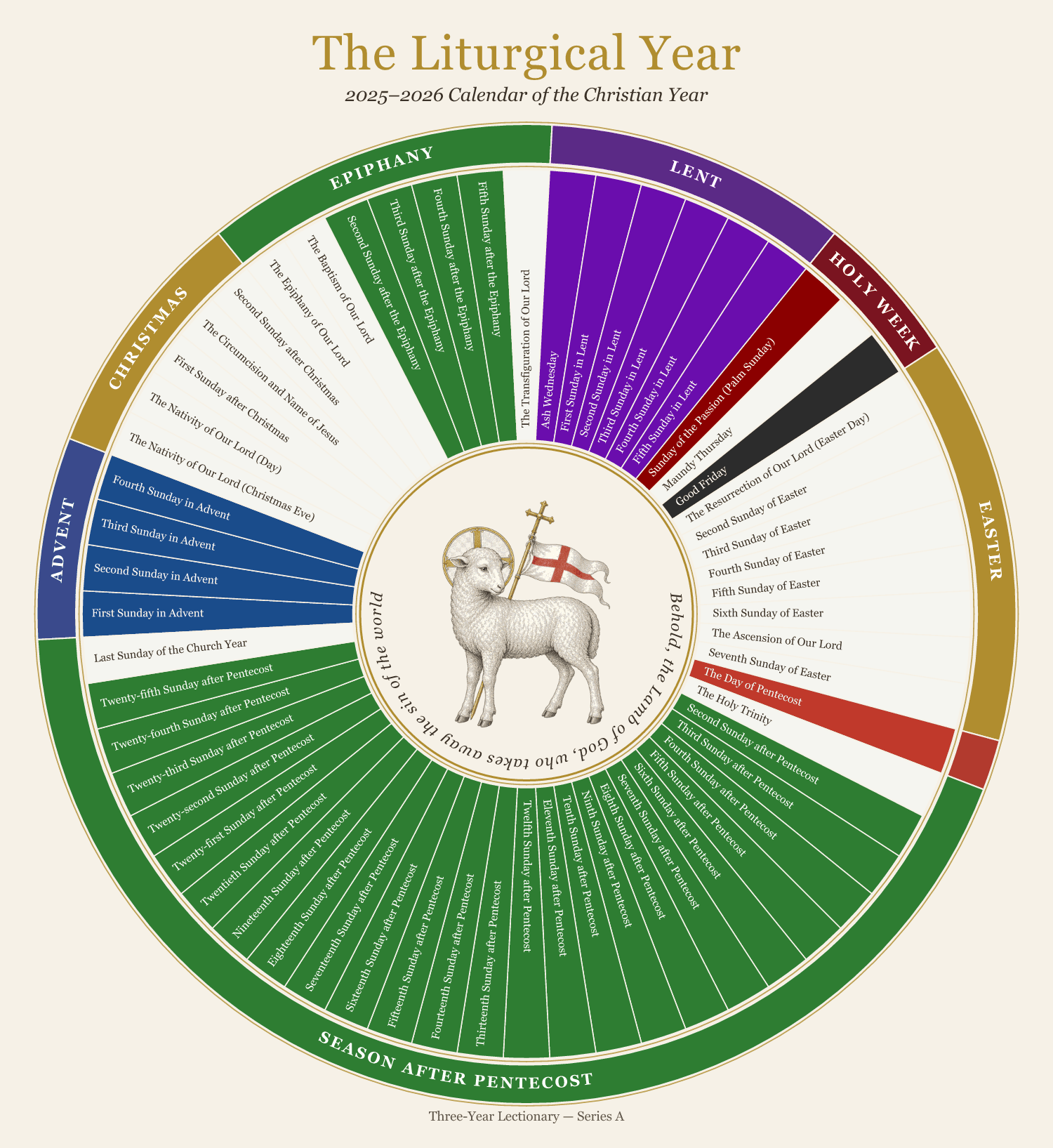
Someone asked me a good question recently: the one-year readings in the Liturgical Calendar come from the Common Service Book of the Lutheran Church (1917), which gives an Epistle and Gospel for every Sunday. But what about the weekdays? Are there historic readings for the Wednesdays and Fridays — and indeed for every day — of Lent?
There are. And the answer opens a window onto something the Western Church has done since at least the seventh century, something Lutherans quietly kept. This month I added it to the app: a Historic Lent section with two companion tracks — the Historic Lenten Weekday Lectionary and the Passion History — and a documented account of where every reading comes from. Here is the story.
Lent is different
Most of the church year gives proper readings only on Sundays and feast days; the weekdays borrow from the Sunday just past. Lent is the great exception. In the historic Western rite, every single weekday of Lent — Ash Wednesday straight through to Good Friday — has its own proper Mass: its own Introit, Collect, Epistle, Gospel. No other season is provisioned so completely.
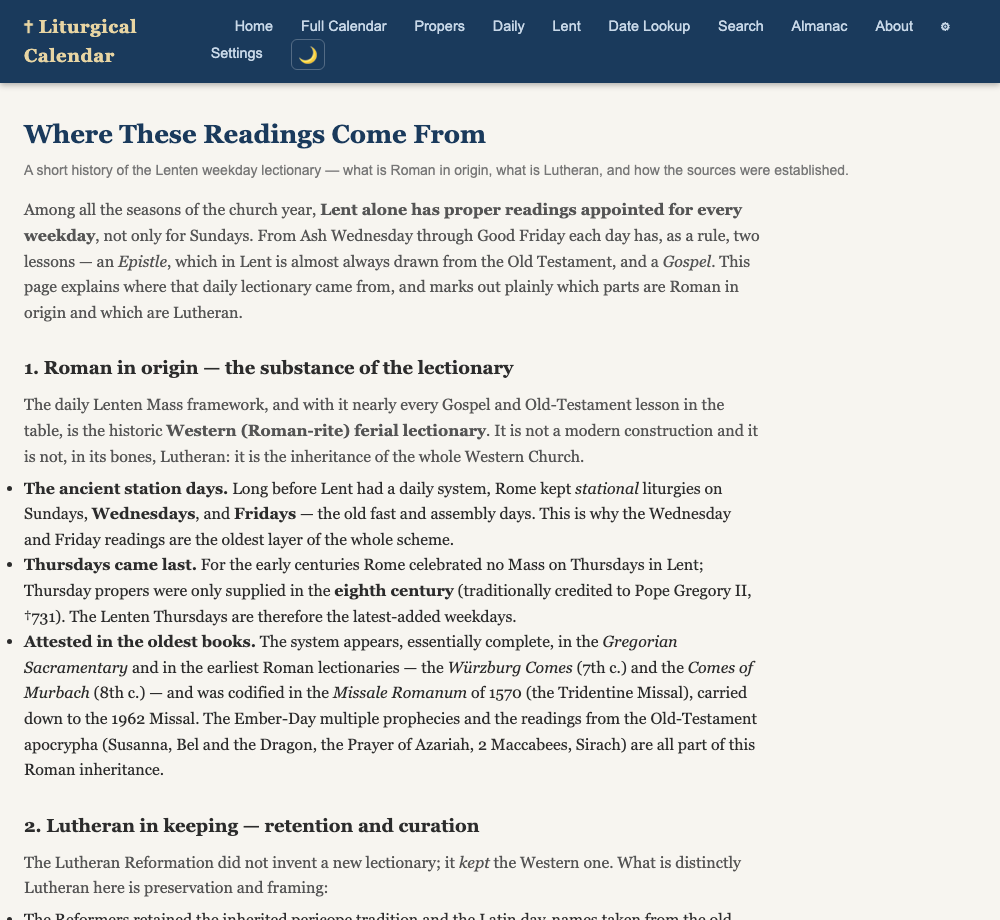
This is ancient. It stands, essentially complete, in the Gregorian Sacramentary and in the oldest Roman lectionaries (the Würzburg Comes of the seventh century, the Comes of Murbach in the eighth), and it was later codified in the Missal of 1570. A few features betray its age:
- Wednesday and Friday are the oldest layer. Long before Lent had a daily lectionary, Rome kept stational liturgies on Sundays, Wednesdays, and Fridays — the old fast days. The person who asked me about Wednesdays and Fridays had, without knowing it, put a finger on the most ancient weekdays of all.
- Thursdays came last. For centuries Rome celebrated no Mass at all on the Thursdays of Lent; Thursday propers were only supplied in the eighth century. The Lenten Thursdays are the newest weekdays in the whole scheme.
- The Ember Days and the deep Old Testament. The Epistles of the Lenten weekdays are drawn almost entirely from the Old Testament — the Pentateuch and the Major Prophets — and the Ember Days pile lesson upon lesson. Ember Saturday alone reads five prophecies before its Epistle and Gospel. You will even find Susanna, Bel and the Dragon, and the Prayer of Azariah, the Greek portions of Daniel, still standing in their ancient places.
So is this Roman or Lutheran?
Both — and it is worth being precise, because the two are braided together.
The substance is Roman. The daily framework, and nearly every Gospel and Old-Testament lesson, is the historic Western ferial lectionary, the common inheritance of the whole Western Church long before there were any confessional divisions.
What is Lutheran is the keeping. The Reformers did not invent a new lectionary; they kept the Western one. The readings survived in the late-medieval German missals and the church orders that grew from them — and it is that specific German recension, not the later Roman standardization, that Lutherans carried forward. The Latin day-names this table still uses — Invocavit, Reminiscere, Oculi, Laetare, Judica — are the old Introit incipits Lutherans never gave up.
The reconstruction shown in the app is the one assembled by The Lutheran Missal project, which is cataloguing the actual manuscript and printed missals of the German Lutheran world and rebuilding the historic lectionary from them. Their method is itself the best evidence for the distinction: where the German Lutheran books agree with the wider Roman tradition, the reading is simply the common inheritance; where they diverge, the divergence is documented.
Reading the provenance marks
In the app, every reading is tagged for its origin, following The Lutheran Missal's own legend:
- (unmarked) — historic and still appointed in today's LSB. The common core.
- pre-LSB — historic, but dropped by the modern LSB. These are the most Roman items, the older usage preserved. Isaiah 53 on Wednesday of Holy Week; Hosea and the Passover-lamb reading of Exodus 12 on Good Friday.
- LSB add. — found in LSB but not historic; modern additions, chiefly the third, Old-Testament reading now given on the Sundays. Historically, for instance, Ash Wednesday's Epistle was Joel alone, with no New Testament reading before the Gospel at all.
The clearest place where Lutheran usage parts from Rome is the Passion Gospel order on Monday and Tuesday of Holy Week. The Lutheran Missal assigns Mark to Monday and John to Tuesday — the minority order in the wider manuscript record, outnumbered roughly two to one. Why choose it? Because every catalogued Lutheran source, and the older northeast-German missals behind them, read it that way — a stream of tradition, as they put it, “as yet unaltered by Rome.”
The other way: the Passion History
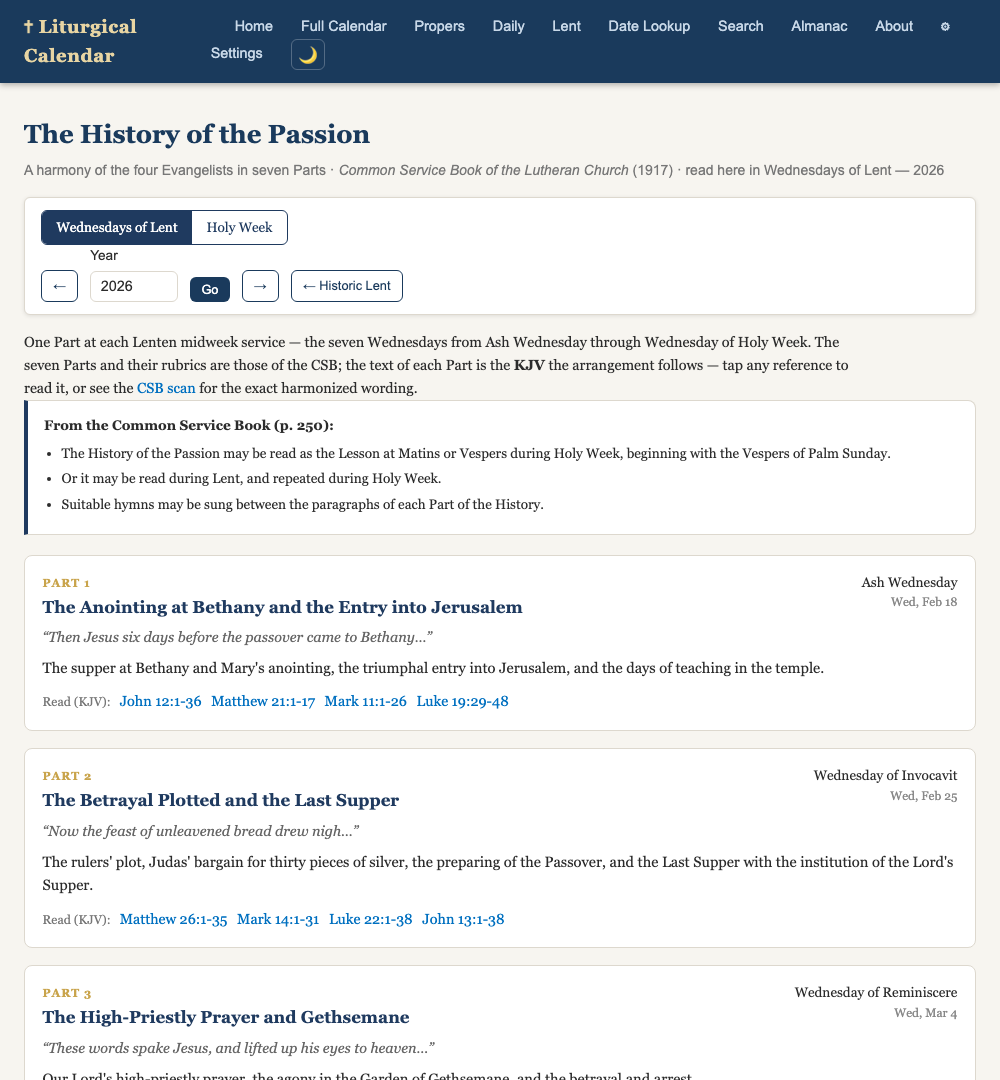
There is a second, unmistakably Lutheran way of keeping the weekdays of Lent, and it is not a Mass lectionary at all. Rather than the daily readings, Lutheran congregations have long gathered at midweek services to hear the Passion History — a harmony of the four Gospels' accounts of our Lord's suffering — read in continuous portions across the weeks of Lent, ending in Holy Week.
The Common Service Book of 1917 prints exactly such an arrangement, made by John Caspar Mattes: “The History of the Passion of our Lord as Recorded by the Four Evangelists,” divided into seven Parts, from the entry into Jerusalem to the sealing of the tomb. Its rubric offers two schedules — read it through Holy Week “beginning with the Vespers of Palm Sunday,” or read it during Lent and repeat it in Holy Week.
The app honors both. A toggle sets the seven Parts against the Wednesdays of Lent (and there are, providentially, exactly seven Wednesdays from Ash Wednesday through Wednesday of Holy Week) or against the days of Holy Week. Each Part links to the King James text the arrangement follows, and keeps the old rubric to kneel at the words, “He bowed his head, and gave up the ghost.”
Where to find it
Everything lives under Lent in the navigation:
- The Historic Lenten Weekday Lectionary — a proper for every day of Lent, any year, with provenance marks and BibleGateway links.
- The Passion History — the CSB 1917 harmony in seven Parts, on the Wednesdays-or-Holy-Week toggle.
- Where these readings come from — the full history, with citations.
The daily Lenten lectionary is, in the end, a small marvel: a Roman inheritance a thousand years deep, kept alive in German Lutheran books, and now a click away. Whether your congregation keeps the weekdays with the ancient Mass propers or with the reading of the Passion, both roads are here — and both are older than they look.
The Liturgical Calendar is free and open-source. The historic Lenten lectionary is reconstructed by The Lutheran Missal; the Passion History is from the public-domain Common Service Book (1917). Always verify against the printed altar book before liturgical use.


Comments ()