
The Stamp of Untruth
What Der Lutheraner told its readers about Germany, 1933–1934
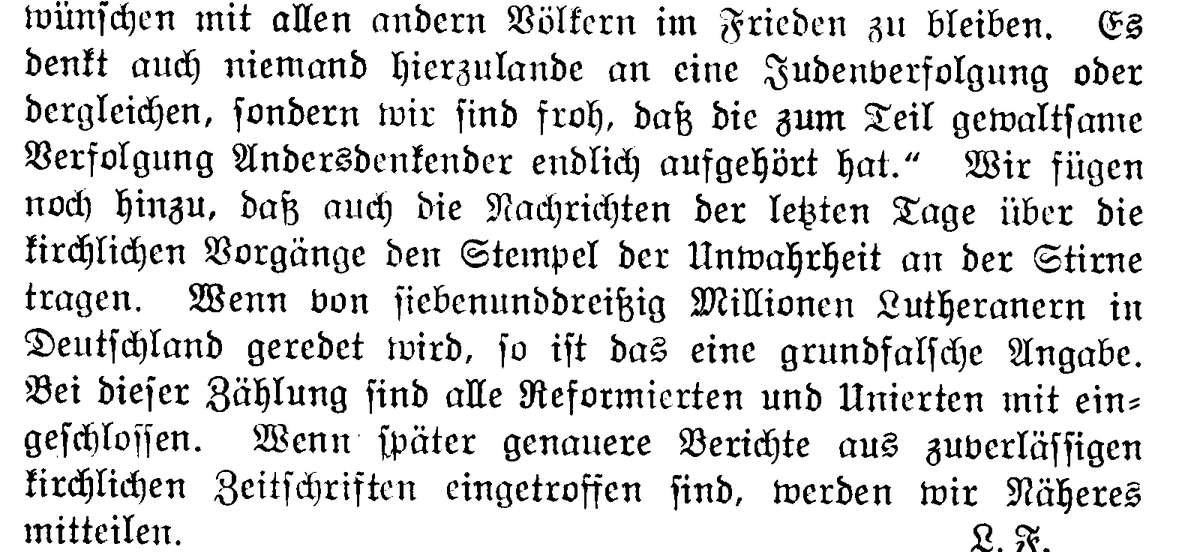
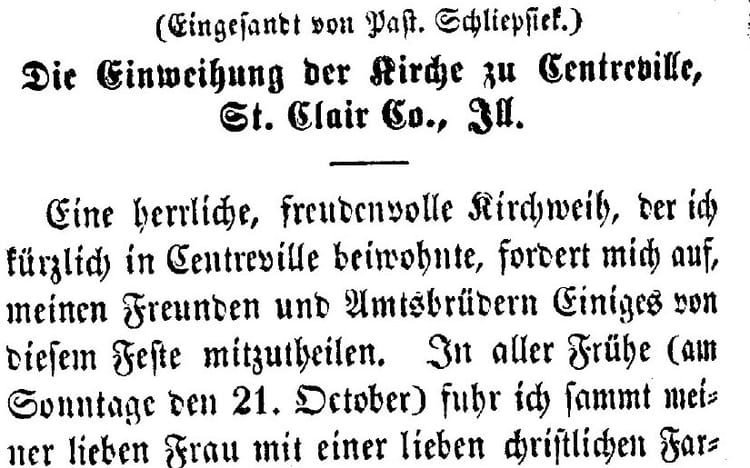
On March 28, 1933, a man in Germany sat down to write to St. Louis. He wanted American Lutherans to know the truth. The newspapers abroad were spreading reports of horrors, and he was in a position to correct them. "Complete calm prevails in the country," he wrote, "and no one is thinking of mistreating the Jews or other opponents of the government now in power."
The editor of Der Lutheraner, the German-language paper of the Missouri Synod, printed the letter with an introduction. Its author was "a man who for years has followed events with a sharp eye and sound judgment," who had lived on another continent, visited America, and knew what had happened in Europe over the past half century. The editor had doubted the press reports from the start. Now he had a witness.
The letter went on: "What is being done against individual Jews is only a defensive measure against those who slander Germany from abroad." It asked to be made known, "so that a false picture of conditions in Germany may not arise again through lying propaganda." And it closed: "No one here thinks of a persecution of the Jews or the like, but we are glad that the partly violent persecution of those who think differently has at last stopped."
The editor added a few sentences of his own, about the latest reports on the German church. They too, he wrote, "bear the stamp of untruth on their forehead." His evidence was a number: the thirty-seven million Lutherans the reports spoke of included all the Reformed and United. It was signed L. F., the initials of Ludwig Fuerbringer, president of the St. Louis seminary.
Four days after that letter was dated, the national boycott of Jewish businesses began.
There are two tidy stories on offer. In one, Missouri was silent about Hitler. In the other, a confessional church saw clearly what the liberals missed. The volumes of Der Lutheraner for these years went up on the archive site only this month. The paper was not silent, and it saw clearly only in part.
The Book Burning
Later in 1933 the paper took up the event every schoolchild now associates with those months. The piece appears under the heading "Hitlers Bücherverbrennung" (Hitler's book burning), and it notices that many people had been making "hearty fun" of the burnings. It grants that "some books were probably burned wrongly." Then it turns:
But the Hitlerian book burning was only a sign of the position of his party against Bolshevist and Communist books. It was a sign that people no longer wanted to tolerate what long since should no longer have been tolerated.
What serious Christian men and women in Germany had wanted for years, it goes on, was "to cleanse the land of book filth" (Bücherschmutz). For evidence it cites the editor of the Wisconsin Synod's Northwestern Lutheran, astonished by the Marxist and atheist titles on sale in Germany in 1931. Its last quotation is from the Lutheran Herald of the Norwegians: "It is not fitting for us to join the accusations of the Bolsheviks against the Hitlerian book burning," and "Let us rather thank God that Germany has been preserved from Communism." The piece is signed J. T. M., the initials of John Theodore Mueller of the St. Louis seminary.
Nothing here is careless. These writers feared one thing, and they had good reason to fear it. Two years earlier Mueller had reported the arrest in Leningrad of about eighty Christians, a number of them pastors, "for the sole reason that they had taken part in the church life of the Evangelical Lutheran congregations." Fear of the one fire made it hard to look at the other.
Where They Saw Clearly
On the same page as the book burning is an item that reads quite differently. Its subject is Ludwig Müller, the military-district chaplain who would soon be Reich Bishop, and who must not be confused with J. T. Mueller of St. Louis. In an interview the chaplain had said that the church should supply "the weapons for our struggle against everything un-Christian and un-German," and should cultivate every good German custom "rooted in our race and our nationhood." Mueller answered that such "lofty words" could be read in many ways, "and not always the right one." The new church would in any case exist to serve the German state "as it now exists," and it would be built wholly on a unionist foundation. He asked what its "inwardly common element" could possibly be.
The Eisleben celebration of Luther's 450th birthday brought the same test. The paper did not condemn everything about it. But it quoted the German Christians, who answered the cry of millions with "the German prophet Luther" and stood together "because we trust the man whom God has given us," and it called these "all empty words." This, said the headline, was how it did not want to keep its own Luther festival. Luther "was indeed a great German; but it is not as a German that he lives in church history," but as a confessor of Jesus Christ.
And Fuerbringer himself printed the most chilling thing in these volumes, to show, he said, what thoughts were moving wide circles in Germany and how they mixed the spiritual and the worldly. It is a letter from an educated woman of the state church, the wife of a respected man. It is, she says, "an incredibly beautiful time."
We are all firmly convinced that the fascist movement, called into being by Mussolini, strengthened by Hitler and anchored on German soil, will spread in all directions and within decades will take in many countries where the foundations for it are already laid. National Socialism will become a world religion; for religion it is unconditionally; faith, love, hope are among its basic lines too. [?] We are only sorry that we did not belong to the fortunate very first fighters, who with great personal sacrifice set the wheel rolling.
That "[?]" is in the print, set between two of her sentences, and nothing on the page explains it. Beneath the letter the editor wrote: "Such thoughts give one pause and fill those who follow the course of events in church and world attentively with serious concern."
So the discernment is real. Notice where it lives. It is sharp wherever the question is the confession: the Gospel, the union of Lutheran and Reformed, the freedom of the church. The remedy offered, again and again, is a free church apart from the state, which is to say, what Missouri already was. Mueller's comment on the Concordat of 1933 was that Hitler ought to have given the Protestants the same rights as Rome, Lutherans and Reformed each apart; then perhaps faithful Lutherans could have come together in a free church "that takes the confession seriously."
When the theological faculties of Erlangen and Leipzig protested the planned reordering of the German church in 1934, he wrote that one might be glad of such words, though "the right clarity and firmness" were not in them. The Erlangen sentence he quoted held that the absorption of Lutheran churches into the German Evangelical Church contradicts the Lutheran confession's idea of the church. It appears again in a declaration printed that September in the Bavarian church's official gazette, as what its signers had already said "in May of this year." The declaration opens by taking for granted that the territorial churches must be reordered "in the new state of national unification," and it ends by calling for "a Reich church of Lutheran confession." It carries six names: Althaus, Elert, Preuss, Procksch, Ulmer, and Hermann Sasse. Erlangen wanted a Lutheran Reich church. Mueller wanted a free church. That was the distance between them.
The Antichrist Question
Near the end of the 1934 volume a writer in the Sunday School Times is reported as suggesting that the dictators of Europe might together make up the coming Antichrist, each with his sign: the crescent, the fasces, the hammer and sickle, the swastika. The writer himself was inclined to take Hitler for the Antichrist foretold.
Mueller found the blindness of this deplorable. Such an interpretation showed great ignorance of Scripture, and above all "how little people recognize the true Antichrist, the Roman papacy." The item goes on to the gulf between Lutherans and Reformed fundamentalists. Hitler does not come up again.
That is Lutheran doctrine as the fathers taught it. It is also a sentence written in Missouri in 1934, and the reader may hold both of those facts at once.
The Alleged Persecution
The hardest item came earlier that year, under a heading that sounds as though it is going somewhere better: "The Growing Hatred of the Jews."
In our daily papers a great fuss is made about the alleged persecution of the Jews in Germany. Yet formal persecutions of the Jews are also setting in in other countries.
The word is angeblich, alleged. What follows is a survey, drawn from the Jewish Missionary Magazine, of real suffering: Jews near starvation in Poland, kept out of vocational schools in Latvia, posters in Antwerp calling for a boycott of their shops. It runs on through Romania, Greece, Tunis, Argentina, China and Toronto, and comes last to Palestine, where Arabs are sending for Mein Kampf. It ends:
Who would not think here of the words of curse which the Jews themselves called down upon themselves: "His blood be on us, and on our children!"? Matt. 27:25.
That is the end of the item. That verse had a long history in Europe by 1934, and Luther's own late writings had added to it.
What the Police Attended
Later in 1934 Fuerbringer printed a long lecture by Martin Willkomm, rector of the Free Church seminary in Berlin-Zehlendorf. Willkomm was no stranger. He had studied at St. Louis from 1895 to 1898, and that year the seminary named him an honorary doctor of theology, on the same list as Vice-President J. W. Behnken. When Fuerbringer wanted "a somewhat more exact, reliable view" of the German church in 1933, instead of the newspapers, it was Willkomm he asked.
The lecture is a clear account of a state-church system that had failed long before Hitler. The old churches claimed to stand on the confession, and for most of their pastors it had long been a position left behind. Willkomm also spoke as a man of his year. The charge of division, he said, weighs all the heavier today, "now that we have learned again what national community (Volksgemeinschaft) is." After 1918, he said, the churches threw themselves into busyness and "all sorts of world conferences" that served "a mistaken internationalism and pacifism," and boasted that the "century of the church" had dawned, while they left false doctrine unfought. Then he called two witnesses:
That this is not painted too black is proved by statements of leading churchmen and theologians such as Dr. W. Laible in Leipzig and Prof. H. Sasse in Erlangen, which are available in print.
He goes on at once to say that the Lutheran leaders and positive theologians "not only failed, but betrayed" the cause. He says that both sides of the church struggle fought at first under the watchword "Here Müller, there Bodelschwingh," over the person of the bishop and power in the visible church. He condemns the current among the German Christians, exposed at the Sportpalast rally, that declared the Old Testament incompatible with "Aryan" feeling. He calls the fight against those errors "entirely justified and necessary," and he reminds his hearers that such errors had been taught on theological faculties long before there were German Christians.
Fuerbringer's introduction contains one more sentence. It is meant to reassure.
Officials of the secret political police attended several sessions of the synod, also requested the manuscript of the lecture, but in no way hindered the assemblies, just as the whole church work of our brethren in the Free Church in general continues, as before, without any disturbance whatever.
The police are in the room, and they want the manuscript, and the report is that there has been no disturbance.
The Two Witnesses
Willkomm does not quote either man or say which statements he means, and these pages do not tell us. Two private letters in the Sasse archive, which he cannot have seen, show how the pairing looked from Erlangen.
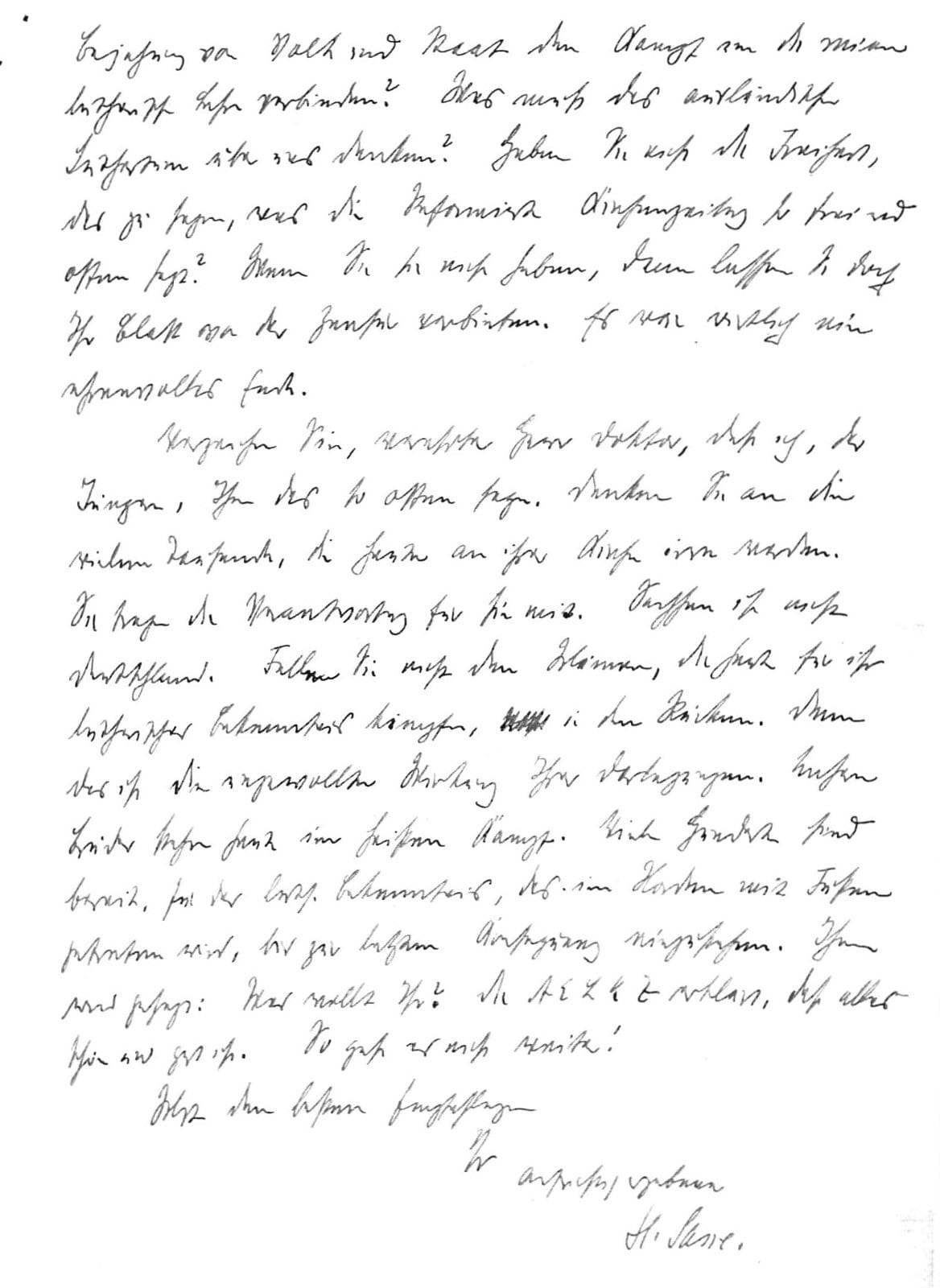
The first is dated October 6, 1933, the date of number 40 of the Allgemeine Evangelisch-Lutherische Kirchenzeitung, the Leipzig paper Sasse elsewhere links with Laible's name. It is addressed only to "Herr Doktor," and it speaks of "number 40 of your paper." Sasse asks how that paper can "capitulate so unreservedly to the false doctrine which today wears the mask of the 'German Christians.'" If the editor no longer has the freedom to speak, he writes, "then do let your paper be banned by the censorship. It would truly be an honorable end." In the same letter he asks whether one can no longer join "joyful affirmation of people and state" to the struggle for Lutheran doctrine. Both sentences are in the letter. Nothing on the sheets shows whether it was sent or answered.
The second, a carbon of June 13, 1934, went to a colleague in Munich after the Barmen synod. In Munich, Sasse writes, many had their eyes opened only "after the Sportpalast." The Lutheran bishops had denied their confession on "the fateful July day of 1933." And he takes up the very remedy St. Louis kept offering: "if I still had to live in Berlin today I should not be with the so-called Confessing Front and its free synod, but probably with the Old Lutherans." Those were not Missouri's German brethren but another free church. He adds that he is staying where he is: "I remain in the church," in the hope that the Bavarian church would yet remember its confession.
None of this settles what Sasse thought of the state in those years, and I do not offer it as settling that. It shows only that the man Willkomm called as a witness was saying some of the same things, in private, from inside the kind of church Willkomm was describing.
What I Take from This
A caution first. These volumes are selected pages, chosen by a compiler who had his own views, so they are not a neutral sample. Among the pages the printed index lists on Germany and our copy lacks are Willkomm's own report of 1933 and a second entry in 1934 under the same heading as his lecture. Absence of a sentence from these pages is not absence of the sentence from the paper, and someone with a complete run may yet correct me.
Nor were these bad men. For years the Synod supported its sister church in Germany "with rich gifts," and they said plainly what was wrong with the German Christians. They trusted a friend who had a sharp eye and sound judgment, and he told them what he believed. They distrusted the daily press, which in their judgment had lied about Germany within living memory; the paper said so in the first months of the war.
That is what stays with me. Their doctrine told them which errors to watch for, and they watched for those very well. It did not tell them to ask, of a letter from a trusted friend in Germany in March 1933, how freely it could be written.
The pages are online now, in the original, with the scans, and I would rather you read them than take my word. The stamp of untruth is an easy thing to apply. We are all applying it this week, to something, on the word of someone we trust.
Sources
Der Lutheraner (St. Louis). Quotations read against the page scans.
| Item | Reference | Signed |
|---|---|---|
| Letter of 28 March, "Nachrichten aus Deutschland" | 89 (1933), 137–138 | L. F. |
| Willkomm asked for a report, "Zur kirchlichen Lage in Deutschland" | 89, 203 | L. F. |
| "Was wollen die Deutschen Christen?" | 89, 267 | J. T. M. |
| "Hitlers Bücherverbrennung" | 89, 267–268 | J. T. M. |
| "Wie wir unsere Lutherfeier nicht gestalten wollen" | 89, 346–347 | J. T. M. |
| Letter of the state-church woman | 89, 376–377 | L. F. |
| Concordat | 89, 379 | J. T. M. |
| "Der wachsende Haß gegen die Juden" | 90 (1934), 105 | J. T. M. |
| "Unsere Ehrendoktoren" | 90, 198 | |
| "Proteste gegen die Neuordnung der deutschen Kirche" | 90, 235 | J. T. M. |
| Willkomm lecture and police note | 90, 354–356 | L. F. (note), M. Willkomm |
| "Böse Zeichen des kommenden Antichristen" | 90, 409 | J. T. M. |
| "Verfolgung in Rußland" | 87 (1931), 187 | J. T. M. |
| "Warum wir unsere Mission in Deutschland unterstützen" | 87, 42 | J. T. M. |
| "Kriegslügen" | 70 (1914), 416 | G. |
Prior study: Kenneth C. Barnes, "The Missouri Synod and Hitler's Germany," Yearbook of German-American Studies 24 (1989): 131–47, which cites the letter of 28 March (as Der Lutheraner, 18 April 1933, 137–38) and the book-burning item (8 August 1933, 267–68), and treats the Lutheran Witness and the Walther League Messenger for the same years.
Sasse papers, read on copies in my catalogued research collection, which is not open to readers. The numbers are that catalogue's.
| Item | Original or holder | Catalogue no. |
|---|---|---|
| "Erklärung von Mitgliedern der Theologischen Fakultät der Universität Erlangen," Amtsblatt für die evangelisch-lutherische Kirche in Bayern, no. 30 (17 Sept 1934), 139–140 | printed | SSP-S2552 |
| Sasse to "Herr Doktor," 6 Oct 1933, autograph | copy, pencilled "orig in BLA file" | SSP-S2463 |
| Sasse to Bachmann, 13 June 1934, unsigned carbon | UB Erlangen MS 2771 (Nachlass Hopf) | UBE2771-HC-100 |
| Sasse to Bogner, 11 Dec 1945 ("Laible-Bergdolts AELKZ") | UB Erlangen MS 2771 (Nachlass Hopf) | UBE2771-BC-013 |
On Sasse and St. Louis, see also last week's essay, As Long as the Pope Believes It.

Comments ()