
Why Sasse Walked Out of Barmen
On Monday, May 14, 1934, Hermann Sasse (1895–1976), the Lutheran theologian then teaching church history at Erlangen, wrote to his young friend Friedrich Wilhelm Hopf, then a city vicar in Aschaffenburg and the man who kept his letters, that he would take the seven o'clock train in the morning from Fürth by way of Würzburg to Frankfurt. The train, he thought, would pass through Aschaffenburg at 10:50. At the foot of the page he added a footnote: "I shall look out of the window and make myself noticed."
He never boarded the train. That same evening, between ten and eleven o'clock by the Erlangen postmark, a second card went to Aschaffenburg in another hand. "By dictation I inform you that I have suddenly fallen ill," it begins; he would not be travelling to Frankfurt. He had told his bishop and named Hopf as support. Perhaps, the card went on, Hopf should go in any case, speak with Hans Asmussen, a Lutheran pastor from Schleswig-Holstein and one of the Confessing Church's leaders, who was helping to draft the declaration, and hold him to C. A. 7 as the foundation. C. A. 7 is the seventh article of the Augsburg Confession (Confessio Augustana), the article on the church. Hopf went, at the last moment.
The meeting he missed was the one that prepared the Barmen Theological Declaration. Two weeks later the Confessing Synod of the German Evangelical Church met in the Gemarke church at Wuppertal-Barmen, May 29–31, and adopted it. Its first thesis is the one most often quoted: Jesus Christ, as he is attested to us in Holy Scripture, is the one Word of God which we have to hear and which we have to trust and obey in life and in death. The received story makes Barmen the Confessing Church's finest hour, and in many ways it was. Sasse was a member of that synod. He left it early on the morning of the last day, after handing its president a written protest.
Hopf kept what Sasse sent him. When Matthew Harrison, then president of the Lutheran Church–Missouri Synod, and I photographed his papers at the University Library in Erlangen in June 2017, the Barmen weeks filled a run of more than twenty letters, cards and copies. They let us follow Sasse there and back.
Before the Synod
The name of the synod already holds the question. Bekenntnissynode can be rendered "Confessing Synod" or "Confessional Synod." The German Bekenntnis means both the act of confessing and the confession that is confessed: the Augsburg Confession is a Bekenntnis, and so is the martyr's word before the magistrate. The men gathering at Barmen meant the first. They intended to confess Christ against the German Christians (Deutsche Christen), the party that wanted a church shaped to the new Reich. Sasse asked about the second. By which confession, and for whom, would this synod speak?
He had seen the Frankfurt draft by May 21, when he wrote to his bishop, Hans Meiser, Landesbischof (territorial bishop) of the Lutheran Church in Bavaria since 1933. "This declaration is far too unionistic," he wrote. It spoke of the theological presuppositions of the German Evangelical Church (Deutsche Evangelische Kirche, the DEK), "whereas on the basis of CA 7 we must deny the DEK the name of a church." A body that joined Lutheran, Reformed and United territorial churches under one Reich constitution was a federation, not a church. A synod drawn from all three, he argued, could not issue a confession "not even under the title of a 'declaration.'" He had sent Hopf to Frankfurt to speak with Asmussen, he told the bishop, "but Asmussen too evidently let himself be impressed by Barth." Karl Barth, the Swiss Reformed theologian then teaching at Bonn, was the declaration's principal author.
What he wanted from Barmen instead fills most of the letter. The synod should state plainly that "the greatest breach of law that German church history knows is taking place": the abolition of the legal right of the Lutheran and Reformed churches, a right that had stood since the Peace of Augsburg in 1555, or for the Reformed since the Peace of Westphalia in 1648. He wondered aloud why the churches did not sue the Reich church government in the State Court. He also faced the possibility of losing: "The way in which we are defeated, if God does not spare us the defeat, is not a matter of indifference." It mattered, he wrote, whether a church laid down its rights of its own accord or had them taken from it by a state overstepping its limits.
To Hopf, the same day, he was briefer. The Frankfurt resolution was "dreadful rubbish." The German word is Blech, tin. "Barthian union." His fevers had returned, the doctors could not find the cause, and he was cancelling every lecture and conference outside his teaching.
He saw a second danger on his own side. On May 27 he reported a long conversation with his Erlangen colleague Paul Althaus, the systematic theologian. A Lutheran front was forming that kept the door open to the German Christians. Its chief dogma, Sasse wrote, was "the holiness of the nation [Volk] and the 'kowtow' before the total state," and its theology was "determined by hatred of Barth." Everything had to be tried to prevent "the false alignment of fronts: here the Confessing front with a union programme under Barth's leadership – there the Lutheran front with the D[eutsche] C[hristen]." He would probably go to Barmen after all, "so that Erlangen is represented."
A letter followed him there. Wilhelm Zoellner, the retired general superintendent of Westphalia, had received Sasse's theses from Hopf and wrote to him at the synod office on May 28, from a sanatorium near Dresden. He asked Sasse earnestly to prevent a disaster. Karl Koch, president of the Westphalian provincial synod and soon to preside at Barmen, and Martin Niemöller, the Berlin-Dahlem pastor who had founded the Pastors' Emergency League, were in his view determined unionists, the League's leaders in Prussia. Meiser had to be helped to see more clearly, and Sasse was the man to help him.
Three Days in Barmen
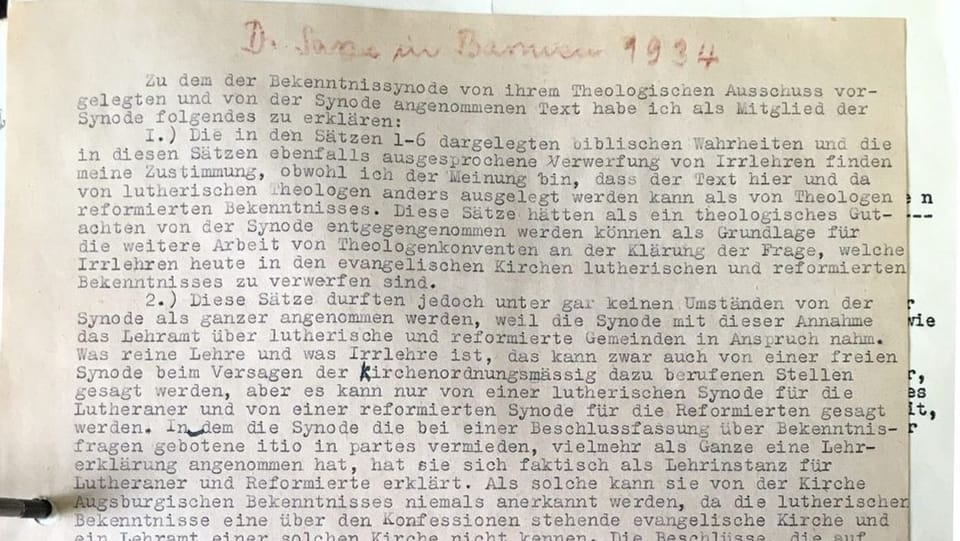
Sasse gave the six theses his assent, with a reservation. His declaration of May 31 begins: "The biblical truths set out in Sentences 1-6, and the rejection of false doctrines likewise pronounced in these sentences, have my assent." The reservation followed at once: Lutheran and Reformed theologians could read the text differently. Received as a theological opinion, a basis for further work, the theses would have been acceptable to him. His letter to Meiser had been harder on the draft, calling it "downright Reformed."
His objection was to who was speaking. A free synod might well say what is pure doctrine when the regular church authorities fail, "but it can only be stated by a Lutheran synod for the Lutherans and by a Reformed synod for the Reformed." The old rule of German church law for such cases was the itio in partes, literally "going into parts": on a question of confession the bodies separate and each confession votes by itself. The Peace of Westphalia had written it into the procedure of the Imperial Diet, and Sasse wrote that it was "legally prescribed" even in the Supreme Church Council of the Prussian Union. In his account Barmen voted as one body. "By avoiding the itio in partes required in a resolution on questions of confession," Sasse wrote, "the Synod has in fact declared itself a teaching authority for Lutherans and Reformed." He also objected to the preamble, which cited Article 1 of the DEK constitution without protest. That article, he argued, made sense only if the divisions of the Reformation were no longer church-dividing and Article 7 of the Augsburg Confession on the unity of the church was false.
So I am compelled solemnly to protest against the resolutions of the Free Synod in Barmen as against a violation of the Evangelical Lutheran Church.
The German word is stronger than "violation": Vergewaltigung, an outrage done by force. The declaration ends in regret, not anger. The great hour of a confederation of the genuine confessional churches had been missed, he wrote, and instead the way of a new union had been taken, "which blurs and dissolves the confession of the Reformation."
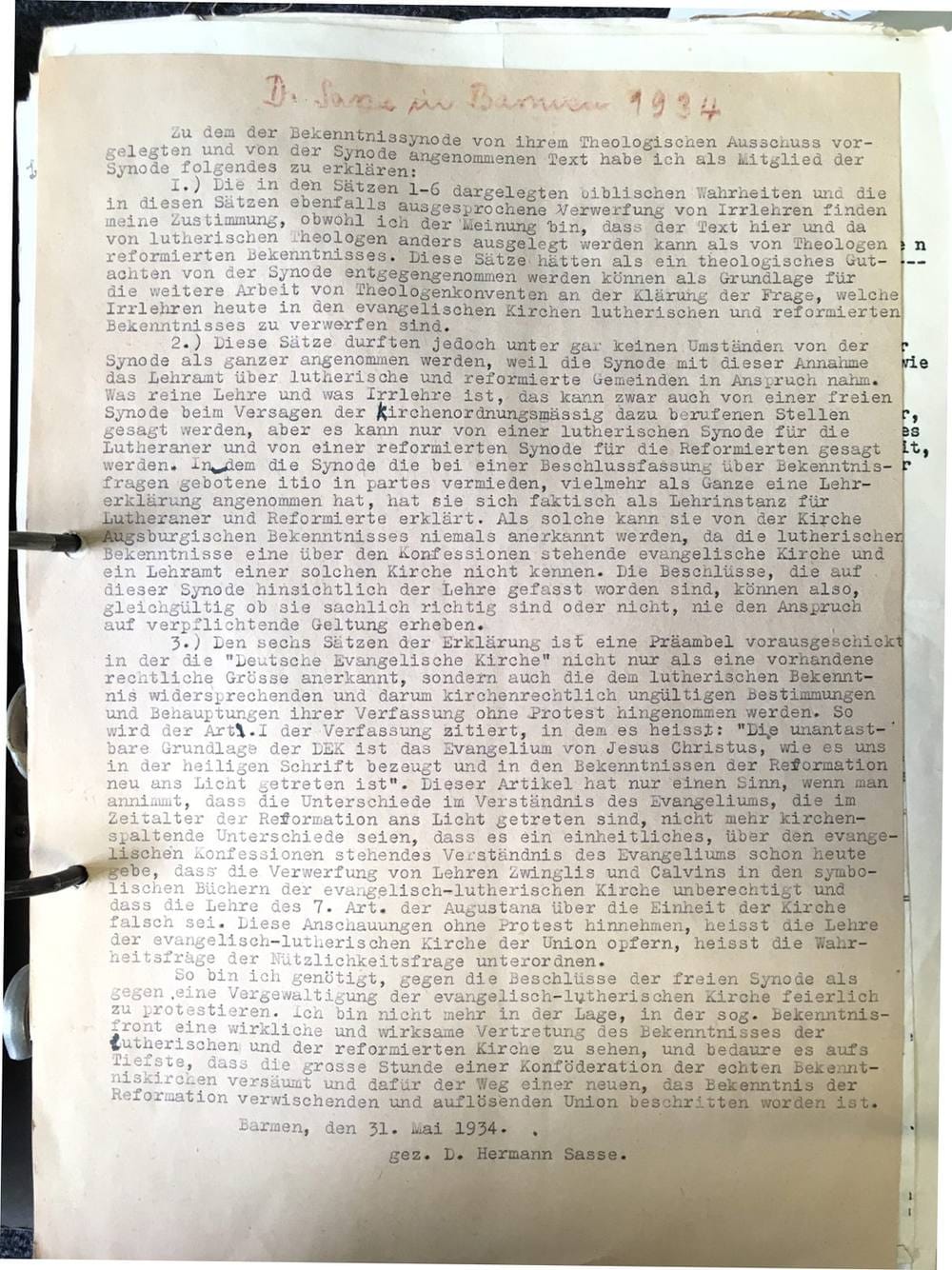
The Hopf papers hold four copies of the declaration, in two versions, typed and carbon. One is headed in red ink "D. Sasse in Barmen 1934," the D. standing for his doctorate in theology. Another, headed "Declaration by Professor D. Hermann Sasse in Barmen," carries the request Bitte zurück, please return. It had gone round.
What happened in the hall Sasse told Friedrich Bachmann, a schoolmaster in Munich, two weeks later. He had tried in vain to get the floor. "Only in a small commission of about seven members could one speak openly." The commission was not enough to stop the vote, but it was not nothing. "Only afterwards, when the sword of Damocles of my declaration hung over the synod, was the sentence put into the introduction that no union was to be created. For days I fought with Asmussen about it in vain." As Sasse saw it, the synod now offered both at once: an assurance that no union was intended, and a doctrinal declaration binding on both confessions together. The synod for its part resolved to hand the declaration to its Lutheran, Reformed and United convents, to be worked out from their own confessions. To Sasse that came after the vote that mattered.
The Private Letters
The formal protest is careful. The private letters are not. To Zoellner, on June 1, the day after he left:
It was simply dreadful, an orgy of stupidity and enthusiasm.
Hans Asmussen, who had given the synod's address on the declaration, was the man Sasse blamed. Asmussen fired off his convictions "like a machine gun fixed in position," and one could never negotiate with him. He was a Pneumatiker, a man of the Spirit, "but it is not only the Holy Spirit that speaks out of him." After his address the Spirit "fairly rushed through the assembly, or what he took to be such." Had Asmussen moved to admit the Koran among the symbolical books of the DEK, Sasse thought, the synod would probably have agreed with enthusiasm. One man alone kept his head: "The only man who was not drunk with the Spirit and with whom one could talk was Karl Barth." The bishops, the imposing August Marahrens, Lutheran bishop of Hanover, among them, had not noticed that they were being used.
Then, before he closed: "All the leading people of the Confessional Synod will have vanished from the scene within a few months, if not weeks. But the Lord of the Church remains; that is our comfort in view of the terrible failure of men."
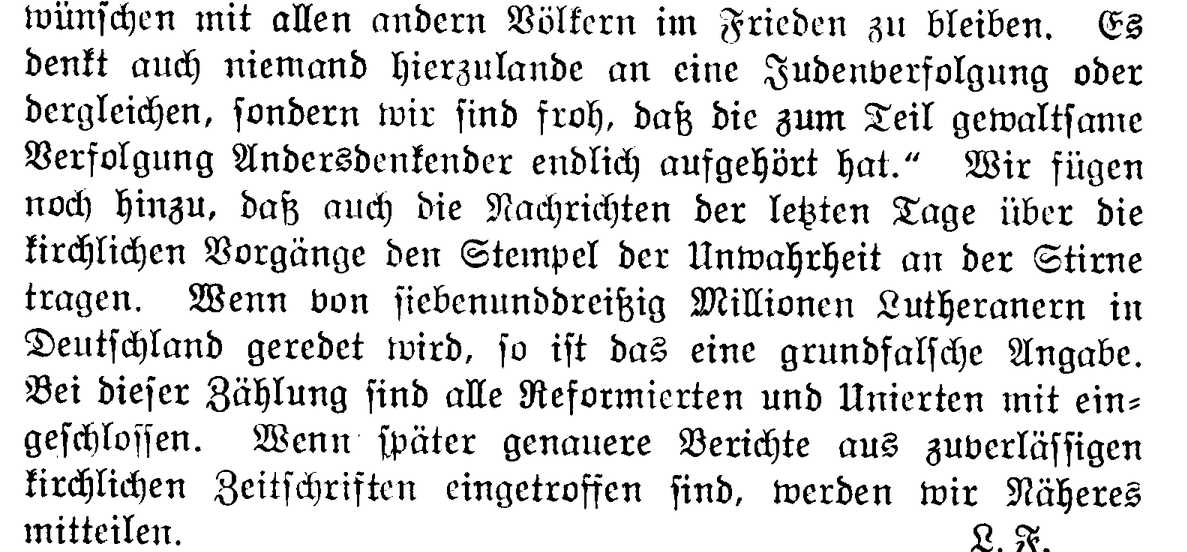
To Bachmann, on June 13, he explained why he had not published the protest: "in order not to stab our Landesbischof in the back, for whom an open word about Barmen could now become a catastrophe." The Landesbischof, the territorial bishop, was Meiser. If the Erlangen faculty spoke, Sasse added, they would do it with a heavy heart: amicus Meiser, magis amica ecclesia Lutherana, Meiser is a friend, the Lutheran Church a greater friend. He gave the substance once more: "My chief objection to the resolutions of the 'Confessional Synod' is that this synod had no right to declare what is pure doctrine and what is not." And he passed a judgment on the texts that any pastor can test: "Just try reading the texts to simple Christians of the congregation. Had the synod really had something great to say, to say magno consensu [with great agreement], it would have been said simply." The rest of that letter, on the Old Lutherans and on the July day of 1933 when the Lutheran bishops signed the Reich church constitution, appeared in last week's post, The Stamp of Untruth.
On June 15 he wrote to Hopf: "The situation is completely hopeless." And: "I have had to break with Asmussen definitively. I am now writing a pamphlet."
October
The break did not last the year. On October 29, 1934, Sasse wrote to Hopf under the heading Ad Barmen, "on Barmen": "I have had a thorough talk with Asmussen. He has learned much and will learn still more regarding the significance of the confession in force and of the Lutheran church." The Confessing Synod had met again ten days earlier at Dahlem, in Berlin. "The atmosphere was toto coelo different from Barmen," wholly different, as far as heaven from earth. "There everything unionistic, at Dahlem everything for clear confessional definiteness." In the same letter he asked why the Lutheran free churches did not call for a great Lutheran free church of Germany, and why the enquiries came from America and none from Germany. He was not sure Dahlem would last: "I greatly fear a new 22 January," he wrote, and "Will this front hold together?"
In June he had resigned from every church association and meant to attend no more church gatherings. By October he was talking again with the man he had broken with, and he saw the confessing movement moving, for the moment, in the direction he had asked of it at Barmen.
Seventeen Years On
Sasse came to think he had waited too long. In March 1951, from North Adelaide, after the final break with Meiser over the Evangelical Church in Germany, he wrote to Hopf:
I ought to have drawn the consequence already at Barmen. I did him [Meiser] the favor of going into the commission, but he was too cowardly to secure even five minutes of speaking time for me. He used us as tools. That was already clear at the time.
Sasse at Barmen has often been read as a crank who missed the moment. The letters show something else. He gave the six theses his assent. He refused to let a mixed synod say it on behalf of the Lutheran Church, because he held that whoever claims to declare pure doctrine claims to be the church. In 1934 almost no one wanted to hear that distinction. In 1948, when the Lutheran, Reformed and United churches of Germany adopted the constitution of the EKD (Evangelische Kirche in Deutschland, then abbreviated EKiD), it became the question of the day. The new constitution affirmed the decisions of Barmen in its first article. Sasse left the Bavarian church for the Lutheran free church that year, and Germany the next.
The Declaration Today
For many Reformed and United churches Barmen is now a confession in its own right. Since 1967 it has stood in the Book of Confessions of the American Presbyterians, and it is named in the basic order of the EKD and in the constitutions of many of its member churches. Sasse's protest is known chiefly to specialists. Yet his question is still asked wherever churches of different confessions sign a statement together: who has the right to say what is false doctrine, and for whom?
Sasse gave his answer on paper, on the morning of May 31, 1934, handed it to the president of the synod, and went home to Erlangen. The six theses had his assent. The synod that spoke them did not. Ninety-two years on, the theses are printed in books of confessions and church orders, and his protest lies in a library in Erlangen. It is worth reading before the next joint statement is signed.
Documents used
All are in the Hopf papers, Universitätsbibliothek Erlangen, MS 2771, photographed in June 2017 by Albert B. Collver III and Matthew C. Harrison with the permission of the Sasse family. The translations are my own.
| Archive no. | Date | Document |
|---|---|---|
| UBE2771-HC-084 | 10 May 1934 | Sasse to F. W. Hopf |
| UBE2771-HC-085 | 14 May 1934 | Sasse to Hopf (the train) |
| UBE2771-HC-088 | 14 May 1934 | Sasse to Hopf, dictated postcard |
| UBE2771-HC-087 | 21 May 1934 | Sasse to Landesbischof Hans Meiser |
| UBE2771-HC-089 | 21 May 1934 | Sasse to Hopf |
| UBE2771-HC-090 | 27 May 1934 | Sasse to Hopf |
| UBE2771-HC-099 | 28 May 1934 | Wilhelm Zoellner to Sasse at Barmen |
| UBE2771-HC-092 to -095 | 31 May 1934 | Sasse's declaration at the Barmen synod, four copies |
| UBE2771-HC-097 | 1 June 1934 | Sasse to Zoellner |
| UBE2771-HC-100 | 13 June 1934 | Sasse to Friedrich Bachmann |
| UBE2771-HC-103 | 15 June 1934 | Sasse to Hopf |
| UBE2771-HC-105 | 29 Oct 1934 | Sasse to Hopf |
| UBE2771-28-019 | 11 Mar 1951 | Sasse to Hopf, from North Adelaide |
On Sasse in these same years, see also last week's essay, The Stamp of Untruth.

Comments ()